Gov. Josh Shapiro, long rumored to have presidential ambitions, claims midterm victory
Nov 11, 2026 | 4:01 am ET
Description
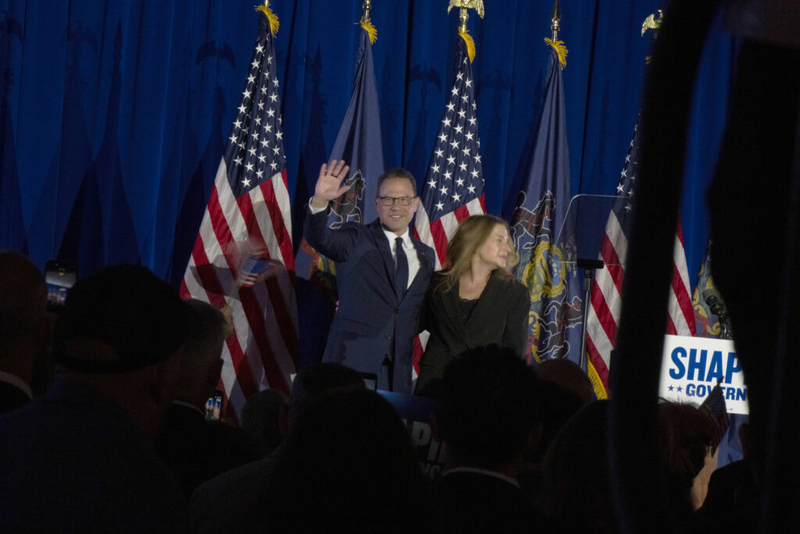
Democratic Gov. Josh Shapiro declares victory in his reelection bid alongside wife Lori Shapiro at an election-night event at the Penn Harris Hotel Harrisburg on November 3, 2026 in Camp Hill. (Photo by Joe Lamberti/Getty Images)
Speaking outside the Governor’s Residence a day after the election, state Sen. Vince Hughes (D-Philadelphia), a self-described “elder statesman” in Pennsylvania Democratic politics, singled out one man in particular for his role in their party’s decisive wins.
“He took every ounce of his own personal political cachet and he put it on the line to make sure that this mission was accomplished so that we can get real stuff done for the people of the commonwealth of Pennsylvania,” Hughes said. “Gov. Josh Shapiro, my friend from a long time ago, thank you.”
Along with Shapiro’s overwhelming victory in the gubernatorial race, Pennsylvania Democrats won a majority in the state Senate for the first time in more than 30 years. They also expanded their majority in the state House and won the largest majority of Pennsylvania’s Congressional seats since the 2008 election that sent former President Barack Obama to the White House.
While the victories were part of a national wave for the party, Democrats across Pennsylvania have praised Shapiro for his role in their success in the state. And Shapiro hasn’t been shy about touting those victories.
Along with being a popular figurehead, Shapiro recruited candidates in competitive districts, helped shape the state party’s political infrastructure, donated over $10 million to help candidates down the ballot and criss-crossed the state to campaign with embattled Democrats.
Leading his party to victory in a major swing state, along with his decisive win over Republican challenger Stacy Garrity, could be a boon to his long-rumored presidential ambitions if he were to enter the 2028 race. But how the results reflect on him may depend on how his coalition governs.
“He’s got some claims now that he could make about his ability to win that I think do put him near the top tier of candidates,” said Berwood Yost, director of the Center for Opinion Research at Franklin & Marshall College. “Whether that gets him over the top, I don’t know, but I certainly think when you look at how he’s performed in an important state like Pennsylvania, some people will have to look at that and think that’s a valuable set of credentials.”
But Yost, who’s been observing Pennsylvania politics for decades, also had a warning.
“It’s all gonna come down to the policies they’re able to enact,” he said. “Could they get distracted by other things and people feel like they’re not doing what they’re elected to do? Yeah. That’s a real risk because that seems to happen a lot. Maybe Democrats will be more disciplined and be able to really advance some policies that change people’s thinking. If they don’t we’ll be right back here.”
By “back here,” Yost meant facing another election that serves as a referendum on the party in power.
‘He put us through our paces’
Shapiro declined a request for an interview with the Pennsylvania Capital-Star, but his campaign’s communications director, Manuel Bonder, discussed his victory and the strategies that led to it.
Bonder was part of Shapiro’s 2022 campaign, then worked in the governor’s office until leaving in September 2025 to return to the campaign side.
When Shapiro officially announced his reelection bid in January, he set some ambitious goals. He said he wanted to help Democrats flip four competitive U.S. House seats in Pennsylvania and win a majority in the state Senate for the first time in decades.
“That was something that has been a priority for us in the entire process of this election cycle,” Bonder said.
While Shapiro was always favored to win the governor’s race, Hughes, who’s represented parts of Montgomery and Philadelphia Counties since 1994, said flipping the state Senate wasn’t initially seen as a sure bet.
“In general, the districts we competed in were essentially 50-50 districts,” he said. “The best analysis would be that they were more slanted Republican.”
But Hughes said the party’s hopes grew around two months after Shapiro officially launched his campaign, when Democrat James Malone won a special election in Lancaster County, flipping a Senate seat that had been represented by Republicans since 1889.
Shapiro, he said, was very involved in early strategy meetings about the senate districts Democrats were trying to flip, discussing subjects like candidate recruitment, polling and fundraising.
“These are very long, intensive, well-researched meetings,” Hughes said. “He put us through our paces.”
Shapiro also invested heavily in the state Democratic party that he helped to reshape. In 2025, party insiders elected Eugene DePasquale, who had Shapiro’s backing, to be the Pennsylvania Democrats’ new chairman. DePasquale then appointed longtime Shapiro advisor Larry Hailsham to be the state party’s executive director.
According to DePasquale, the party was not in great shape when he arrived.
“We didn’t even have the money to make payroll for the first two weeks,” he said. “We had to do a lot of things, and we had to do it right away. We had to build up our staff infrastructure … We [had] to build up our communications team. And one of the big reasons why that was possible was that the party, myself included, had a tremendous partner in Gov. Josh Shapiro.”
Over the course of the 2026 election cycle, Shapiro donated over $7 million in campaign funds to the state party. That funding was used in part to launch what’s called a coordinated campaign, where state party organizers campaign for candidates across the state.
“I think we ended up knocking on 1.4 million doors, [made] 500,000 phone calls, give or take,” DePasquale said about the coordinated campaign. “That meant that took that off the plate of our individual other campaigns. We were shouldering that load so they could focus on getting their message out.”
Shapiro also donated $1 million to the Pennsylvania House Democratic Campaign Committee and $2 million to the Pennsylvania Senate Democratic Campaign Committee. His ability to do so was helped by the substantial fundraising advantage he held over Garrity.
It’s common for a governor or party figurehead to spend money helping their state party and other candidates on the ballot. But according to Chris Borick, a longtime pollster currently at Lehigh University, the level of involvement Shapiro had in party politics, and the amount of financial support he offered candidates, was unique in recent Pennsylvania history.
“Ed Rendell would be the closest thing,” he said, referring to the former Democratic governor and Philadelphia mayor. “But Shapiro seems to be in a different class.”
Shapiro also made his pitch for voters to give his party a trifecta in Harrisburg a centerpiece of his own campaign, in a sense tying his success to that of his party more broadly.
“You’d be hard pressed to find an event where the governor was not going out of his way to elevate multiple candidates on the ballot,” Bonder said. That included dozens of campaign stops with candidates for the state House and Senate and U.S. House.
Eli Cousin, the Mid-Atlantic press secretary for the Democratic Congressional Campaign Committee, said Shapiro also played a large role in helping Democrats flip four U.S. House seats in Pennsylvania, including through candidate recruitment.
“He was heavily involved,” Cousin said.
In Pennsylvania, national figures like Barack Obama and former Secretary of Transportation Pete Buttigeieg played a smaller role in Democratic candidates’ campaigns than they did in other states.
Cousin says that’s in part because they already had a strong messenger in Shapiro.
“Governor Shapiro has achieved, you know, god-tier status in the state of Pennsylvania,” he said. “There’s no better surrogate for our candidates.”
Cousin was referring, in part, to Shapiro’s high approval rating. Throughout his race, he also maintained a significant polling advantage over Garrity.
Shapiro ultimately ended up featuring in numerous campaign ads for Pennsylvania Democratic candidates. Even some Republicans tried to tie themselves to him.
While Democrats seemed poised to make big gains, with disapproval of President Donald Trump weighing on Republicans, Borick, the pollster, said Shapiro’s decision to get so involved with other races carried risks.
“In some ways his position was on the ballot in those other races. He had put himself in the game,” Borick said. “Because he’s going to be looked at as a potential candidate in the 2028 [presidential] race, the expectations were high. So if those races didn’t come through, it would be looked at less positively.”
Success in Pennsylvania could raise Shapiro’s national profile
While he was in the middle of a post-election national media blitz to discuss his party’s success in the midterms, his campaign released a seven-page memo Saturday highlighting the scope of Democrats’ victories in Pennsylvania and the governor’s role in ensuring them. It said Shapiro won more than twice as many counties as former Vice President Kamala Harris did in 2024 and flipped 11 won by Trump that year.
“These [down-ballot] candidates won by embracing both Shapiro and his agenda,” it said.
The memo also compared Shapiro’s own victory to those of other national figures in his party. It including a graphic showing Shapiro outperformed Democrats like Texas’ James Talarico, Georgia’s Jon Ossoff and North Carolina’s Roy Cooper when it came to earning support from “non-MAGA Republicans,” independents and voters who view the Democratic Party unfavorably.
According to Shapiro, the victories have earned him praise from leaders in Washington, D.C. He said he spoke with U.S. House Minority Leader Hakeem Jeffries (D-N.Y.) and U.S. Senate Minority Leader Chuck Schumer (D-N.Y.) on election night. Bonder also confirmed reporting from HuffPost that Shapiro received a call from former President Joe Biden.
“I thanked [Jeffries] for following my lead here in Pennsylvania,” Shapiro said at a press conference, describing his call. “I recruited those four candidates to run. He supported that, he invested in that, and ultimately those four candidates got through.”
But Borick warned that 2028 is still a long way away and, historically, midterm victories do not always translate to success in the next presidential election. He pointed to Republicans’ gains in the U.S. House and Senate in 2010, which was followed by Obama’s reelection in 2012.
This could be especially true in determining the success of a candidate in a party primary, where voters many voters come in with concerns beyond electability.
“I don’t put a lot of stake in what happened here as determinative two years from now,” Borick said.
Yost, however, said Democrats’ victories in Pennsylvania present an opportunity.
“Somebody’s got to figure out some policy sets that appeal to voters and really kind of split up what is sort of a back-and-forth struggle,” he said. “It’s all going to come down to policies.”
Asked by liberal commentator Harry Sisson after the midterms what Democrats should do on day one in power, Shapiro said, “It needs to be a sobering moment for Democrats. We got the keys to the car and now we have to drive it responsibly.”
He also told reporters last Wednesday he’s talked to Jeffries and Schumer about the need to pass an agenda that will keep Democrats from districts that supported Trump in 2024 in office.
Despite his involvement in national politics, Shapiro has neither confirmed nor denied that he plans to run for president in 2028, stating when asked that he’s focused on Pennsylvania.
Bonder, asked whether he would join Shapiro’s campaign in 2028 if he announced, told the Capital-Star, “the governor’s been very clear what he’s focused on in getting through this past election and looking towards the horizon of what he wants to keep getting done as governor.”
Asked if he’ll now be returning to work in the governor’s office, as opposed to for his campaign, Bonder said, “we’ll see.”
Harrisburg, PA