2 states, 2 abortion ballot measures, and the effort to win over Gen Z voters
Oct 15, 2026 | 5:00 am ET
Description
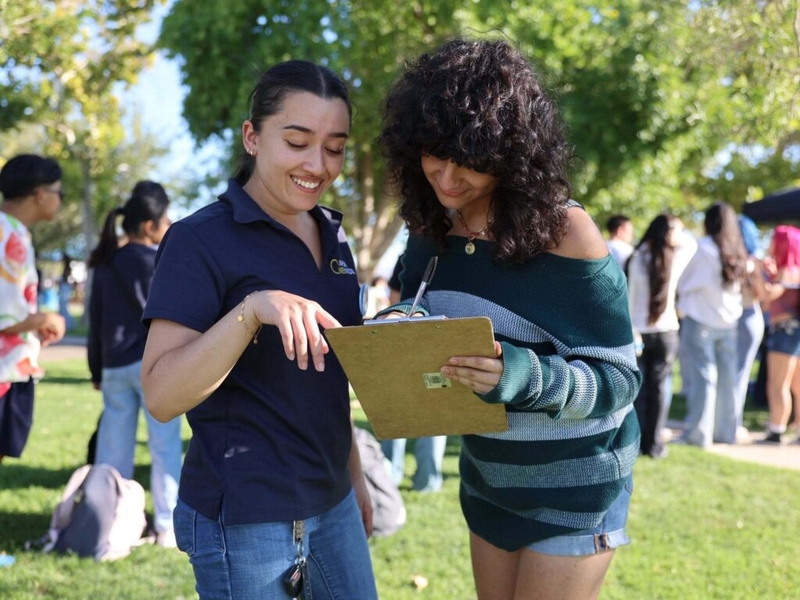
A volunteer helps a young person fill out a form on National Voter Registration Day in 2025. For some young voters, abortion remains a defining issue, but for many others it ranks behind more immediate economic concerns. (Photo courtesy of Alliance for Youth Action)
Editor’s Note: This story is part of Gen Z at the Ballot Box, a collaboration between States Newsroom and The 19th.
Boise State University senior Cade Syvock opposes abortion. As president of the school’s chapter of the conservative group Turning Point USA, the organization founded by the late activist Charlie Kirk, Syvock helped coordinate anti-abortion protests on campus.
But he’s not spending much time this fall campaigning against an Idaho ballot initiative that would restore abortion access. Not for lack of interest — he calls the proposed law “very, very extreme” because it allows abortions after viability in certain emergency cases — but because of pressing economic issues he’d rather be working on.
“It’s not like everybody’s going out and getting abortions 24/7, but everybody is trying to find a home,” Syvock said.
In Idaho and Missouri, where voters will decide the future of abortion access on Nov. 3, campaigns are trying to reach a generation dealing with rising living costs and skepticism toward politics. For some young voters, abortion remains a defining issue. But for many others, it ranks behind more immediate economic concerns.
Idaho’s initiative would restore abortion access. Missouri’s measure seeks to reinstate a near-total ban jettisoned by voters two years ago.
People pushing for and against both measures are making their appeals to young voters, using social media and canvassing to increase turnout on Election Day, but they’re competing against other issues for Generation Z’s attention.
“I’m not saying that the abortion stuff is any less important than housing, but I think in terms of what young people are focusing on right now, it’s definitely dropped a little bit,” Syvock said.
Gen Z politicians who want to make a change grapple with parties that aren’t always ready for them
In most elections, it’s difficult for campaigns to achieve high turnout among young voters, especially in between presidential election cycles. Less than half of the 40 million Gen Z Americans between ages 18 and 29 who were eligible to vote in 2024 cast a ballot, a study by the Center for Information & Research on Civic Learning and Engagement at Tufts University found. This year, the number of eligible Gen Z-age voters is estimated at nearly 50 million.
But there are some signs that turnout could be higher this year. Nonpartisan youth vote organization The Civics Center noted a significant increase in voter registration among 18-year-olds compared with the 2022 midterms, from 35% to 42%. And the Tufts survey points out that there are many signs Gen Z is active and engaged on political subjects, but that connecting issues to candidates and ballot questions is the challenge.
The majority of Gen Z adults support abortion access, according to a September poll from The 19th and YouGov. But there’s a gender gap: Women were more likely than men to say abortion should be always or mostly legal, 69% to 51%. Almost half of men versus 31% of women say it should be mostly or always illegal.
The number of Generation Z Missourians who got involved in the 2024 initiative petition is not available, but more than 110,000 Idahoans signed the petition to put abortion access on the state ballot. About 7% of those signatures came from people between the ages of 18 and 25, and twice as many of those signatures came from women than from men.
But some organizing efforts are made more difficult by local politics as well as increasing costs for food, housing and transportation. The 19th/YouGov poll found that 21% of Gen Z adults were worried about their ability to pay for groceries and 34% were somewhat worried.
We want abortion and reproductive rights to stop being presented as this women-only issue and more so as an economic issue that affects everyone and is a family issue.
Sandra Kelly, volunteer and leadership program coordinator at the University of Idaho, runs the campus food pantry and has seen the signs of economic stress in students.
“A lot of people use it daily. I’ve seen it increase now that people know about it – a big day used to be like 18 (people) three years ago. That’s a slow day now,” Kelly said.
Selasi Tagbor Morales, communications manager at the national progressive grassroots organizing group Alliance for Youth Action, said reproductive rights should be and often are viewed in the same category as economic issues. Financial difficulties are cited as one of the reasons people terminate a pregnancy, and in that way, she said it is an issue that affects everyone.
“We want abortion and reproductive rights to stop being presented as this women-only issue and more so as an economic issue that affects everyone and is a family issue,” said Tagbor Morales, 25.
Chris Melody Fields, executive director of the national progressive group Ballot Initiative Strategy Center, said that while reproductive rights is an issue that only physically affects a certain population, people of all genders and ages have seen the effects of abortion bans on those they love.
“When we center it on the people that they care about, I think we have a real opportunity to bridge gaps and divides,” Melody Fields said.
Campus outreach and social media campaigns
Missouri and Idaho are among four states that will have reproductive rights on the November ballot. Voters in Nevada and Virginia, which have few abortion restrictions, will consider codifying abortion rights in their state constitutions.
Although the national fervor over abortion access has waned since 2022 when the U.S. Supreme Court overturned Roe v. Wade with the Dobbs v. Jackson Women’s Health Organization decision, abortion remains a highly debated issue in Idaho and Missouri.
Missouri was the first state to ban abortion following the court’s decision, and two years later, it became the first state to overturn an abortion ban at the ballot box.
Many young Missourians who collected signatures for the 2024 reproductive rights ballot measure are back canvassing to keep abortion legal in 2026, but the motivation runs deeper, said Tori Schafer, a spokesperson with the Stop the Ban campaign. They’re offended that lawmakers rejected the will of the people by putting an abortion ban back on the ballot.
“To feel so much autonomy in moving that campaign forward, and then to have it go directly back to the ballot, we’ve seen those volunteers come back and also bring their friends with them,” said Schafer, who, at 30, is a millennial slightly older than Gen Z.
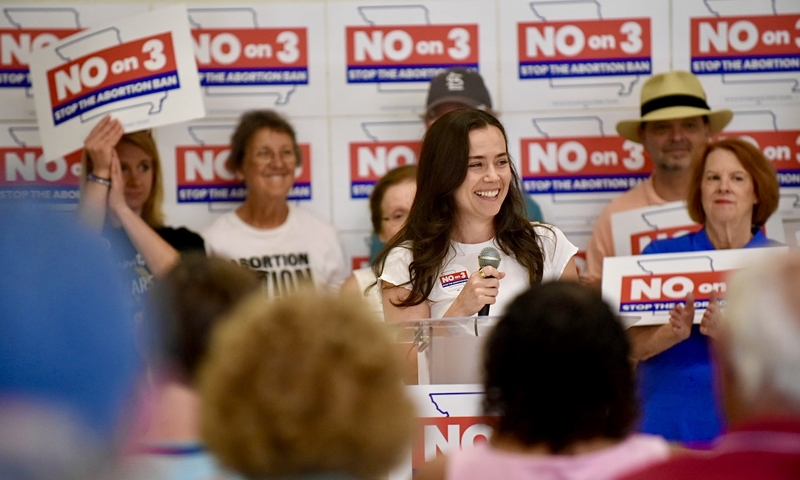
The campaign supporting the ban also has eager volunteers. Students for Life members organized four canvassing events across the state to talk to potential voters, while others are on campus. Those who prefer not to be out front take up prayer.
Hazel Myles, the 20-year-old president of the University of Missouri chapter of Students for Life, saw “how emotionally charged the issue really is.”
In 2024, weeks before Missourians narrowly overturned the state’s near-total abortion ban, Myles said she was met with hostility talking to students about abortion. But it changed her approach two years later. She takes as much emotion out of the conversation as possible, trying to convince students that the abortion rights amendment was “too radical” rather than trying to convince them to become anti-abortion.
Not long after the August primary, most students she asked about the abortion ban amendment hadn’t heard of it.
“Most college students seem pretty ambivalent about a lot of political issues,” she said. “ … If they’re not a (political science) major, their interest in sitting down to do more homework about what they should vote about is pretty limited.”
For some groups, social media plays a significant role in Gen Z outreach.
Monica Snyder, executive director of Secular Pro-Life, a national atheist-led anti-abortion advocacy group based in the St. Louis suburbs, said her organization relies on short-form videos on platforms such as TikTok and Instagram to reach young voters.
“We fill a unique role in anti-abortion advocacy because we’re led by atheists,” Snyder said. “This approach can be particularly effective with younger audiences. Gen Z tends to be highly interested in questions of social justice and human rights. We find that when we emphasize that abortion is a human rights violation, and not primarily a religious or partisan issue, Gen Z is much more willing to consider the pro-life position.”
Alyssa Smith, of St. Louis, was 18 in June 2022 when Roe was overturned. Now 22, Smith is volunteering with Stop the Ban to defeat the proposed abortion ban, called Amendment 3, and keep the reproductive rights amendment in place.
“Though there’s a lot of performative posting on social media, people are willing to have these discussions and open up in these more difficult conversations about what the reality of Amendment 3 and abortion bans actually holds for us,” she said.
Melody Fields, who leads the Ballot Initiative Strategy Center, said the Missouri Legislature’s action on the amendment is one of many attempts to overturn the will of voters. The Legislature repealed a mandated sick leave policy in July 2025 after voters approved it in 2024.
Missouri voters will be asked to reinstate the prior abortion ban, and at the same time prohibit gender-affirming care for minors. State law already prohibits gender-transition surgery for minors. Missouri law also bars minors from beginning hormones or puberty blockers, though this law is set to expire in August 2027, at which point lawmakers have said they intend to consider a ban without an expiration date.
Those now championing Amendment 3 point to the August 2027 sunset of the restrictions on cross-sex hormones and puberty blockers as a reason for asking voters to prohibit something that’s already banned. The ban on gender-affirming surgeries for minors has no expiration.
“This is the first time we’re seeing a near-total abortion ban and a ban on gender-affirming care for minors on the ballot,” Melody Fields said. “What happens in Missouri is critically important, because if the opposition is successful, they will use this to undo every single gain we’ve had at the ballot box since the Dobbs decision.”
Reaching a ‘jaded’ and transient population
Idaho has one of the strictest abortion bans in the country. It applies to all stages of pregnancy, with narrow exceptions for rape and incest in the first trimester with a police report, and only an exception to prevent a pregnant person’s death, not to preserve their health. State Attorney General Raúl Labrador, a Republican, is fighting a recent federal court ruling that would allow abortions in cases in which the patient’s physical or mental health is threatened by staying pregnant.
Idaho’s Reproductive Freedom and Privacy Act would restore access to abortion and protect access to other forms of reproductive healthcare, including contraception and certain fertility treatments such as in vitro fertilization. It qualified for the ballot in July.
The number of registered Gen Z voters who signed the petition for the initiative in Idaho was low overall, partly because it can be a challenging cohort of voters to reach under the best of circumstances, said the campaign’s lead organizer, Melanie Folwell.
“They’re quite cynical, they’re quite jaded, they are not necessarily taken in by easy promises from a broken political system,” said Folwell, who has two Gen Z-aged children.
But Idaho’s political environment added another layer of complexity to signature gathering, Folwell said.
Gen Z women want politicians who can make the ‘American dream’ feel attainable
“We did not do a lot of campus gathering, given the current posture of Idaho’s Legislature and animosity towards any discussion of anything related to reproductive rights (and) birth control,” Folwell said. “We did not want there to be additional scrutiny or focus on our institutions.”
Lawmakers have repeatedly singled out the University of Idaho and Boise State University, including a proposed $2 million cut for each school that was pitched in 2025 by a Republican representative who said he was frustrated by diversity, equity and inclusion programs and the classes that were being taught.
The cut did not become law, but the proposal followed a few months after the Idaho State Board of Education passed a ban on DEI at college campuses, prompting the closure of the University of Idaho’s Women’s Center, which had been a staple on campus since 1972. Other campuses followed suit.
All of that came four years after the University of Idaho changed its policy to no longer allow student health facilities to dispense birth control or distribute condoms for pregnancy prevention, citing the state’s 2021 No Public Funds for Abortion Act, which also prohibited any university employees from counseling or referring someone for an abortion.
Despite those challenges, Folwell remains optimistic about young voters supporting the measure at the ballot box. The campaign, led by nonprofit Idahoans United for Women and Families, is active on social media, with messages about how politicians have let people down and how the initiative represents an opportunity to take back some power. Folwell said the campaign receives a lot of engagement on TikTok and Reddit.
“This is not an age group that’s hanging out on Facebook or even really Instagram, and I think that’s always one of the unique challenges about engaging this generation,” Folwell said. “I think it’s important to reckon with the fact that this is a group that is not taking in information from traditional news sources.”
But there aren’t that many other ways to easily engage with young voters, either, she said. About 4% of homebuyers in 2025 were between the ages 18 and 26, meaning the vast majority are renters who can be difficult to track down for door-to-door canvassing. And others may leave the state before the election is held.
Folwell said young men the campaign has contacted for signature gathering tended to think it wasn’t an issue that affected them, but she watched many volunteers convince them otherwise, especially if they had a partner.
As with all Idaho voters, there is a strong culture of protecting life among young Idahoans.
Stateline asked representatives with the campaign against Idaho’s initiative how they were engaging with young voters, including specific means of connecting with them and any unique challenges.
“Our campaign is eager to share the truth about Prop 1 with voters of all ages,” Mary Strow, communications director for Stop Prop 1, wrote in an emailed statement. “As with all Idaho voters, there is a strong culture of protecting life among young Idahoans. Our campaign resonates with Idaho values that cross all generational lines. We are urging voters of all ages to vote No on Proposition 1.”
Adam Pendergrass, a senior majoring in political science at Boise State University, said the women he talks to support reproductive rights and the ballot initiative, and they are the ones who bring it up in his classes. While there are more young men who support reproductive rights than he thinks people give them credit for, he does think that on the whole, young men are more conservative on the issue.
“It’s kind of tough to say what the general consensus is, because I do think many men kind of stay away from the issue and don’t want to be pressed on it,” said Pendergrass, who favors the initiative.
But for one Gen Z woman, the salience of the issue is increasing. Cynita Peña, 25, also attends Boise State and said a relative had an ectopic pregnancy in 2021 that turned into a medical emergency. She thinks about how much worse it might have been if that emergency had happened after Idaho passed its ban.
After the ban, she said she’s watched people she knows who are in their early 20s have to commit to unwanted pregnancies without abortion access.
“Just being able to have that choice has been completely taken away from them,” Peña said. “It was hard to see the people around me have to go through that.”
Said Folwell: “Most people are one bad day away from having their feelings about (the abortion ban’s) relevancy changed forever. When you’re 18 to 25, you haven’t lived a lot of life yet, and you don’t know the ways that this could impact you at some point.”