Democrats aiming for control of Congress vow action on healthcare, cost of living, Iran war
Oct 14, 2026 | 3:43 pm ET
Description
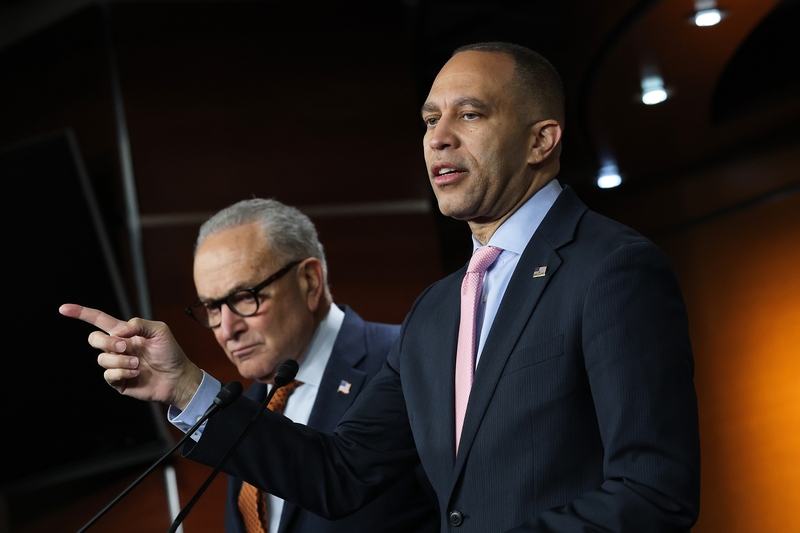
House Minority Leader Hakeem Jeffries, D-N.Y., speaks as Senate Minority Leader Chuck Schumer, D-N.Y., looks on during a news conference at the U.S. Capitol on Jan. 8, 2026 in Washington, D.C. (Photo by Kevin Dietsch/Getty Images)
WASHINGTON — Democrats are touting an ambitious legislative agenda centered on affordability and accountability if they take back the U.S. House or Senate — or both — in November.
A slew of pressing policy debates are on tap for Democrats, including healthcare, immigration, voting rights, the war in Iran, oversight, education and beyond, as they aim to reverse many of President Donald Trump and congressional Republicans’ actions since January 2025.
Some issues, while surging to the forefront, likely will provoke internal divisions, such as “Medicare for All,” a movement popular among progressives to extend single-payer national health care to all Americans.
“Healthcare costs have consistently been at or above other concerns on the public's affordability worries,” said Liz Hamel, a senior vice president and director of public opinion and survey research at KFF who oversees the nonpartisan health organization’s polling program.
Democrats also are poised to conduct tougher oversight of the Trump administration.
Any legislation from Democrats faces the threat of Trump’s veto, making any legislation without broad bipartisan support almost certain to fail. In addition, Democrats would need a filibuster-proof majority of 60 votes to advance most measures in the Senate.
Democrats remain heavily favored to regain the majority in the House, while Senate races continue to move in the party’s favor, amid Trump’s plummeting popularity, according to the Cook Political Report with Amy Walter, an elections forecaster. Democrats currently hold 47 Senate seats, including two independents who generally vote with the party.
“House Democrats are committed to fighting for an affordable America, lowering the high cost of living, lowering the cost of groceries, lowering the cost of gas, lowering the cost of housing and fighting to make healthcare affordable for every single American,” House Minority Leader Hakeem Jeffries told reporters in September.
The New York Democrat is in line to become the next speaker — the first Black person to hold that office — if the party clinches control of the lower chamber.
Jeffries announced five working groups on affordability — housing, healthcare, gas and utilities, groceries and goods, and caregiving — which House Democrats will concentrate on at the beginning of the new Congress.
The Democratic Party’s campaign apparatus for House races echoed an agenda centered on affordability.
“House Democrats are going to win the majority because voters know we’re focused on lowering costs, and that’s exactly what we’re going to do when we’re in charge,” Nebeyatt Betre, a Democratic Congressional Campaign Committee spokesperson, said in a statement shared with States Newsroom.
“From ending the war in Iran to lower gas prices, restoring (Affordable Care Act) tax credits to lower health care prices, to rolling back reckless tariffs to lower prices on everything in between, House Democrats’ number one priority will be making life more affordable for working families,” Betre said.
Sen. Kirsten Gillibrand, chair of the corresponding campaign arm for Senate races, cited healthcare access and affordability as a top priority in a Democratic-led upper chamber.
“I think the most important issues that I’ve heard from voters is restoring their healthcare, making sure that those cuts to Medicaid get restored, making sure that people can afford healthcare and get access to good, high-quality healthcare,” Gillibrand said in a September interview with States Newsroom and other members of the Regional Reporters Association.

The New York Democrat, who leads the Democratic Senatorial Campaign Committee, said other major priorities include “trying to fix the problems Trump has created, end the war in Iran” as well as getting “costs of groceries, housing, and healthcare and other everyday costs down.”
While not a major part of the party’s messaging in the general election, House Democrats are poised to take a harder line with Israel amid the country’s war in Gaza. Jeffries said a measure meant to discourage violence in the West Bank, where Israeli settlements have inflamed tensions, “should be considered” next year, according to The Hill.
With less than three weeks to go until Election Day on Nov. 3, here’s a closer look at what Democrats want to accomplish in both chambers:
Anti-corruption, impeachments
Democrats are all but certain to open investigations into the Trump administration if they gain power over congressional subpoena decisions.
“Our promise to the country in the new Congress is that beginning on Day One, we’re going to hold the crooks accountable,” Jeffries vowed at an Oct. 8 press conference.
High-ranking Democratic House members say multiple probes are on the table, including Trump’s IRS settlement, brokered by his administration’s Justice Department, which delivered retroactive tax audit immunity for him and two of his sons as well as the creation of an “anti-weaponization” fund.
A federal judge slammed the settlement in a July order prohibiting Trump, his sons Eric and Donald Trump Jr., and the Trump Organization from claiming they reached a “settlement,” and referred Trump’s personal attorneys to the bar for investigations.
Democrats are also weighing whether the party would attempt to impeach Trump if they take back control of the House.
The president was impeached twice in the House and acquitted twice in the Senate during prior sessions of Congress.
Jeffries told PBS Newshour in September “we certainly haven’t ruled anything in, and we haven’t ruled anything out,” when asked about any impeachment proceedings against the president if Democrats regain the majority in the lower chamber.
Democrats could also try to impeach Defense Secretary Pete Hegseth if they clinch control of the House.
Outgoing GOP Rep. Thomas Massie of Kentucky introduced eight articles of impeachment against Hegseth in September for the secretary’s handling of the war in Iran.
But House GOP leadership sent the lower chamber home early for its weeks-long campaign break, punting any vote until after the midterms.
House Democrats will also likely dog the administration’s legally mandated release of files related to the 2019 federal sex trafficking investigation of deceased sex offender Jeffrey Epstein, who kept the company of powerful and wealthy individuals, including Trump.
Trump denies any knowledge of Epstein’s involvement in trafficking girls and young women for sex.
Democrats and Republicans on the House Committee on Oversight and Government Reform opened a months-long probe, subpoenaing documents from the Epstein estate and compelling closed-door testimony from Epstein associates and former Attorney General Pam Bondi.
Healthcare
On the healthcare front, House Democrats want to undo the healthcare provisions tucked into a mega tax and spending cut law signed by Trump in July 2025, known as the “One Big Beautiful Bill Act.”
“Undoing (that law) is the floor, but not the ceiling,” according to a September memo obtained by Politico from Democrats’ affordability working group on healthcare.
The 84-page memo proposes myriad healthcare policy priorities in the first 100 hours, first 100 days and first year of the next session of Congress, broken down into eight wide-ranging categories.
“There is broad consensus in the Democratic caucus that the Democratic agenda must both reverse the immediate harms of the administration while also taking bold action to rein in corporate monopolies, invest in a durable healthcare system, and pursue an ambitious path towards universal coverage,” per the memo.
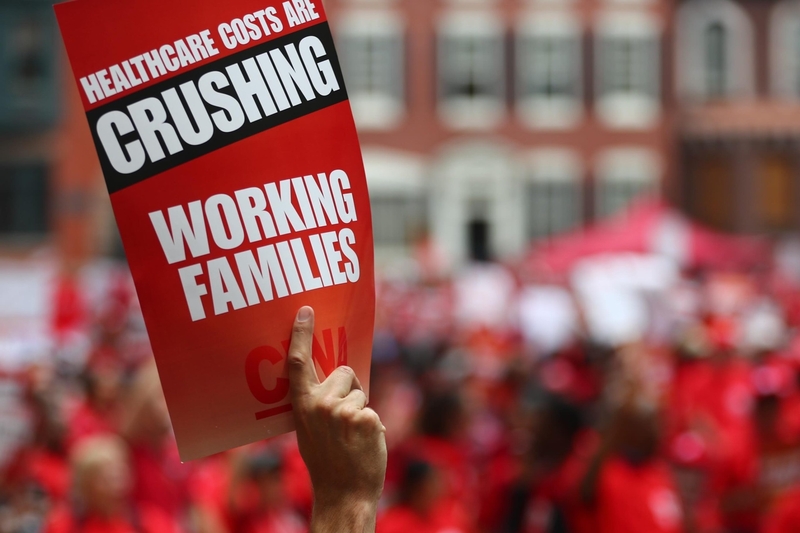
Part of Democrats’ healthcare agenda includes reversing the GOP’s mega tax and spending cut law’s sweeping Medicaid cuts, which axe roughly $1 trillion in program spending over 10 years and impose new work requirements.
The party is also looking to “permanently restore” the enhanced Affordable Care Act tax credits, which expired in December 2025 and were used by individuals who buy their own health insurance through the Affordable Care Act Marketplace.
The expiration of those credits has “sharply increased” individuals’ out-of-pocket costs toward premiums, according to KFF.
The memo also underscores a commitment to “achieving universal coverage” in the first year of the next session of Congress, and mentions the “Medicare for All Act” as one avenue to examine in achieving this ambition.
The bill would establish a national health insurance program administered under the Department of Health and Human Services.
Iran war
The costly war in Iran that has caused prices at the gas pump to soar for Americans is a major reason for Trump’s sagging poll numbers, and Democrats, if the House and Senate flip, would likely pass a measure to try to end any further conflict without congressional approval.
The war has cost $40 billion and counting, according to the nonpartisan Congressional Budget Office, and will continue to cost American taxpayers $2 billion to $3 billion per month as the conflict drags on.
The national average price of diesel remains above $6 per gallon in the U.S., according to AAA, as Iranian officials continue to block petroleum products from reaching the global market.
The national motor club, which monitors daily fuel prices, reported that Americans were paying a national average of $4.33 for a gallon of gasoline as of Oct. 14.

Meanwhile, Democrats’ attempts to rein in Trump’s military campaign in Iran have slowly picked up some Republican support over multiple votes in both chambers.
Senate Democrats have forced 14 War Powers Resolution votes to curb Trump’s unilateral military decisions without input from Congress. The votes are privileged, meaning they can be brought to the floor without the blessing of majority leadership.
The measure has advanced twice in the upper chamber, but the latest attempt to advance a House-passed War Powers Resolution narrowly failed, 49-50.
House Democrats picked up seven Republicans on Sept. 15 to approve the War Powers Resolution.
Administration officials contend the War Powers Resolution, established by Congress during the Vietnam War era, is unconstitutional, so it’s unclear what might happen if a resolution were approved.
Immigration
To help the president carry out his mass deportation campaign, congressional Republicans used a legislative tool to skirt Democratic support and allocate more than $200 billion for immigration enforcement through two measures.
With the “One Big Beautiful Bill Act,” more than $170 billion was given to the Department of Homeland Security to hire more immigration agents, expand detention centers and carry out deportations.
The “Secure America Act” funded Customs and Border Protection and U.S. Immigration and Customs Enforcement until late September 2029, at nearly $70 billion, after Democrats refused to approve funding for DHS following two deadly shootings of American citizens by immigration officials in Minneapolis.
Though it’s unlikely Democrats will be able to claw any of that funding back even if they take both chambers, there are several avenues they are likely to pursue amid the president’s immigration crackdown.
The first avenue is oversight and the ability to subpoena Trump officials. Democrats are likely to hold oversight hearings into the deaths of Renee Good and Alex Pretti, who were shot and killed by federal immigration officials in Minneapolis in January.
Members of both parties on the Senate Homeland Security and Governmental Affairs Committee reached rare bipartisan agreement at a grilling of top Trump immigration officials after the killings.
Democrats will also likely hold hearings on the scores of U.S. citizens detained by ICE and also shot by federal immigration officers, such as Marimar Martinez, who has already appeared several times before lawmakers as the minority witness for Democrats.
She was shot in her car five times by Border Patrol agents during the aggressive immigration deportation campaign in Chicago in October 2025 and was labeled a domestic terrorist by DHS. The DOJ dropped charges against Martinez after the Trump administration accused her of using her car as a weapon.

Democrats are also likely to continue with oversight at federal facilities that detain immigrants, including the high death toll of immigrants at those detention centers. So far, 61 immigrants have died in ICE detention, which has doubled under the second Trump administration. Democrats have demanded answers from the administration about the deaths, along with concerns about medical neglect at the facilities.
And even though former Homeland Security Secretary Kristi Noem stepped down earlier this year, Democrats still plan to question some of her decisions while leading DHS, such as a $220 million ad campaign that prominently featured her and the practice of no-bid contracts awarded to her close allies.
Apart from oversight, Democrats are likely to introduce and pass legislation related to immigration reform, such as creating a pathway to citizenship for immigrants who were stripped of their Temporary Protected Status and for children brought into the country without legal authorization under the Deferred Action for Childhood Arrivals program, or DACA.
The Trump administration has stripped more than 1 million immigrants of their legal status, and House Democrats, with a handful of Republicans, in April moved to extend TPS for more than 500,000 immigrants hailing from Haiti.
TPS is granted to nationals who hail from a country deemed too dangerous to return to due to violence, disasters or other destabilizing forces.
In the Senate, Democrats have tried to pass legislation through unanimous consent to grant a pathway to citizenship for TPS recipients, but were blocked by Republicans. If Democrats regain the Senate, they will need a 60-vote majority for that legislation to move ahead.
Some Democrats in Congress also likely will advocate an end to funding for ICE, but it’s unclear whether that would have enough support to advance.
Voting rights and democracy
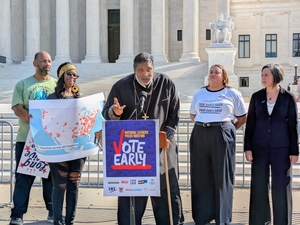
Voting rights and democracy are likely to be high priorities for Democrats if they retake one or both chambers of Congress.
A gerrymandering war egged on by Trump and a U.S. Supreme Court decision this spring that severely weakened the federal Voting Rights Act left Democrats and their base deeply angry and eager for action.
Democrats are likely to again turn to the John Lewis Voting Rights Advancement Act, named after the late civil rights activist and Georgia Democratic Rep. John Lewis.
Though the U.S. House last passed the measure in 2021, the bill did not advance through the Senate.
The legislation would seek to restore preclearance, a major provision of the Voting Rights Act that was previously blocked by the Supreme Court in 2013. Preclearance required states and local governments with a history of discrimination to obtain federal permission before making voting changes, and it applied to most Southern states and a handful of others.

“We fight to pass the John Robert Lewis Voting Rights Advancement Act so we can end the era of voter suppression in the United States of America once and for all,” Jeffries said in an August speech.
The renewed focus on the voting rights legislation comes after the Supreme Court in a 6-3 decision in April sharply weakened Section 2 of the 1965 Voting Rights Act. The section prohibits voting practices or procedures that discriminate on the basis of race and other characteristics.
In 1982, Congress expanded Section 2 to ban voting practices that have a discriminatory effect, whether or not the law was intended to discriminate.
Louisiana had redrawn its congressional map in response to a court order to include a second majority-minority district where a majority of residents are Black. The Supreme Court ruled the new map was an unconstitutional gerrymander.
In response, several Southern states quickly redrew their congressional maps to eliminate majority-minority districts — part of a larger wave of gerrymandering that swept the country over the past two years after Trump initially urged Texas to enact a more GOP-friendly map.
In response, some Democrats are also pushing for gerrymandering reform. At a minimum, some lawmakers want to require states to return to a once-a-decade redrawing process. That was the norm before 2025, and followed the census every 10 years.
Over the summer, the bipartisan House Problem Solvers Caucus unveiled a framework for changes to the redistricting process. The proposal calls for restricting new maps to once a decade, requiring “clear, objective” criteria to draw lines and supporting steps to reduce partisan influence, such as turning to independent commissions to develop district lines.
Education
Congressional Democrats also want to halt and undo the administration’s ongoing efforts to dismantle the U.S. Department of Education and repeal major education provisions in the GOP’s mega tax and spending cut law.
The department has entered into a series of interagency agreements with other departments that transfer several of its responsibilities to those agencies, including Health and Human Services, Labor, Interior, State, Justice and Treasury.
If Democrats take back the Senate, Virginia Democratic Sen. Tim Kaine told States Newsroom his first goal in education is to “stop the handoff of critical components of (the Education Department) to other agencies that don’t want them.”
In the most-far reaching of the interagency agreements yet, the department said in June that HHS would administer programs under Education’s Office of Special Education and Rehabilitative Services, while civil rights enforcement under Education’s Office for Civil Rights would be transferred to the DOJ.
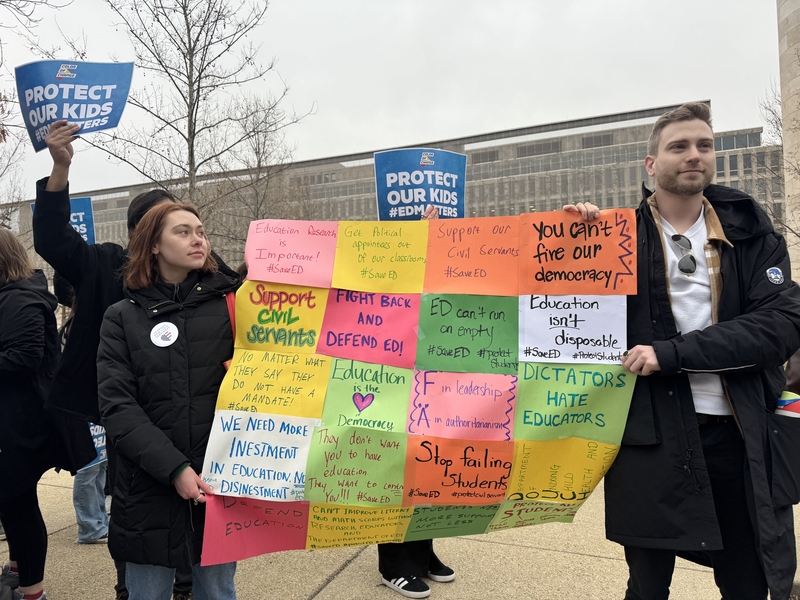
Kaine sponsored a bill, with GOP Sens. Susan Collins of Maine and Lisa Murkowski of Alaska as original co-sponsors, that would block interagency agreements that transfer programs regarding special education, elementary and secondary education, postsecondary education and Native American education.
That measure advanced out of the Senate Committee on Health, Education, Labor and Pensions in July.
Sen. Mazie Hirono told States Newsroom “we need to restore federal support for education and how it’s going to look, I mean, clearly we need to support IDEA and support it to a greater extent than we have normally,” pointing to the Individuals with Disabilities Education Act, which guarantees a free public education for students with disabilities.
The Hawaii Democrat is also looking to repeal a national school voucher program baked into the GOP’s mega tax and spending cut law that’s set to launch in early 2027.
The program allocates up to $1,700 in federal tax credits for people donating to organizations that provide K-12 scholarships, with 31 states having opted in so far.
Hirono and Arizona Democratic Sen. Mark Kelly, joined by more than two dozen of their colleagues, introduced legislation in April to repeal the program.
Wisconsin Democratic Rep. Gwen Moore introduced a companion bill in June with Reps. Suzanne Bonamici of Oregon, Maxwell Frost of Florida, Adelita Grijalva of Arizona, Mark Pocan of Wisconsin and dozens more original cosponsors.
All States Newsroom content is free to republish. Read our republishing policy for more information.