Feds say New Mexico’s lobos are ‘nonessential’
Oct 14, 2026 | 1:27 pm ET
Description
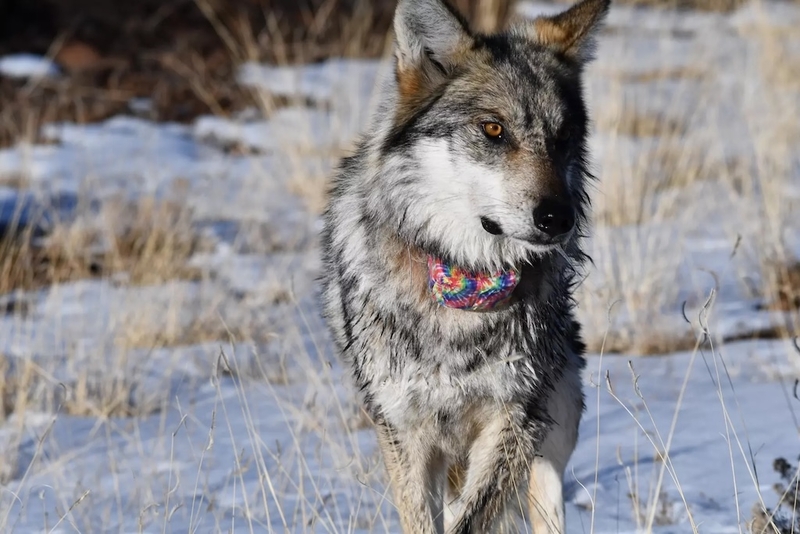
A Mexican wolf rests shortly after a release. (Evelyn Lichwa/Mexican Wolf Interagency Field Team /U.S. Fish and Wildlife Service.)
Ever since their reintroduction in the late 90s, wild Mexican wolves — a rare subspecies of gray wolf in the Southwest — have been labeled “nonessential” to the species’ overall survival by the federal government.
Conservationists objected in front of a panel of judges Tuesday, arguing that this legal distinction denies valuable protections often afforded to other endangered species.
As it stands, this definition means the genetically unique Mexican gray wolf population, which mainly live in New Mexico and Arizona, can be removed or lost without jeopardizing the existence of the broader species in the wild.
“The fundamental problem we have, in this case, is that the [U.S. Fish and Wildlife] Service never applied the correct definition of an ‘essential’ experimental population,” said Andrew Hawley, during oral arguments at the U.S. Court of Appeals for the 9th Circuit in Missoula. “This is a legal error.”
Hawley represents a slew of environmental groups appealing a 2025 decision in an Arizona district court that favors the federal government’s original definition designation. They first filed the lawsuit in 2022.
In Arizona and New Mexico, Mexican wolves are allowed to live under a special “experimental” management rule that restricts them below Interstate 40. It also governs specific conditions when they can be captured, removed, or killed by the federal government.
Conservationists argue labeling that population as “non-essential” means wolves miss out on critically protected habitat and federal consultation requirements.
“As a result, it [the wolf population] didn’t get all of the protections that it should have from day one,” said Hawley in an interview with KUNM.
In the courtroom, the government countered, pointing to a long-standing wolf breeding program as evidence they have the knowledge and expertise to restart the population if needed.
“The Fish and Wildlife Service, thanks to that program, has successfully established a growing Mexican wolf population that is progressing towards recovery goals year after year after year,” said attorney Kyle Gwen, on behalf of the federal government.
Creating the experimental management area was a compromise with the agricultural industry to ease livestock depredation tensions and other regulatory concerns.
Criticisms have long centered on how these boundaries are “arbitrary” and should be abolished to allow northern and southern wolf packs to intermingle.
Famously, a female wolf nicknamed “Asha” crossed north of the I-40 boundary twice – garnering the national spotlight as she searched for a mate in the southern Rockies.
After capture and relocation to the Sevilleta National Wildlife Refuge, Asha was placed with a mate. There, she gave birth to five pups.
Elsewhere, roughly 45 other lobos live separately in northern Mexico — and fewer than four are tracked with radio collars — which conservationists say is alarmingly low. They claim the U.S. Fish and Wildlife Service cannot rely on this population across the border if numbers start to dwindle here in the United States.
Although the Mexican gray wolf lacks a habitat specifically set aside and protected for its recovery, federal law generally protects the species from being killed, harmed, or harassed by the public.
Attorney Gwen contends that the U.S. Fish and Wildlife Service applied the correct definition of essentiality after exercising reasonable scientific judgement. By doing so, they determined that losing Arizona and New Mexico’s lobos would not reduce the species’ likelihood of survival.
“So, the [U.S. Fish and Wildlife] Service had sufficient information to undertake this comparative analysis — at least in rough terms — even if it did not put a numerical point on it,” Gwen told the court.
Environmental groups in the Southwest have long maintained that the Mexican gray wolf’s genetic make-up is poor because the species was brought back from the brink of extinction by breeding just seven individual “founding” wolves together.
Often, any two random lobos are as genetically similar as brother and sister, leading to questions about how the Mexican wolf can live in the wild without human intervention.
Despite persistent concerns about the species’ future, its population has risen significantly. According to the U.S. Fish and Wildlife Service’s 2025 count, the minimum number of wolves on the landscape jumped from 286 in 2024 to 319.
While it’s nearly impossible to nail down an exact timeline for a judgment, a decision on the essentiality definition could come down sometime in the next six months.
Santa Fe, NM