Meta revealed as company behind controversial Mason County hyperscale data center
Oct 14, 2026 | 1:04 pm ET
Description
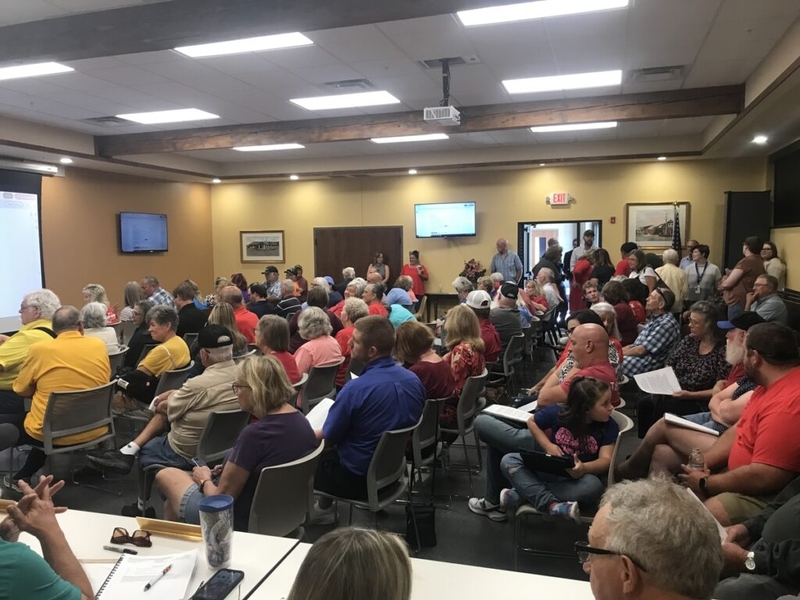
Attendees gather at a Maysville-Mason County Joint Planning Commission meeting on Sept. 3, 2025, including members of “We Are Mason County” who expressed their concerns about a data center project. (Photo courtesy of Max Moran)
The technology company Meta will invest billions of dollars for a proposed Mason County hyperscale data center and will pay millions of dollars to local schools and the county but will also receive a 40-year tax break on local property taxes, according to a tentative agreement.
During a regular Mason County Fiscal Court meeting Tuesday, Democratic Mason County Judge-Executive Owen McNeill revealed that Meta was the primary company behind the nearly 3,000-acre project, and the fiscal court had unveiled the tenative community benefits agreement with a subsidiary of the company earlier this month.

“I’m confident that this court will be able to continue to lower taxes and the tax burden on local citizens through investments like this,” said McNeill, who has been a local backer of the project since the project first started to gain attention last year.
The fact that Meta was behind the project had remained secret for more than a year until this week. Local officials signed non-disclosure agreements that prevented the release of specific information about the project, something that residents including with the group We Are Mason County had strongly criticized as being anti-transparent.
Meta owns Facebook and Instagram and recently settled a multistate lawsuit over whether its products harmed young people. Kentucky will get $358 million in the deal.
We Are Mason County executive director Max Moran told the Kentucky Lantern local residents should have known who was behind the project much earlier so they could research the company and “make sure they are a true good neighbor.” McNeill had previously defended non-disclosure agreements as a part of the economic development process.
“Of course they’re building a massive one in Louisiana and all over the country,” Moran said, referring to another Meta data center in Louisiana where Republican Gov. Jeff Landry had signed a non-discloure agreement with the company’s data center subsidiary.
Moran is also concerned about a decades-long tax break on local property taxes that is a part of the agreement for the data center.
The community benefits agreement with Meta’s subsidiary commits to a number of investments ranging from investing at least $130 million in water and wastewater infrastructure, roadway improvements and public safety enhancements. The agreement states thousands of workers will be needed during construction with 400 full-time employees as a part of the project.
But the agreement also would have the county issue what’s known as industrial revenue bonds, lasting for up to 40 years, that would exempt the data center campus from paying local property taxes. In such cases, the government buys the property where a company site is to be located and leases the property back to a company, therefore allowing the company to avoid paying property taxes because a local government is exempt from paying property taxes on its own property.
The agreement instead allows for payments to be made directly to the county government and county school district of $5 million a year and $2 million a year, respectively. Those payments would be on top of millions of dollars in tax revenue on electricity sales that would go to the county school district.
Earlier this year, a progressive think tank in Kentucky had warned about the use of industrial revenue bonds as one of the ways data center developers could skirt having to pay their full share of local taxes.
Jim Parsons, an attorney with Keating Meuthing & Klekamp PLL, discussed details about the community benefits agreement before the county fiscal court Tuesday. Parsons told the fiscal court that the payment agreement is “not perfect” but highlighted that it does ensure a floor of revenue for the local school district.
“I will tell you that the company is getting an incentive on this particular project, and it is a benefit to the company here. But on the other hand, it’s good for the company, it’s good for the community,” Parsons said.
Moran questioned whether industrial revenue bonds would meet the standard required in an executive order by Democratic Gov. Andy Beshear that data center developers pay their “full and fair share” of local taxes.
McNeill did not immediately respond to a Wednesday text message and email sent by the Lantern requesting a response regarding concerns about the industrial revenue bonds. An email requesting commentary about the bonds sent to a media relations inbox for Meta was not immediately returned.
A Beshear spokesperson did not immediately respond to a Wednesday email asking whether Beshear supports the use of local industrial revenue bonds for data centers and whether Meta is seeking additional state tax breaks for the data center.
This story may be updated.
Frankfort