Should a Virginia jail be exempt from state standards just because it contracts with ICE?
Oct 14, 2026 | 5:26 am ET
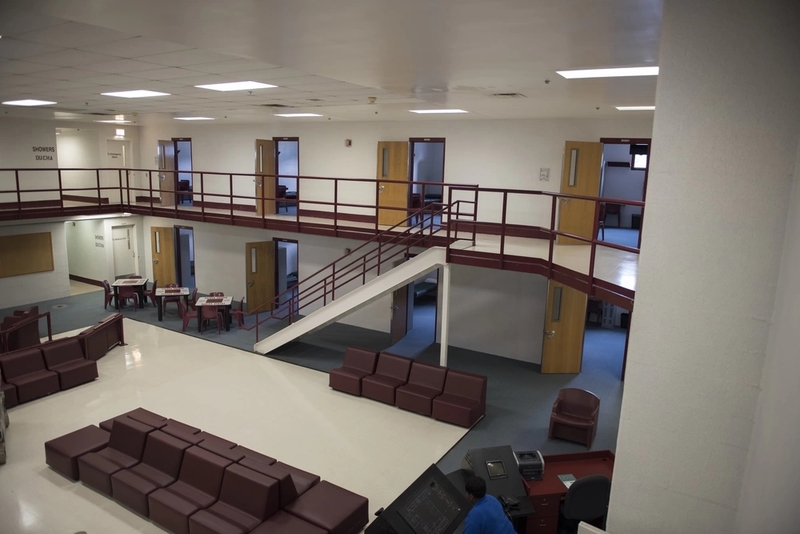
Description
Located near Bowling Green, the Caroline Detention Facility began operations in the 1990s as a legal entity known as the Peumansend Creek Regional Jail Authority. It is now used as an Immigration and Customs Enforcement detention facility. (Photo by Keith Gardner/Defense Visual Information Distribution Service)
Harsh practices used by Immigration and Customs Enforcement (ICE) continue to make news across the country, with detainees including U.S. citizens describing agents kneeling on their necks, holding them in isolation and more.
Records show that the majority of detainees have no criminal convictions and a PBS News/NPR/Marist poll earlier this year found a majority of citizens say “ICE is making Americans less safe,” while “a growing number believe the agency’s actions have gone too far.”
How should Virginians who share those sentiments respond? One could start by demanding our local and state institutions use the power they already have.
The Caroline Detention Facility, one of two main immigrant detention centers used by ICE in Virginia, is a case in point. Virginia law gives a state regulator, the Board of Local and Regional Jails, authority to inspect and oversee the facility. The Board has largely abdicated its responsibility to do so.
Origins of the jail
Located near Bowling Green, the Caroline Detention Facility began operations in the 1990s as a legal entity known as the Peumansend Creek Regional Jail Authority. It was a joint project between Caroline County and Northern Virginia localities to deal with overflowing jail populations.
Thankfully, incarceration rates have since declined and counties set up successful programs to divert low-level drug offenders away from incarceration Consequently, in 2017 the facility was no longer needed by Caroline’s regional partners, who withdrew from the authority, leaving an empty jail with no clear public safety mission.
Three young immigrants ordered freed as Virginia lawsuit tests ICE detention policy
The state and Caroline County explored different uses for the jail, including converting the facility into a state mental health hospital. Instead, in 2018 under the first administration of President Donald Trump, the County opted to use the facility and its staff for immigration enforcement through a contract with ICE.
Humanitarian concerns
Since Trump took office a second time and made mass deportation a federal priority, the Caroline Detention Facility has routinely exceeded its rated capacity. The large majority of people held at the facility have no criminal record.
Despite its nonviolent population, the jail was highlighted in a national report by Physicians for Human Rights for improper and excessive use of solitary confinement.
Nationally, human rights organizations have credibly reported unsanitary conditions at ICE detention facilities and the physical abuse of people being held there (see here or here).
Given this context, the state of Virginia should be doing all it can to ensure safe and humane treatment of people being held at the Caroline Detention Facility. Instead, the state regulator of regional jails has largely given it a free pass.
Continued inaction
The Virginia state code that gave local governments the ability to create regional jails also requires that they abide by certain basic standards. In 2020, the General Assembly passed legislation to confirm that a jail like the Caroline Detention Facility, which incarcerates people on behalf of the federal government, is still considered a local correctional facility subject to state standards.
Despite the clear letter of the law, the Board of Local and Regional Jails stated in its annual inspection report released last December that it is not “authorized to inspect or audit United States prisons or federal corrections institutes” and therefore can only conduct a minimal sanitation inspection of the Caroline Detention Facility.
Based on this incomplete and erroneous reading of the law, the Board forgoes a comprehensive inspection of the facility that would also assess the wellbeing and humane treatment of inmates.
State administrative code also requires local and regional jails to produce a “written annual report of the availability of services and programs to inmates…”
However, when I asked the Superintendent of the Caroline Detention Facility (CDF) for its annual reports from the last few years, he said “the CDF does not provide an end of year report to the Peumansend Creek Jail Authority. We have Authority meeting minutes available on our website.”
Clearly, meeting minutes are no substitute for a report required by state code.
More troubling, Virginia code requires that all local and regional jails notify the state in the event of a serious incident or death at the facility. When I asked for any such past notification submitted by the Caroline Detention Facility to the state over the past five years, I was told that there were none.
The explanation I was given: “The Caroline Detention Facility does not house or hold any Virginia State or Local inmates; only detainees who are held under federal authority.” But again, Virginia state law does not exempt local jails from state standards on reporting if they are contracting with ICE.
Asserting state authority, rethinking the future of the facility
When the Virginia General Assembly gave localities the ability to create local and regional jails, its members did not anticipate that one of those counties would use that authority, in effect, as a legal shell to contract with ICE.
This, however, is exactly what Caroline County has done. While the jail gets benefits from the law like authorization to detain people, tax exempt status, and state employee retirement benefits, it also claims that it does not have to comply with the same state rules and regulations applicable to all other regional jails.
The Board of Local and Regional Jails should uphold the law and apply it equally across all the correctional institutions that it regulates. Its evident failure to do so means it might need to be reminded of its responsibilities by Virginia’s governor or attorney general.
In its upcoming session, the General Assembly may want to consider the future of the Caroline Detention Facility.
The Peumansend Regional Jail Authority was created as a shared project between counties in the state with a clear criminal justice mission. But now that the regional nature and its public safety objective have ended, it is time to ask if the jail authority should be dissolved and the facility put to some other beneficial use.
Richmond, VA