Remember that time when technology was a boon to humanity? Yeah, I miss it, too.
Nov 22, 2026 | 4:33 am ET
Description
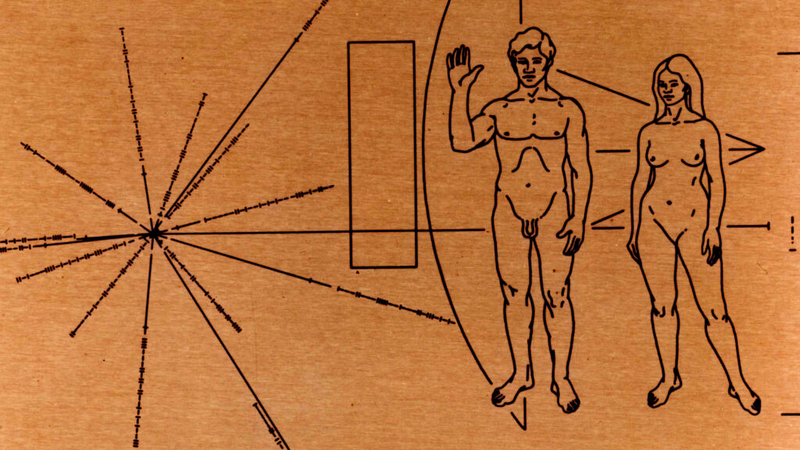
Plaques affixed to the side of the Pioneer 10 and 11 space probes, launched in 1972 and 1973, display images of a nude woman and a nude man with a hand upraised in greeting, along with a diagram of the solar system and our position in the galaxy. (Photo by NASA)
The word of the year is “human.”
That’s according to the Cambridge Dictionary, which each November chooses a word to suit the year. In 2025, the online dictionary gave us a real clunker of a word, “parasocial.” What the hell does that even mean? It apparently describes a one-sided (read: fictional) relationship people have with celebrities, fictional characters or chatbots. Think of Chiefs fans and Taylor Swift. Or me and every song on Neil Young’s 1972 album, “Harvest.” Yep, that’s parasocial.
Despite a few misses like “parasocial,” the dictionary gets it right some years. For 2020, they nailed it with “quarantine.” Another winner was 2016’s “paranoid.” But we were right.
The dictionary, which is associated with the University of Cambridge, England, chooses the word for the year based on how often it is looked up by users and taking into account the prevailing cultural zeitgeist, the spirit of the age.
“The year has been defined by global debates on what it means to be human when AI is blurring the boundaries between people and machines,” the dictionary declared in the announcement for 2026. The word, derived from Latin, as the dictionary notes, is from the 1450s, and relates to the qualities possessed by people “as opposed to gods, animals or machines.”
Fair enough, but to that I would add background from Eric Partridge’s 1958 dictionary of word origins, that notes “human” is related to the word “humus,” or “of the ground,” and is also associated with “humility.”
My copy of the Shorter Oxford English Dictionary generally agrees with Cambridge. The “shorter” OED is in two volumes with a combined 3,472 pages. I say my copy because my wife, Kim, also has the two-volume dictionary. We wound up with multiple copies of books, including “The Crying of Lot 49″ and various translations of “The Odyssey,” because we merged separate but similar personal libraries when we married in 2011.
There are a plethora of gods, animals and machines in our combined library. My side of the collection has more machines, and there are more animals in Kim’s, but it is a celebration of difference and not a sign of disagreement. And, I must add in this age of blurred boundaries, every damn book we own was written by a bona fide human.
If you are unclear about the nature of humanity, please refer to images of the gold-anodized aluminum plaques affixed to the side of the Pioneer 10 and 11 space probes, launched in 1972 and 1973. Each has an image of a nude woman and a nude man with a hand upraised in greeting, along with a diagram of the solar system and our position in the galaxy defined by the position of our sun relative to 14 pulsars. These craft were the first man-made objects to leave the solar system. Pioneer 10 is on a trajectory that will take it to the vicinity of the star Aldebaran, while Pioneer 11 is headed to the constellation Aquila. Their journeys will take several million years.
This rumination on words and libraries and humanity is a necessary preface for what follows. I have written about artificial intelligence and its data center creches often over the past several months, but I could not drag myself again to the fray without a reminder of the joy of human accomplishment. I would argue with editors of the Cambridge Dictionary about their description of AI blurring the boundaries between humans and machines, because in my view the debate has sharpened, not softened, the lines.
This year has witnessed a groundswell of resistance to AI and data centers. Of at least 40 ballot initiatives across the country on data centers, only one locality — tiny Harwood, North Dakota — gave its approval.
The big tech backlash has been driven by factors that include the fear of higher utility prices, a desire to protect the environment, and concerns about the threat AI poses to human welfare and creativity.
A CNBC poll found that 56% of voters described concerns about data centers as crucial or major factors in their decisions. This was similar to the number of respondents in the recent Kansas Speaks public opinion survey who said they had concerns about energy and water usage connected to data center construction.
Kansans in three cities voted Nov. 3 to adopt data center bans.
In Ottawa and El Dorado, voters overwhelmingly approved 10-year moratoriums on data centers. In both of those towns, the bans passed by landslides, with more than 70% of the vote.
In my town of Emporia, voters also approved a decade-long ban on data centers and battery energy storage systems. In the days leading up to the Nov. 3 election, Emporia (and Ottawa) voters were showered with mailers attempting to persuade them to vote against the ban, partially paid for by the Defend US PAC, which is aligned with Republican causes.
“The activist group pushing to ban technology jobs in Emporia is working straight from the Bernie Sanders-Mamdani Playbook,” claims one of the mailers. “Don’t be fooled. If we pass their ban, they won’t stop there. Which jobs will they try to ban next?”
On the other side:
“If we follow their plan, EMPORIA WON’T HAVE ANY JOBS AT ALL.”
But Emporians weren’t buying it. The data center ban was adopted, with about 60% of residents in favor.
The ban might be rendered moot by a pending court case. The city sued to have the measure, which was placed on the ballot by petitions circulated by Emporia Neighbors United, deemed administrative in nature rather than legislative. If a judge finds the measure to be administrative, meaning that it was already or more properly addressed by city policies or regulations, the Emporia ban would be nullified.
The data center issue had roiled Emporia since it was announced June 2, creating a rift between business and civic leaders and average citizens concerned about what the project would do to utility rates, the environment and the character of the town. Public relations surrounding the project was a disaster from the beginning.
The legal entity behind the proposal, Kanza Park Place LLC, identified the “master developer” as Gary Pinkston, a West Coast businessman who had filed a massive personal and business Chapter 11 bankruptcy case in May 2026. Pinkston later swore in a bankruptcy proceeding that he had no personal interest in the Emporia data center project, just days before he received a $3 million wire transfer from Kanza Park Place.
The mystery surrounding ownership of Kanza Park Place has been a cause of citizen concern about the project, which seeks to turn about 1,000 acres on the west side of Emporia into a “digital campus.” The end user of the proposed data center has not yet been chosen, according to a Kanza Park Place spokesman.
Although Kanza Park Place is a cipher, that hasn’t stopped it from attempting to exert its influence on the legal challenge filed by the city. Just two days after the election, the company filed a motion to intervene in the case.
“Kanza has a substantial interest in the subject matter of Emporia’s litigation,” the motion stated. “Kanza has already taken substantial steps towards constructing what the proposed ordinance would prohibit as a ‘high-impact data center’ by optioning the necessary land, having said land rezoned and having the DI-O (digital infrastructure overlay) applied, and paying Evergy for an energy study.”
The amount Kanza paid the utility is not cited. The document, filed on behalf of Kanza by a trio of Topeka lawyers, contains no hint as to the actual owner of Kanza Park Place.
An election postmortem, conducted recently by the Regional Development Association, a group wholly funded by the city and which touted the data center as Emporia’s economic savior, was a bitter exercise in attempting to prove the association right about the claimed negative effects a ban would have. The Emporia Main Street director said one investor unrelated to data centers had already walked away from the city, while others were delaying decisions.
If any of the association members attributed the economic handicap to a loss of trust in community leaders, it was not reported by the local news media. The implicit message sent to the public by the RDA was to blame voters and to complain, this is why we can’t have nice things.
Instead of coming to terms with voter anger about data centers, city leaders — and Kanza Park Place — are doubling down on a widely hated project that has been poorly described and whose ownership remains cloaked in mystery. They appear oblivious to the fact that the midterms represented a referendum on AI in general, and that big tech was on the losing side.
Harwood, North Dakota, was the exception, but its 845 residents at least knew who the owner and operator of the $3 billion data center would be: Applied Digital, a Texas firm.
The lack of transparency with the proposed Emporia data center is symptomatic of similar projects across rural America, where the identity of developers is a tightly held secret. A new study accelerated environmental concerns, because it found the largest U.S. data centers spew carbon emissions on a par with entire countries the size of Bolivia or Denmark. Carbon dioxide is a greenhouse gas that traps the heat from sunlight, driving global warming. America’s largest data centers also consume about 2% of the nation’s electricity, the study said, which is more power than New York and Los Angeles combined.
Add to this the events of the past week or so, in which security patches and routine updates appear to have crippled the very systems they were supposed to fix. From the Friday the 13th “ground stop” of the nation’s airports to outages that hit Microsoft and many major banks, the transition to new systems has been a hellscape for consumers.
Wall Street suffered a “correction” as of Nov. 20, in which stocks dropped 10% from their peak, despite a historic initial public offering of AI company Anthropic. “The wheels are coming off the AI trade,” wryly noted the Wall Street Journal.
The AI reckoning is here.
The battle between tech oligarchs and average Americans will continue, and it will be waged on devices from Main Street to Wall Street. It’s not just the frustration and loss of control that many of us feel when attempting to make a doctor’s appointment, check a bank balance or make a simple purchase. It goes to a fundamental question: At what point does artificial intelligence make us less human?
It’s easy to blame our devices.
But it’s not the machine’s fault, or the fault of machine learning. It’s the human beings pushing the technology who should be held accountable, the tech masters who treat us as pawns and the lawmakers who regard us as so much electoral fodder. If we’d had the kind of regulation and safeguards for AI instituted for the commercial use of nuclear power, we wouldn’t be having conversations about threats, existential and otherwise.
From Emporia to Washington, D.C., our leaders have failed us.
About 1 in 5 Americans can’t pay their utility bills in full, and with winter coming on, many will face a choice of heat, food or medicine. Meanwhile, our largest data centers are using enough electricity to power Denmark.
There’s a word to describe that.
It’s inhuman.
Technology isn’t the problem. It’s the hand that wields it.
In 1972, the creators of the Pioneer 10 plaque — Carl Sagan, Linda Salzman Sagan and Frank Drake — wrote a piece for the journal “Science” in which they explained the intent of the Pioneer 10 plaque. Titled “A Message from Earth,” they wrote that the visual intergalactic postcard “should carry some indication of the locale, epoch, and nature of its builders.”
It is a remarkable testament to what can be achieved when cutting-edge technology serves the human spirit. Sadly, those roles seem now to be reversed.
Their interstellar Adam and Eve pictograph likely will never be found by an extraterrestrial intelligence. The spacecraft is about the size of a small car and the universe in unimaginably vast. But the message was really meant for ourselves all along. It is, as the creators put it in 1972, a “hopeful symbol of a vigorous civilization.”
We need some of that human hope now.
Max McCoy is an award-winning author and journalist. Through its opinion section, the Kansas Reflector works to amplify the voices of people who are affected by public policies or excluded from public debate. Find information, including how to submit your own commentary, here.
Topeka, KS