The rocky road to more manageable healthcare costs in NC
Oct 05, 2026 | 6:00 pm ET
Description
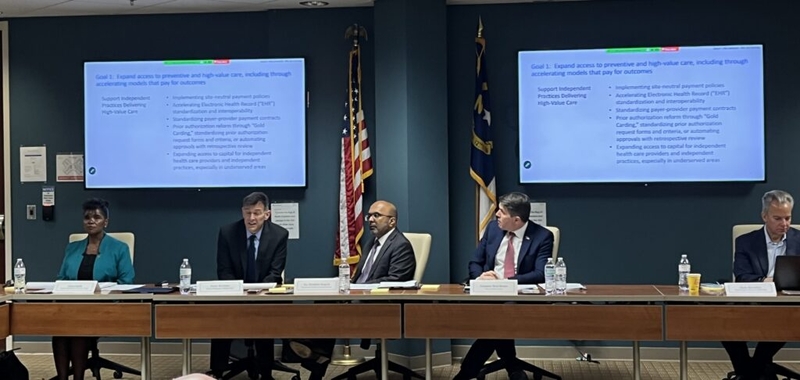
The NC commission coming up with ideas to lower healthcare costs met Oct. 2, 2026. From left: independent practitioner Dr. Karen Smith, facilitator Barak Richman, NC DHHS Secretary Dev Sangvai, state Treasurer Brad Briner and Mark McClellan, director of the Duke-Margolis Institute for Health Policy.
As it seeks ways to make healthcare in North Carolina more affordable, a group of some of the state’s main decision-makers in medical care, payments, and policy highlighted the challenges of developing and agreeing on ideas that will lead to lower costs and better health.
In on the discussions are the state’s big insurers, including state Treasurer Brad Briner, who oversees the State Employee Health Plan; the CEO of Blue Cross Blue Shield, the state’s largest insurer; the state Health and Human Services secretary, who runs Medicaid; and doctors, nurses, hospital administrators, and academics.
Gov. Josh Stein appointed the bipartisan Health Care Affordability Commission in June. The goal is to come up with suggestions for reducing the share of household income that state residents spend on healthcare while improving quality.
Legislators and state government officials are voting members. The advisory members represent healthcare providers, businesses, and nonprofits.
“We’re trying to move a large and complicated system in a different direction,” said Barak D. Richman, the commission facilitator, at the commission’s Friday meeting. ”We’re trying to change a lot of interlocking parts at once.”
The commission is considering how to invest in primary care as a way to lower overall patient cost and improve health. The idea is to keep people healthy or catch problems early before they become harder and more expensive to treat.
One option is setting annual spending targets for primary care for both public and private insurers. However, leaning more heavily on primary care is a challenge because the state doesn’t have enough doctors in rural counties.
“We just don’t have enough docs,” said Dr. Tunde Sotunde, Blue Cross North Carolina president and CEO. The state is short about 2,000 doctors, he said.
“At the end of the day, we have to solve for this,” Sotunde said. “Status quo is not going to work. We have to come up with creative solutions. The bottom line is that we are facing a significant access issue in our rural and underserved parts of the state.”
Dr. Karen Smith, an independent primary care doctor with an office in Raeford, likened talk of different ways of paying doctors to performing CPR on a patient that is bleeding to death.
“Right now, independent primary care practices are hemorrhaging,” she said, because they can’t afford to stay open.
Lawsuit over doctors supervising nurse practitioners adds new twist to long NC debate
Another suggestion that nurse practitioners be empowered to treat patients without supervision from doctors revealed the familiar fault lines between advanced practice nurses who want independence and doctors who oppose it.
“Advanced practice registered nurses have known for many, many years they could be doing more for the people of North Carolina, but have been restricted by a 1970s-era regulatory structure,” said Tina Gordon, CEO of the North Carolina Nurses Association.
“This has never been about what nurses want,” she said. “This is about what nurses can do, and what patients need.”
Steve Keene, CEO of the North Carolina Medical Society, representing the doctors, said physician supervision for advanced practice nurses is an important safety feature.
“I do not think we are in a position to say conclusively that it’s time to change,” Keene said.
Legislators have filed bills to allow advanced practice nurses to work without doctors’ supervision, but they have not become law. Last month, a nurse practitioner filed a lawsuit to overturn the requirement.
Expensive medical bills are stressing North Carolina households, recent polls have shown.
A poll from earlier this year found that 75% of respondents said they were concerned about costs, and 57% said their medical bills were too high but they paid anyway,
Raleigh, NC