Despite some overall progress, Vermont test scores show a widening achievement gap
Oct 05, 2026 | 4:55 pm ET
Description
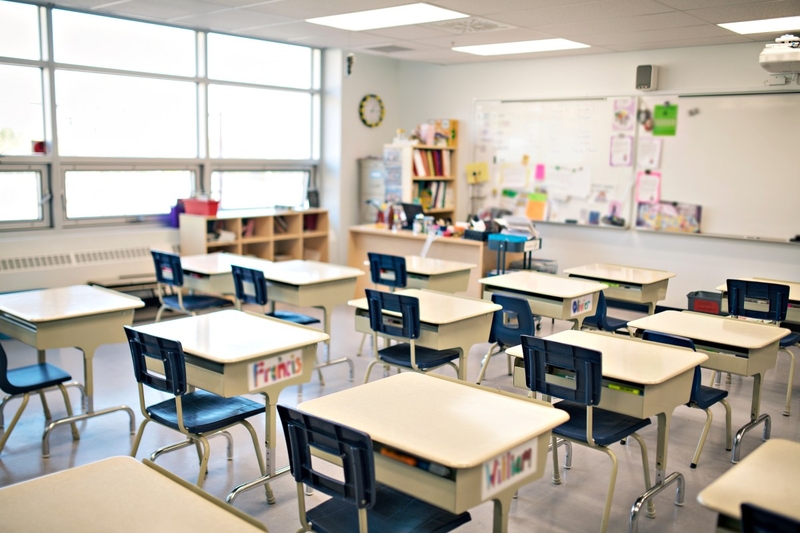
A classroom. Photo via Adobe Stock
Despite some improvements in standardized test scores, state data reveals a widening achievement gap in Vermont’s schools.
The state’s initial evaluation of its annual standardized test scores for the 2025-26 school year, released last month, shows “marginalized students,” including those with disabilities, living in poverty or belonging to a racial minority, are falling behind their peers.
The gap in subject matter proficiency between students who are considered marginalized and those who are not ranges from 30 to 38 percentage points, according to data from the Vermont Agency of Education.
And that gap has only grown over time, according to Education Secretary Zoie Saunders. Last year’s evaluation showed gaps ranging from 26 to 36 percentage points between marginalized students and their peers depending on the subject matter.
The results come as lawmakers and Gov. Phil Scott are in a multi-year effort to radically change public education in Vermont, starting with consolidating the state’s school districts and transitioning to a new education funding model.
Alongside Scott, Saunders has advocated for moving the state to a foundation formula method, which provides districts with a set amount of money based on their number of students and how expensive those students are to educate. Currently, districts have wide latitude to build their budgets from the ground up.
Saunders said that the widening statewide disparities are evidence that Vermont needs the transformation she envisions, which she said will provide more equitable resources, leading to better outcomes for students.
While advocates agree that disparities are fueled in part by gaps in resources, they say the problem isn’t so easily attributed to solely school funding.
Rebecca Eunmi Haslam, a professor of education at St. Michael’s College who specializes in racial equity, said the state needs to better support students of color by, for example, improving staff responses to bias.
Schools need to ask: “What do we do when students are experiencing bullying and harassment at school? What do we do when our curriculum does not reflect their experiences or their reality?” Eunmi Haslam said.
The widest disparity is seen in English language arts scores among students in sixth grade, with a 38 percentage point gap between marginalized and non-marginalized students.
The data shows more narrow disparities among students in third and fourth grade who tested in English language arts, with marginalized students scoring 33 points lower than others.
In Saunders’ eyes, the widening achievement gap is evidence that the state’s education system and the funding model that scaffolds it need reform.
“Our current funding system is not equitable, and it’s resulting in a widening between the haves and have nots,” Saunders said.
In some subject areas, the majority of Vermont students lack proficiency, although the state data also shows modest improvements. For example, only 41% of Vermont students in third through ninth grade on average are considered proficient in mathematics.
Historically marginalized students make up 57% of students out of the about 80,000 enrolled in the state, according to Grace Fischer, director of the agency’s assessment division.
The state considers students marginalized if they belong to a racial or ethnic minority, are living in poverty, have an individualized education program, are a migrant or English language learner, are experiencing homelessness, are in foster care or come from a military-connected family.
Karen Price operates an education tip line for the Vermont Family Network, an organization that advocates for kids with disabilities. Parents reach out to the organization for help when things have gone wrong for their child in school, giving her anecdotal evidence of how kids with disabilities can go underserved.
To Price, the heart of the issue is the fact that special education is often “siloed” from general education, meaning there isn’t a coordinated approach between general education teachers and special educators.
That separation comes in part from school culture, she said. Sometimes general educators don’t see students with individualized education programs as their responsibility to educate, she said, while other times they don’t properly coordinate with special educators.
“In a perfect world, the special educator should be able to look at the curriculum and adapt or modify according to the child’s needs,” Price said.
But that requires advance planning, which doesn’t always happen in the state’s understaffed schools, according to Price. Other times, special educators may not have the expertise to individualize curriculum to students’ needs, she said.
Gaps are often exacerbated in small schools, she said, because students with disabilities might be in smaller numbers, making it harder for districts to find the qualified supports.
In Saunders’ eyes, gaps in student achievement are the product of Vermont’s education funding system, which allows for a wide range of per-student spending across the state.
Under the state’s current education funding system, local school boards have the power to decide their districts’ budgets, as long as voters approve. Local property taxes then reflect the local district’s budget, as well as the spending decisions made across the state.
Saunders has supported transitioning to a foundation formula model, which most states across the country use. Under that model, the state decides how much money it will spend per student, with rates adjusted for those who have high needs.
Transitioning to a foundation formula model is the key to making more equitable investment across the state’s education system, Saunders said, which would “elevate quality” and make progress closing the state’s achievement gap. The state is set to transition to the new model in 2029 as long as a number of contingencies are met.
Modest improvements in state test scores are “promising,” Saunders said.
Proficiency in English language arts among students in third through ninth grade improved by 1.14 percentage points on average compared with 2025, according to the state’s data.
The state saw more significant improvement in mathematics, with proficiency among students in third through ninth grade improving by 2.7 percentage points on average.
Saunders attributed the progress to the success of the agency’s recent campaigns to improve student performance in reading and math. Those campaigns involved training teachers on new methodology for teaching the subjects.
Eunmi Haslam said gaps in the state’s test scores signal that Vermont schools need to be more willing to invest in professional development training to make classroom curricula more inclusive and help staff respond to discrimination.
Kids of color are more likely to be bullied or feel socially isolated, especially those in rural districts with a mostly white student body, she said.
“If students aren’t socially well and not emotionally safe, they’re not actually available for academic learning at all,” Eunmi Haslam said.
But if staff are trained on racial equity, they’re less likely to act on stereotypes and racial bias, creating a more inclusive learning environment, she said.
“People’s first instinct is often to blame the students for failing within the systems that we have set up,” Eunmi Haslam said.
“We’ve known it’s not working, and we continue to do the same thing.”
Read the story on VTDigger here: Despite some overall progress, Vermont test scores show a widening achievement gap.
Montpelier, VT