Texas college campus protest law faces First Amendment challenge
Oct 06, 2026 | 6:00 am ET
Description
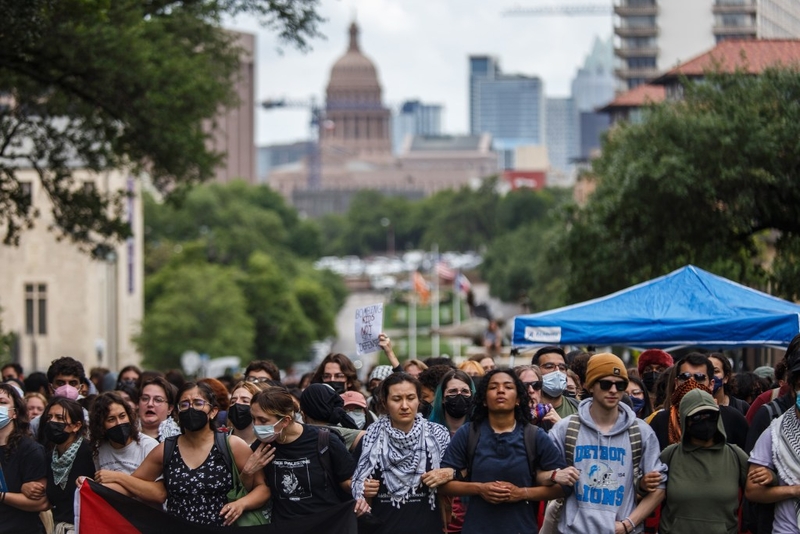
Student protesters link arms during a demonstration on the South Mall lawn at the UT-Austin campus on April 24, 2024. (Julius Shieh/The Texas Tribune)
A Texas law restricting protesting on public college campuses will face a constitutional test Tuesday.
Legislators passed Senate Bill 2972 in response to the 2024 pro-Palestinian protests at colleges that occurred across the state.
The U.S. Court of Appeals for the 5th Circuit will consider whether the law’s overnight and end-of-term restrictions violate the First Amendment after a federal judge temporarily blocked their enforcement last year. Here’s what you need to know:
What does Senate Bill 2972 do?
Known as the Campus Protection Act, the bill requires Texas public colleges to adopt policies barring expressive activity on campus from 10 p.m. to 8 a.m. School policies also must prohibit invited speakers, amplified sound and drums or other percussion during the final two weeks of a semester or term.
Lawmakers passed the measure in 2025 after pro-Palestinian protests swept college campuses nationwide.
Demonstrations intensified after students at Columbia University set up an encampment in April 2024 and later occupied a building. Days later, hundreds of students walked out of the University of Texas at Austin to demand the university system divest from weapons manufacturers supplying Israel. Then UT-Austin President Jay Hartzell called in state troopers, saying he did not want the university to become “the next Columbia.”
Then state Sen. Brandon Creighton, who would later author SB 2972, praised the response.
“The First Amendment does not protect violence or harassment,” he wrote on X on April 24. “What we have seen at Columbia and Harvard are clear and simple harassment against Jewish students.”
The law took effect on Sept. 1, 2025.
Why was the law challenged?
Students and student groups at UT-Austin and UT-Dallas sued, arguing the restrictions on expressive activity overnight and during the last two weeks of a semester are so broad that they could encompass activity that has nothing to do with the kind of protests that prompted the law.
They argue the law could prevent a student journalist from publishing a story from a dorm room at 10:30 p.m.; a Christian group from quietly worshiping with an invited minister; or a percussion group from performing in a space designed for music.
“The Texas Legislature cannot send the First Amendment to bed at 10 p.m.,” lawyers for the student groups wrote in a brief filed by the Foundation for Individual Rights and Expression, or FIRE.
U.S. District Judge David Alan Ezra, who is based in Austin, sided with the students on Oct. 14, 2025, and temporarily blocked UT System officials from enforcing the challenged provisions. He found the students were likely to succeed on their First Amendment claims and that the restrictions were unconstitutionally broad. UT System officials appealed Ezra’s ruling to the 5th Circuit.
What are the two sides arguing?
Texas Solicitor General William Peterson and Assistant Solicitor General Daniel Ortner, who are representing UT System officials, argue Ezra interpreted Senate Bill 2972 too rigidly. They say the law does not itself prohibit students from speaking after 10 p.m. or during finals. Instead, it directs colleges to write campus policies that balance free speech with preventing disruptions to exams, studying and sleep.
They point to the law itself and UT-Austin’s policy. SB 2972 explicitly notes “nothing in this section may be construed to limit or infringe on a person’s right to freedom of speech or expression protected by the First Amendment.” UT-Austin, meanwhile, did not prohibit all expression across campus overnight, the state’s lawyers added.
The school’s policy applies in common outdoor areas and speech loud enough to be heard in a dorm. Restriction on amplified sound during finals likewise applies to sound that can be heard inside academic, administrative or residential buildings, according to the policy.
Peterson and Ortner also argue the students do not have the legal right to challenge the law because it regulates colleges, not students, meaning they cannot show the law itself harms them.
Lawyers for the students counter that SB 2972 leaves colleges little discretion: the law says schools “shall adopt” the restrictions, requires disciplinary sanctions and was adopted nearly word-for-word by UT-Dallas.
They argue the law cannot be saved by promises that officials will enforce it responsibly.
“We would not uphold an unconstitutional statute merely because the Government promised to use it responsibly,” they wrote, quoting a 2010 U.S. Supreme Court decision.
The two sides also disagree over whether the law treats speech differently based on its content.
Lawyers for the students say it does because it exempts commercial speech, such as selling merchandise or soliciting donations. Lawyers for UT System officials say commercial speech is regulated separately and that the students have not shown the law discriminates based on messaging.
The Texas Tribune partners with Open Campus on higher education coverage.
Disclosure: The University of Texas at Austin has been a major financial supporter of The Texas Tribune. Open Campus has been a financial supporter within the past five years. The Texas Tribune is a nonprofit, nonpartisan news organization that is funded in part by donations from members, foundations and corporate sponsors. Financial supporters play no role in our journalism. Find a complete list of them and more information about our financial and disclosure policies here.
Austin, TX