New report finds low reconviction rates for teens in first years of Vermont’s ‘Raise the Age’ law
Oct 05, 2026 | 6:08 pm ET
Description
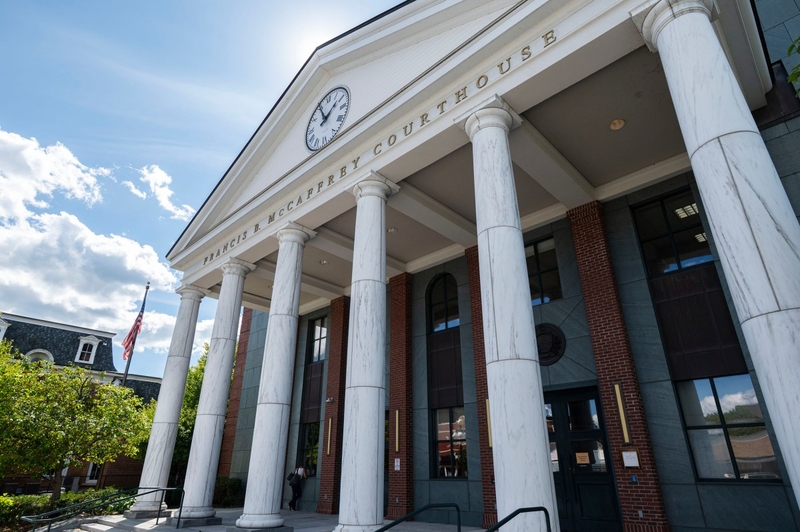
The McCaffrey Courthouse in Rutland on Thursday, September 10, 2026. The building houses Vermont Superior Court. Photo by Glenn Russell/VTDigger
Theo Wells-Spackman is a Report for America corps member who reports for VTDigger.
As Vermont considers the future of its “Raise the Age” law, a new report has found relatively low rates of reconviction among the teenagers whose cases have been affected by the reform — though the data come with important caveats.
The landmark law, which sought to route young adults charged with most offenses through juvenile delinquency proceedings rather than adult criminal court, began to take effect in 2020. And though it currently extends only to 18-year-olds, the reform is set to include 19-year-olds starting next year.
The matter has seen increasing debate in recent years as Republican Gov. Phil Scott and his administration have indicated opposition to the law’s continued rollout and cited public safety concerns. The law’s supporters say the change directs young people charged with lesser infractions to a more developmentally appropriate venue for addressing their behavior and providing them the right services.
The Vermont-based nonprofit Crime Research Group released a new report last Thursday detailing outcomes for 377 18-year-olds whose cases were processed via Family Division courts rather than adult criminal proceedings since 2020.
The report, which was commissioned through the Vermont Department for Children and Families and the state Council for Equitable Youth Justice, found that the reconviction rate among the observed teenagers was 6.9% after one year, and 18.7% after three years among the 160 cases where longer observation was possible.
The reconviction rates in Thursday’s report were much lower than those in a 2022 baseline report from the Crime Research Group, which found that 24% of 18- and 19-year-olds processed through adult criminal court were reconvicted within one year, and 46% were within three. But the comparison comes with important limitations: The two groups were studied over distinct periods and selected for observation using somewhat different criteria, according to Monica Weeber, the research organization’s executive director.
While some officials remain skeptical, a number of advocates and juvenile justice experts say the data indicate promising progress since the reform’s passage.
The low three-year recidivism rate from Thursday’s study is an excellent new benchmark for Vermont, according to Marshall Pahl, the state’s top juvenile defender.
“That’s pretty incredible work by our court system, our defense attorneys, our prosecutors and our (Department for Children and Families),” he said in an interview Friday. “This is showing that every component of the system is working.”
Matthew Bernstein, the state’s child, youth, and family advocate, was similarly enthusiastic.
“We already know that ‘Raise the Age’ is working, and this completely echoes that,” he said.
While these data are limited, the results line up with existing research on this type of law and offer an opportunity to fine-tune the state’s youth justice system, he said.
The report also comes as the state has seen overall juvenile delinquency cases trend downward over the last nine years, Bernstein added. That’s part of why he believes the state’s youth justice system has “ample capacity” to proceed as planned with “Raise the Age.”
Some officials remain unconvinced.
Routing 19-year-olds through the Family Division could protect offenders at the expense of victims, according to Timothy Lueders-Dumont, executive director of the Vermont Department of State’s Attorneys and Sheriffs.
The state’s court system is already sensitive to defendants’ ages through options like “Youthful Offender” status, which moves certain cases from criminal court to the Family Division at the discretion of prosecutors and judges, he added. Under “Raise the Age,” young people accused of more serious crimes like murder, kidnapping and sexual assault are still tried as adults in criminal court.
“The Department remains focused on elevating the voices of victims and survivors of crime,” who are often left feeling unheard despite being most impacted, Lueders-Dumont said in an email.
Aryka Radke, who leads the Family Services Division at the Vermont Department for Children and Families, agreed that the recidivism rates in Thursday’s report were low. But because 18-year-olds tend to have access to some supports that older youth don’t, like school, 19-year-olds wouldn’t necessarily respond in the same manner to such reforms, she said.
Bernstein also underlined the high rate of cases — nearly half — that ended in diversion, a path that requires an admission of responsibility followed by a restorative justice process. It’s a judicial tool that helps young people connect with the support they need to refrain from breaking the law in the future, he said.
Pahl, the juvenile defender, agreed.
Diversion “matches perfectly with this population of kids,” he said. “It’s much more personalized, and it focuses not on punishing someone for what they’ve done wrong but on having that person repair the harm that they’ve done.”
It’s a practice that’s considerably less common in adult court than in juvenile delinquency proceedings. In 2024, nearly twice the share of juvenile cases ended in diversion compared with adult criminal proceedings, according to data from the Vermont Attorney General’s office.
Scott has signaled a desire to stop the law’s full rollout on a number of occasions. But for the reform’s supporters, Thursday’s report is a clear indication that the state should proceed with its plan to extend the juvenile court process to 19-year-olds.
“My hope is that this will encourage our lawmakers and policymakers and the administration to hold the course with ‘Raise the Age,’” said Karen Vastine, who chairs the Vermont Council for Equitable Youth Justice, an advisory body to both lawmakers and the governor.
Clarification: An earlier version of this article referenced previous reporting that the Department for Children and Families would not include 18- or 19-year-olds in designs for a new locked juvenile facility planned to open in the coming years. In recent weeks, the department has indicated some openness to including youth older than 17 years old.
Read the story on VTDigger here: New report finds low reconviction rates for teens in first years of Vermont’s ‘Raise the Age’ law.

Montpelier, VT