Judge permanently blocks WA sheriff standards law
Oct 02, 2026 | 4:23 pm ET
Description
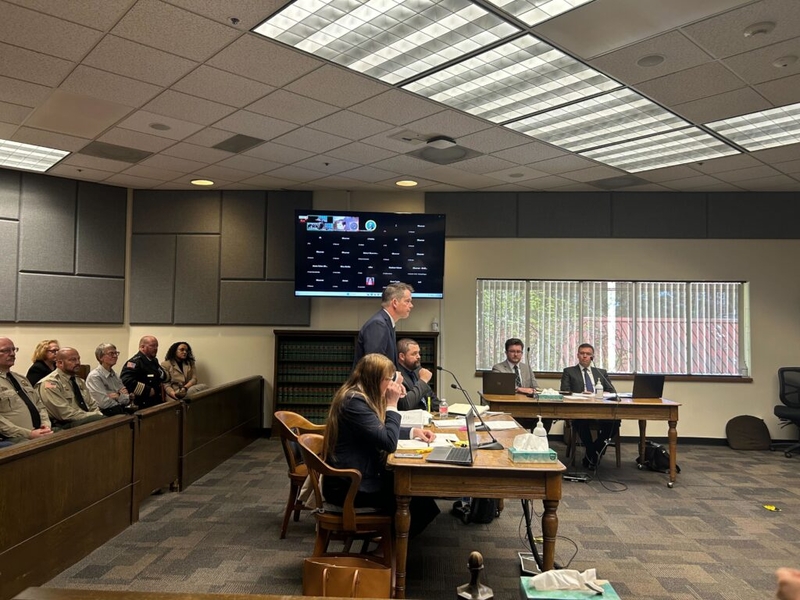
Mark Lamb, the attorney for Washington sheriffs, speaks in Thurston County Superior Court against a new law setting heightened eligibility standards for sheriffs as several county sheriffs observe on April 29, 2026. (Photo by Jake Goldstein-Street/Washington State Standard)
A judge on Friday threw out tough new job standards for county sheriffs approved by Washington lawmakers this year that critics argued would force some out of office.
The decision from Thurston County Superior Court Judge Christine Schaller permanently blocks the most controversial pieces of the Democrat-sponsored policy, pending an appeal by the state. A formal court order outlining the ruling is expected later this month.
The law’s supporters see it as vital to building trust in law enforcement by requiring sheriffs to meet the same standards as their deputies. But its opponents — including a dozen sheriffs who challenged the law – say it amounts to state overreach that could override the will of voters by ousting elected sheriffs.
“The First Amendment and democracy, for all of us to be participants in that, it requires that we have the belief that people may elect someone that we don’t like, people may vote for someone that we don’t like, and elected officials, as they frequently do, may say things that we don’t like,” plaintiffs’ attorney Mark Lamb said.
“And the remedy for that is not to have a commission that is able to remove them from office when they do something that they deem to be offensive or impermissible,” Lamb continued.
Mike Faulk, a spokesperson for the attorney general’s office, said the state plans to appeal the ruling to “defend this important state law.”
Senate Bill 5974 requires county sheriffs, who are usually elected, to meet the same minimum eligibility standards as police chiefs, who are appointed. Failure to do so or getting state certification revoked are grounds for removal from office under the law. The seldom-used recall process is currently how voters can remove sheriffs before their term ends.
Schaller temporarily blocked much of the law on April 29 the day before it was set to take effect so elections for sheriffs this year moved forward without the new eligibility requirements. The state appealed Schaller’s earlier decision to the state Supreme Court, but a court commissioner chose to maintain the status quo and declined to lift the judge’s block.
The attorney general’s office defended the law in court.
“Voters place immense trust in sheriffs to faithfully execute the duties of office, and accountability, trust, and proper training are paramount,” Assistant Attorney General Kristen Valore said in court Friday. “The Legislature passed Senate Bill 5974 to further these interests and ensure that county sheriffs meet the same basic qualifications as other law enforcement leaders in the state.”
Democrats in the Legislature passed the law and Gov. Bob Ferguson signed it despite ardent opposition from Republican lawmakers.
Schaller’s action sets aside the law’s imposition of new criteria that, in order to be a sheriff, one must have at least five years of law enforcement experience, no felony or gross misdemeanor convictions, be at least 25 years old and no history of actions that would get state certification as a peace officer revoked. They have to undergo background checks to confirm they meet the requirements. Under the law, if a sheriff is removed from office, county officials would appoint a replacement.
The law sought to force sheriffs not already certified to get state certification from the Criminal Justice Training Commission within nine months of taking office. Under current law, they have a year.
Five-member hearing panels from the Criminal Justice Training Commission make final decisions on decertification. The panels include two police officials. These decisions can be appealed.
Examples of misconduct that has gotten officers decertified in recent years include crimes like domestic violence, harassment and sexual abuse, as well as interfering with an internal investigation and endorsing on social media police use of force against protesters.
The decision comes in response to lawsuits brought by sheriffs across the state.
The sheriffs who brought the original litigation include: John Nowels of Spokane County, Glenn Blakeslee of Pend Oreille County, Brad Manke of Stevens County and Ray Maycumber of Ferry County. The Washington State Sheriffs’ Association filed a similar lawsuit of its own.
Walla Walla County Sheriff Mark Crider said he and other sheriffs are “fairly satisfied” with the ruling, noting that the “majority of it that we thought was unconstitutional, she agreed with us.”
“I think it would’ve disenfranchised the voters,” said Crider, who is retiring this year. “That’s our big thing. The right of the people is being impaired because they don’t get to select who’s representing them.”
Anne Levinson, a retired judge who helped draft the law, countered in an email after Friday’s hearing that “there is great harm to the public and in particular to vulnerable individuals if top law enforcement officials are allowed to continue in office after having committed serious misconduct.”
Schaller’s ruling doesn’t appear to block other provisions in the law related to police chief standards and the use of law enforcement volunteers.
Olympia, WA