Supreme Court will consider Trump’s mandatory immigrant detention policy
Oct 01, 2026 | 3:12 pm ET
Description
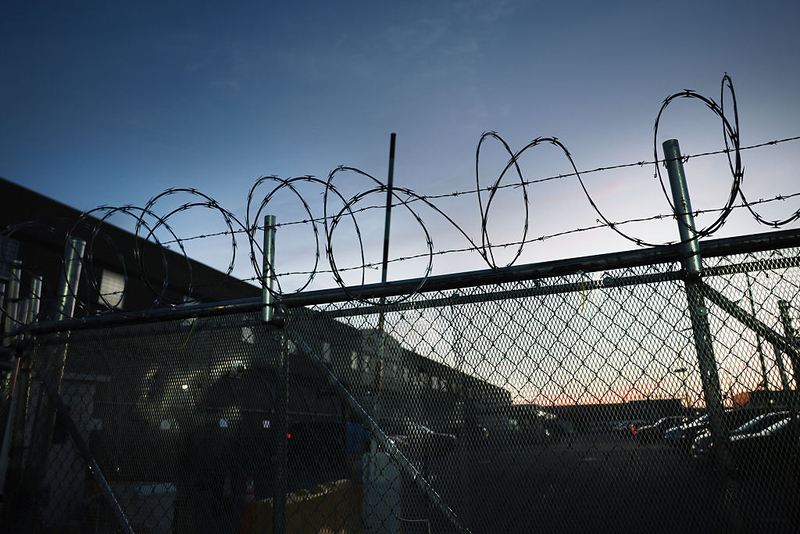
Barbed wire lines a fence outside of the Delaney Hall Detention Facility, where the Trump administration is housing detained immigrants, in August in Newark, N.J. The U.S. Supreme Court will hear a case on whether the administration can indefinitely detain immigrants who at one time crossed the border illegally. (Photo by Spencer Platt/Getty Images)
The U.S. Supreme Court on Thursday agreed to hear a case challenging a Trump administration policy that threatens millions of immigrants with mandatory and indefinite detention while fighting their court cases.
The policy, put into place in July 2025, requires people picked up by Immigration and Customs Enforcement agents to be kept incarcerated without bond if those immigrants crossed a border illegally — even if the crossing was decades ago.
The shift was part of the administration’s broad effort to deport immigrants who don’t have legal status.
Flouting Trump policy, federal judges are freeing immigrants from mandatory detention
Several appeals courts have struck down the policy, but the administration appealed further to the high court. If the Supreme Court agrees with most other federal judges, including Republican nominees, the result could mean that immigration courts would be required to offer detained immigrants bond hearings, which could allow them to be released until their court dates.
“Clearly it means that the Supreme Court is going to have a deciding voice here on what it looks like for mandatory detention,” said Ariel Ruiz Soto, a senior policy analyst at the nonpartisan Migration Policy Institute.
“Federal judges have ruled against the policy and it’s been very lopsided,” Ruiz Soto said. “And now it comes down to a Supreme Court that has ruled at times with the administration and at times against the administration on issues of immigration.”
The Trump administration has argued that its policy is legal under a sweeping 1996 federal immigration law.
The specific case involves a Brazilian immigrant, Ricardo Barbosa da Cunha, who was arrested last year despite legal work permission and an asylum case. He entered the country illegally in 2005.
He sued for release in a New York federal court, which ordered a bond hearing, and he was released by an immigration court judge.
The 2nd U.S. Circuit Court of Appeals, which includes Connecticut, New York and Vermont, upheld the ruling in April and found that the administration’s policy was illegal, saying that the policy would create “the broadest mass detention-without-bond mandate in our Nation’s history for millions of noncitizens.”
Trump administration claims court victory in mandatory detention
Nine appeals courts have also ruled against the policy, but two have upheld it – the 8th Circuit Court of Appeals, covering Arkansas, Iowa, Minnesota, Missouri, Nebraska, North Dakota and South Dakota, and the 5th Circuit Court of Appeals, covering Louisiana, Mississippi and Texas.
Lower courts have rejected the policy more than 20,000 times, and a Stateline review found even many Republican appointees were releasing prisoners held under the new policy, finding it unconstitutional.
No date has been set for oral arguments.
Even if the Supreme Court rules against the Trump policy, the results are unpredictable, Ruiz Soto said.
Immigrants could get required bond hearings from immigration judges, but those immigration judges would be under pressure to deny bond. The American Immigration Lawyers Association, a trade group, recently told Stateline that some judges are treating immigrants as a flight risk by definition and denying bond on that basis.
A ruling in favor of the administration could be devastating to immigrants who are being held, however.
“It could kind of cement how difficult it is for people to be in detention, and could then indirectly push more people to accept voluntary departure once they’re detained,” Ruiz Soto said. “‘Self-deportation’ is what the administration calls it — if you agree to leave on your own they’ll give you $3,000.”
Stateline reporter Tim Henderson can be reached at [email protected].