Wisconsin Elections Commission meets ahead of midterms
Oct 01, 2026 | 5:39 pm ET
Description
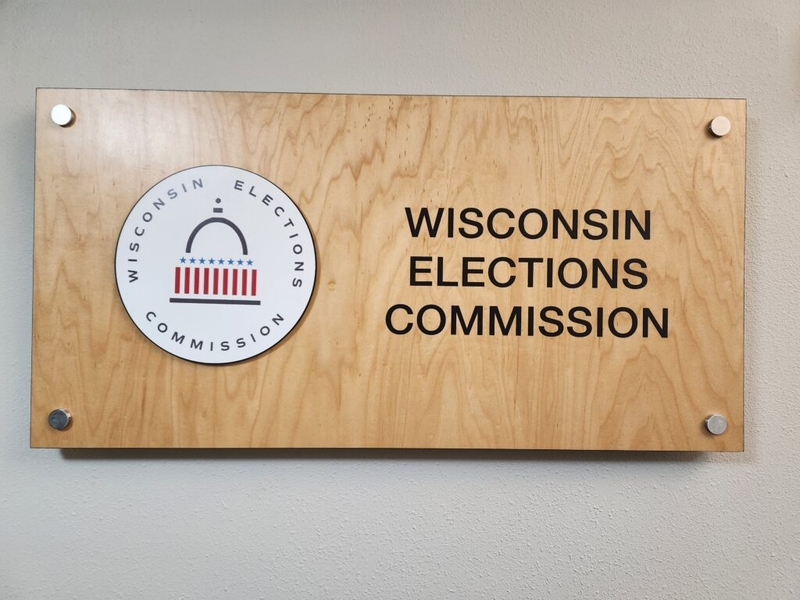
Sign for the Wisconsin Elections Comission. (Wisconsin Examiner photo)
The Wisconsin Elections Commission met Thursday to assess its preparations for the midterm elections in November, review reports on allegations of voter fraud and determine the outcome of two complaints against election officials.
The commission met as concerns continue to swirl around Wisconsin and the country over the possibility that President Donald Trump and his Republican allies will work to undermine confidence in the results of the election.
In the meeting, WEC Administrator Meagan Wolfe gave the agency’s pre-election readiness report in which she outlined the ways the commission works to keep the state’s voter rolls accurate, train election officials, ensure the election’s security and answer any questions that come from local officials or voters.
One of the most frequent complaints about the election system made by conspiracy theorists is that Wisconsin’s voter registration database includes the information of “inactive” voters who have moved, died or been convicted of a felony. The critics argue that leaving these files in the database makes it easier for fraud to occur.
The report states that WEC and local election officials have reviewed or updated nearly 500,000 voter files ahead of the election to make sure that only eligible voters cast votes in November.
“And in total, since the last general election, our municipal clerks have updated or deactivated over a half a million records, and so I think that’s really, really important to highlight how much work goes into maintaining Wisconsin’s voter registration list all day, every day to ensure that anybody that’s lawfully registered will show up on the registration list,” Wolfe said. “They’ll show up on the polls when they go to vote on Election Day, and anybody who is not eligible, so anybody who maybe has been convicted of a felony or is otherwise not eligible, is removed from the list or their record is updated.”
Commission Chair Don Millis, a Republican, said that leaving the inactive voter files in the database actually protects against fraud.
“Basically, you have one database with 7 million records, and there’s a very good reason why we keep records of inactive voter records, deceased voters, because if you got rid of those, you would lose one of your best tools to combat election fraud,” Millis said.
Wolfe also said that in an effort to provide as much information as possible to voters and clerks, the WEC office is set to open at 5 a.m. in the weeks ahead of the election.
Commissioner Ann Jacobs, a Democrat, said she appreciates the sacrifice from WEC staff to help people, but that the agency’s 30-person staff is not large enough to handle the demands of the public.
“We have put in a request for our budget for many more positions because the work we’re doing has expanded dramatically,” Jacobs said. “It shouldn’t be something where people are sacrificing as much as they are. And I want to express my admiration for our staff’s devotion to this work and commitment to it. And also say that our need for additional staff is real. It’s profound. And I hope if any legislators are out there listening, that you treat our budget request for more personnel with great attention, and hopefully give us those staff positions.”
Voter fraud, felon reports
Commission staff also presented the results of the agency’s regular reports on felons who have voted and reported election fraud.
As is generally the case, neither report shows widespread levels of election fraud at the level Republicans have regularly alleged in recent years.
The report shows that since the 2020 general election, nearly 22 million votes have been cast in Wisconsin. Only 445 of those votes, 0.002%, were matched to voters with felony convictions and an even smaller number of those instances were actually referred to prosecutors and charged.
The commission’s annual report on voter fraud found that in the elections since November 2025, municipal clerks have referred 53 cases of election fraud to local prosecutors. The WEC report, agency staff said, could be an undercount because it’s dependent on clerks reporting the referrals to WEC when they happen.
Most of the referrals, 44 of them, were made because the “election day registration” postcard delivered to a person’s address after they register at the polls was returned undeliverable.
Milwaukee Complaint
The commission also voted on Thursday that there is no probable cause to further investigate a voter’s complaint that the city of Milwaukee violated state law by sorting absentee ballots at its central count location behind a curtain.
The complaint alleged that city staff were conducting “observable” election activities behind the curtain at the city’s central count location during the November 2024 and April 2025 elections. The commission’s discussion of the complaint reopened long-running arguments between commission members — most notably from Republican Robert Spindell, who has long been the WEC member most friendly to election conspiracy theories.
Spindell argued that people continuing to have doubts about Wisconsin’s elections is evidence that Wisconsin’s elections aren’t run competently or transparently enough.
“Let’s stop having these problems that we have, where 45% of the citizens of Wisconsin feel that there’s something wrong with this thing,” Spindell said. “I’m sure Mayor [Cavalier] Johnson does not like the bad publicity that comes out regarding the lack of transparency. There’s no reason why that black curtain is up. There’s no reason why all these actions are being blocked if there’s nothing nefarious going on.”
Jacobs pointed out that the complaint included several blatantly false statements.
“Bob, I’m concerned by your comments because I know you’ve been to Central Count. I know you have seen ballots being opened in the machines. I know you have seen the tables. I know you have seen the poll workers calling out names. I know you have seen all this,” Jacobs said. “And this complaint was by someone who swore under penalty of perjury that those things were happening behind this curtain. This man brought a lie to us, a lie, because he’s so invested in putting forward this conspiracy theory of secret things going on behind black curtains that he’s willing to lie on these documents to us. You and I both know, we’re both there, you and I both know that’s not true and he lies to this commission with the hopes of diminishing the work being done in the city of Milwaukee and I think you should be as offended as I am by that, because I’m pretty darn offended.”
Mark Thomsen, another Democratic member of the commission, said that it’s Spindell’s repeated indulgence of conspiracy theories that has allowed distrust of the system to continue.
“For you to turn this discussion about a complaint and a recommendation into the politics of the election, I think that hurts us more than anything,” Thomsen said. “I think that promotes mistrust, and … years and years of this is like it’s like Chinese torture, Bob. I mean, it’s enough.”
Madison, WI