Judge rules Salah Sarsour is deportable
Oct 01, 2026 | 4:30 am ET
Description
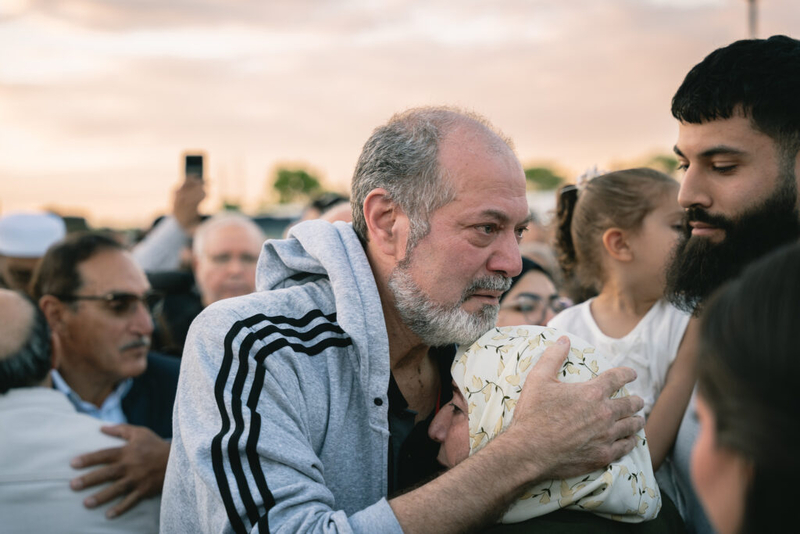
Salah Sarsour being released from immigration detention in June. (Photo courtesy of Yaseen Najeed)
A federal immigration judge ruled Wednesday that Salah Sarsour, president of the Islamic Society of Milwaukee, can be deported. Judge Jayme Salinardi rejected accusations made by the Department of Homeland Security that Sarsour lied on his green card application over 30 years ago, and that he registered to vote despite not being a citizen. Salindari did, however, give what Sarsour’s attorneys called “extreme deference” to a 2025 memo by Secretary of State Marco Rubio stating that Sarsour — a vocal advocate for Palestinian rights — is deportable “because his actions undermine” U.S. foreign policy.
The same morning Salindari ruled on Sarsour’s case, he announced his retirement. A different immigration judge will preside over further proceedings in Sarsour’s case. During a press conference Wednesday, attorneys representing Sarsour called the decision “unjust,” and said the timing of Salindari’s retirement announcement was “odd.”
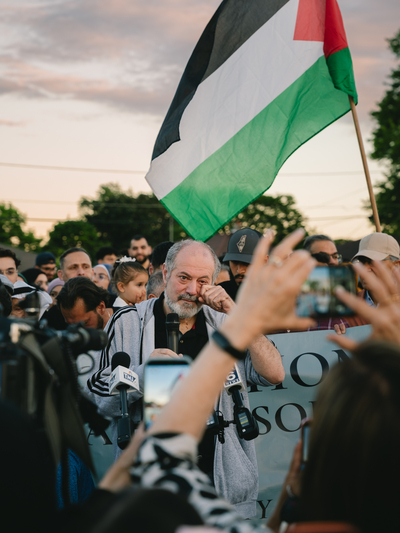
Immigration attorney Patrick Taurel said that Sarsour — who is not taking interviews at this time — was “disappointed but not shocked” by the judge’s ruling, and that he understands that immigration judges are under pressure from the Trump administration. Last year, nearly 100 immigration judges were fired by the Trump administration, shrinking the number of judges by about a quarter, NPR reported.
“It does feel odd,” said attorney Luna Droubi, who is representing Sarsour in a separate federal case arguing First Amendment retaliation by the government.
Taurel said he plans to appeal Salindari’s ruling down the road. Now that Sarsour has been found deportable, the next question is whether he is eligible for any kind of relief, such as asylum. Taurel said that Sarsour will eventually be able to appeal his case to the 7th Circuit Court of Appeals, which he described as more neutral than the immigration courts. Proceedings are expected to continue into next year and under a different judge, Taurel said.
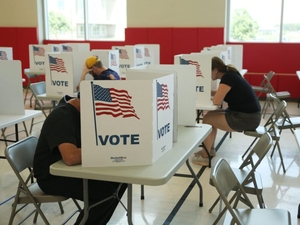
Sarsour was in Milwaukee when immigration agents arrested him in late March. They then transported him out of Wisconsin and to a detention center in Indiana. DHS accused Sarsour of lying on his green card application in the 1990s, and claimed that he had been convicted as a teenager in Israeli military courts of throwing Molotov cocktails in 1988, during the First Intifada uprising. Sarsour grew up in the West Bank under Israeli military occupation. DHS also said that Sarsour had been charged in Israel with illegally attempting to possess weapons and ammunition in 1995. Prosecutors also accused Sarsour of registering to vote in 2004 despite not having full citizenship.
A spokesperson for the Department of Homeland Security, reached for comment on the ruling, reiterated the department’s assertion that Sarsour “is a terrorist who was convicted of throwing Molotov cocktails at the homes of Israeli armed forces.” The spokesperson wrote in an email to the Examiner that “due to a previous court order, this public safety threat was loose on our streets,” and said that the judge in Sarsour’s case sustained the government’s case that there were grounds to deport Sarsour. “All illegal aliens receive due process,” the spokesperson wrote. “If a judge finds an illegal alien has no right to be in this country, we are going to remove them. Period. Under President Trump and Secretary Mullin, if you break the law, you will face the consequences. Criminal illegal aliens are not welcome in the U.S.”
Sarsour is a legal permanent resident and has lived in the United States for over 30 years, during which time he has not been arrested or convicted of any crime prior to his immigration arrest.
Sarsour’s attorneys dispute the accusations, saying that their client was convicted of throwing stones, not explosives. They also introduced evidence that Israeli authorities tortured Sarsour to get his confessions which were signed in Hebrew, a language Sarsour can neither speak nor read. Experts and witnesses called to the stand by Taruel testified to the use of torture by Israeli authorities, a lack of due process rights afforded to Palestinians like Sarsour, and that Sarsour continues to suffer from PTSD due to his time in Israeli detention. Another expert said that Sarsour passed a polygraph test in which he denied having registered to vote. Prosecutors did not call any witnesses or experts for their side during the proceedings.
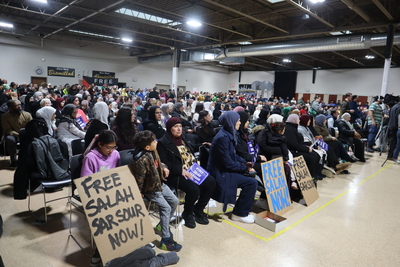
Although Salindari rejected the accusations that Sarsour lied on his green card application and that he registered to vote, Taurel said that the judge did give “extreme deference” to Israeli documents concerning Sarsour’s convictions. Despite the testimony involving the nature of the Israeli military court system, Salindari found the convictions against Sarsour to be valid.
Droubi said that Sarsour’s immigration case has no bearing on his federal First Amendment retaliation case, which she and Taurel believe is the reason the Trump administration targeted Sarsour for deportation and is supported by Salinardi’s ruling that he could be deported on foreign policy grounds. After Rubio said Sarsour’s “actions undermine U.S. foreign policy,” the Justice Department announced it would begin targeting the group American Muslims for Palestine, for which Sarsour is a board member.
Sarsour’s First Amendment claims, his lack of any criminal record in the U.S. and his deteriorating health, contributed to a federal judge’s ruling that he should be released due to having a “substantial” claim of First Amendment retaliation.
“You have to ask yourself,” Droubi told the Examiner, “if you are an immigrant, ‘Do I have the right to speak out about issues that matter to me? What if I draw a political cartoon? Am I going to be arrested and detained because of that? Is the government going to bring charges against me and potentially remove me from this country?’” Droubi added, “That is significant, and I think it does chill the speech of immigrants and non-citizens in this country, and it should really terrify all of us.”
Taurel said that the cases of Sarsour, Mahmoud Khalil, and other Palestinian activists targeted for deportation underscore “the need for Congress to repeal the foreign policy ground of deportability.” Senator Peter Welch (D-Vermont); Senator Alex Padilla (D-California) introduced a bill titled the Land of the Free Act to repeal the rarely-used Cold War provision of immigration law last year, saying the Trump administration had “weaponized” it to punish political speech.
Like many Palestinians born before or around the Six Day War between Israel and a group of Arab nations, Sarsour has travel documentation issued by Jordan but is not a citizen of that country. If he were deported, he would likely ultimately end up back in Israeli territory.
“We feared this outcome,” Taurel said of the judge’s decision. “But Salah is determined to keep speaking out.”
Madison, WI