Pa. House panel advances bill to regulate kratom
Sep 30, 2026 | 4:31 am ET
Description
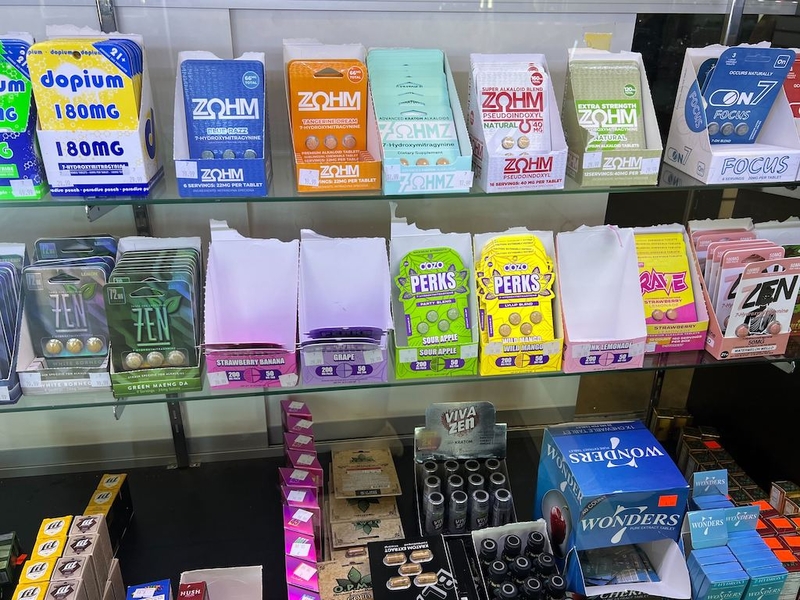
A variety of kratom and 7-OH products — including capsules, cartridges and wellness shots — are on display at a smoke shop in Buffalo, N.Y. States have led the way in regulating kratom, and now federal officials want to ban 7-OH, a powerful compound found in some kratom products. (Photo by Amanda Hernández/Stateline)
A panel of Pennsylvania House members advanced a bill Tuesday that would allow the sale of some kratom products to continue in the state, while banning others and creating stricter regulations for sellers.
Under the proposed law, retailers who register with the state would be allowed to sell natural leaf kratom products to people 21 and over. But those products would have to meet strict packaging requirements and be subject to the tobacco tax.
Packages would have to include the manufacturer’s name and address, a warning that the products have not been evaluated by the U.S. Food and Drug Administration (FDA) and not contain any medical claims. They would also have to be child resistant and not designed to appeal to minors.
The bill would also ban the sale of so-called synthetic or adulterated kratom products, including those that contain more than .5% alkaloid composition of 7-hydroxymitraynine or 7-OH, a potent intoxicating compound found in only trace amounts in the kratom leaf. Violators would be subject to criminal penalties, though those would target sellers and not individual users.
Kratom is a substance that, in low doses, acts as a stimulant and, in higher doses, more as a sedative. It’s made from a plant native to southeast Asia, where it’s been ingested for medicinal, ceremonial and recreational purposes for hundreds of years.
But recently, its popularity in America has skyrocketed.
Along with natural kratom leaf, more potent synthetic derivatives and products made by extracting intoxicating compounds from the plant have become readily available at many gas stations and smoke shops throughout the country.
It has reportedly also been used by some who’ve struggled with addiction to more powerful opioids in an attempt to manage their withdrawal symptoms outside of the medical system.
Experts in public health and substance abuse treatment have warned kratom in any form can be addictive and research into the long-term effects of taking it and other issues like potential drug interactions are extremely limited. They also warn that using kratom in an attempt to mitigate opioid withdrawals has not been proven effective, and that those struggling should seek professional help.
“The goal is to continue to make products that some find therapeutic available, while eliminating the most dangerous products or forms that might be appealing to young people or consumers who simply don’t understand how dangerous kratom can be,” House Health Committee Chair Dan Frankel (D-Allegheny) said.
The measure received a unanimous committee vote, though Frankel said the bill’s sponsor, Rep. Bridget Kosierowski (D-Lackawanna) intends to offer a future amendment to address “potential loopholes in the bill, to tax the products in a simpler way, and to direct those tax dollars towards oversight amongst other changes.”
The amendment, he said, would be brought before the full House as the bill advances in an effort to pass the legislation before the end of the current legislative session in November.
In recent years, a number of overdoses have been recorded where kratom was found in the victim’s body alone or in combination with other drugs. According to the state Department of Health, there have been 33 in Pennsylvania since 2025.
Calls to poison control centers regarding kratom have also increased, with 106 this year through June 30, including 41 involving 7-OH.
As it stands, kratom is marketed as a dietary supplement, a category of product that includes vitamins and minerals and receives limited scrutiny from federal regulators like the FDA.
Mac Haddow, a senior fellow on public policy with the American Kratom Association, a lobbying group that represents kratom product manufacturers and sellers, says the group broadly supports the aims of the bill, but would like to see some changes.
He said that he would like to see the proposal allow the sale of products made from kratom using extraction methods that have been deemed safe for food by the FDA, even if it stipulates they can be no more potent than natural leaf products generally.
“As long as they are properly extracted using FDA-approved solvents that maintain the ratio of the plant material the same as it is in the natural plant, it should be fine because they’re safe,” he said. “Depending on when they were harvested in southeast Asia and how they’re transported, you can have variances [in potency] that are fairly significant in the powdered form. An extract standardizes that dose.”
Haddow said he would also like to see language that he believes could better preempt the sale of newly derived synthetic compounds based on those found in kratom. New ones, he says, often pop up faster than regulators can act.
Recently, the U.S. Drug Enforcement Administration (DEA) classified three synthetic compounds as Schedule I on an emergency basis, meaning the designation will last two years. Those include mitragynine pseudoindoxyl, MGM-15 and MGM-16, potent compounds that produce opioid-like effects.
The DEA has also opened a public comment period on a proposed Schedule I classification for 7-OH.
In Pennsylvania, district attorneys in Bucks and Chester counties have asked the state Department of Health to use emergency powers to classify 7-OH as a schedule I substance, similar to drugs like heroin and LSD.
“At this time, DOH is reviewing the situation and considering all options to ensure any decisions support the health and safety of Pennsylvanians,” a department spokesperson told the Capital-Star earlier this month. “DOH is working to raise awareness and educate the general public …. These products are often sold in retail stores, which can make people assume they are regulated and safe when they are not.”

Harrisburg, PA