Public Utilities Commission staff recommends denying CMP temporary rate hike
Sep 29, 2026 | 4:13 pm ET
Description
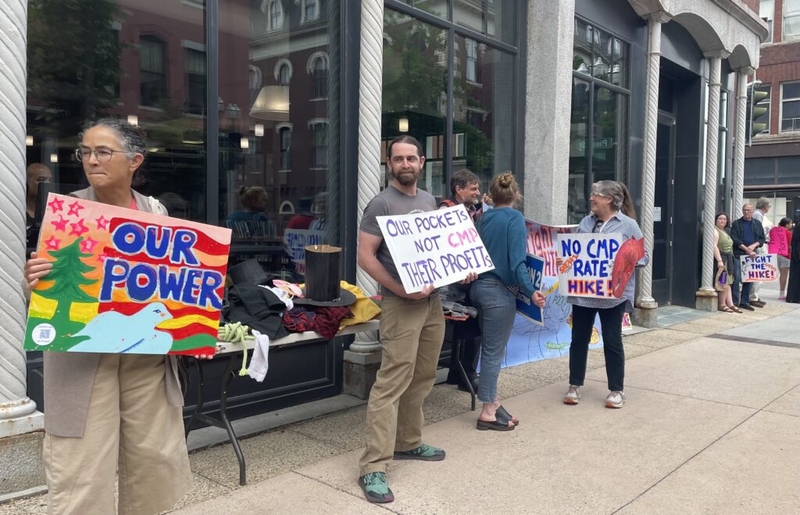
Members of the Fight the Hike Coalition rally outside the Lewiston Public Library, ahead of a June 23, 2026 Public Utilities Commission public hearing on the Central Maine Power rate increase. (Photo by Kaitlyn Budion/Maine Morning Star)
The Public Utilities Commission is poised to reject a temporary rate increase for Central Maine Power customers, after commission staff recommended denying the change.
In the recommended decision published Monday, staff wrote that the many groups involved in the CMP rate case are unable to reach an “undisputed” amount for the temporary rate, leaving the commission unable to approve an increase.
“This case presents concerns around affordability; there is a risk of customer confusion associated with temporary rates, particularly given the number of rate changes that CMP customers have experienced in recent years; performance incentives are under consideration; and finally, this case is complex,” the recommendation states.
CMP is seeking to increase its revenue by $189 million, and while that case is pending before the commission, the utility requested a temporary rate increase to provide $69.3 million.
CMP estimates the proposed temporary rate would mean an increase of $7 a month for the typical residential customer using around 550 kilowatt hours each month.
Numerous groups, including the Department of Energy Resources and local consumer protection organizations, have intervened in the overall rate case, several of which object to the temporary increase. Some of the groups oppose any temporary increase while others contest how much money CMP would be gaining.
With so many different positions on the temporary rate, staff wrote that the commission can’t reach an “undisputed” amount as required under state law. And several of the issues raised by the opposing groups still need to be investigated in the broader rate case, leaving staff unable to rule on the merits of the concerns.
Staff noted that the main argument in favor of the temporary rate is CMP’s “relatively low” earnings and the impact on its credit rating — in July, S&P Global recently revised CMP’s rating outlook from stable to negative.
“If this concern outweighed other concerns, the Commission might look to essentially the lowest common denominator and approve a temporary revenue requirement that reflects the lowest amount agreed to by most parties,” staff wrote.
In a statement Tuesday, CMP said the recommended decision will have consequences beyond the rate case, and would extend financial uncertainty for the company.
“CMP has already been forced to defer planned capital work, including projects intended to make power available, strengthen reliability, improve resilience and modernize the system, and will continue to do so,” the utility said. “CMP will now also be forced to evaluate workforce levels and hiring plans that support current operations and future needs.”
But the staff ultimately conclude that the factors against a temporary increase — affordability, customer confusion, performance incentives and the complexity of the rate case — outweigh the arguments in favor of the increase.
Parties in the rate case can file their responses to the recommendation until noon on Monday, Oct. 5. After that the case will go before the commissioners, who are not required to follow the staff recommendation.
Even if the commission denies the temporary rates now, CMP can seek temporary rates later in the process if the utility can reach a clear agreement with the other parties.

Augusta, ME