Local officials knock NIPSCO storm outage response
Sep 29, 2026 | 6:02 pm ET
Description
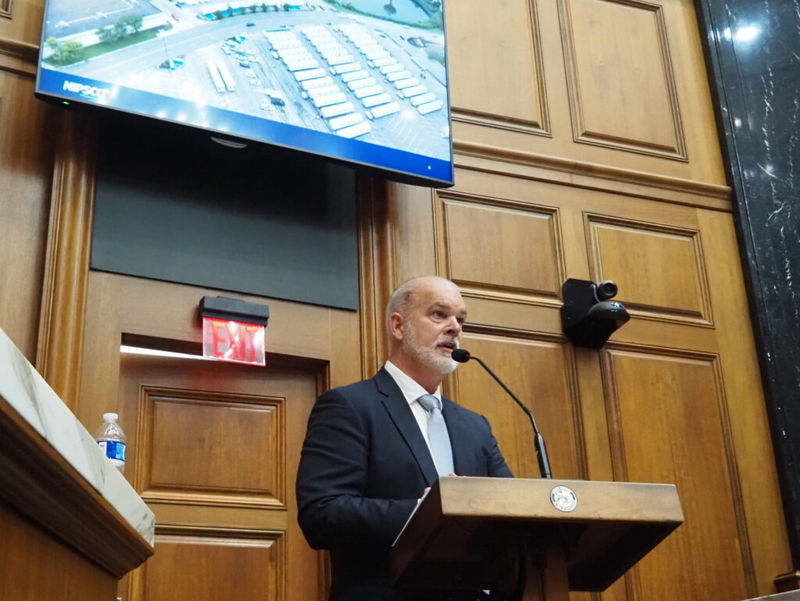
NIPSCO President and Chief Operating Officer Vince Parisi speaks during an interim committee hearing focused on the utility's storm response, on Tuesday, Sept. 29, 2026. (Photo by Leslie Bonilla Muñiz/Indiana Capital Chronicle)
Northwest Indiana residents and officials on Tuesday panned the Northern Indiana Public Service Co.’s response to devastating storms last month, calling for a slate of changes in the upcoming legislative session.
Strong winds from Aug. 11 storms inflicted the worst damage in NIPSCO’s history, knocking out power to 375,000 customers — largely in Lake and Porter counties. Some homes and businesses didn’t regain electricity for two weeks.
“There seemed to be a failure in communication,” Griffith Police Chief Albert Tharp told lawmakers during an interim legislative committee meeting repurposed into a storm hearing.
Tharp said town leaders “weren’t getting” regular meetings with NIPSCO for at least a week after the Aug. 11 storms and that the meetings ended before all customers were reconnected. Residents calling NIPSCO were repeatedly told their outages weren’t showing up on the logs.
And when the town convened state staff and prison labor to help clear alleyways of debris and access utility equipment, NIPSCO sent “different workers than were planned and the management there didn’t really have a game plan.”
“Let’s do better with our execution,” Tharp said.
NIPSCO President and Chief Operating Officer Vince Parisi said the utility was “prepared for what we understood was coming” but weather forecasts “consistently underestimated” the storms’ eventual severity. The first indication wind speeds would top 100 miles an hour came just 11 minutes before the storm crossed into the utility’s territory, Parisi said.
He said thousands of trees were downed — “primed” by heavy rains and saturated soils — with five transmission towers and 1,500 utility poles damaged. The wooden distribution poles that line the average street are typically rated for 55 mile-an-hour winds.
Wind speeds “exceed(ed) what the system was designed to withstand,” Parisi said.
NIPSCO has plenty of spare wooden poles in inventory with higher ratings than older ones, but the utility will also likely consider hardier steel poles in the future, according to Parisi.
He said the company is paying for an internal after-action review that will be provided to the legislative committee. An outside contractor will also review the response, with the results published publicly. It’s unclear if the costs will be passed to ratepayers; NIPSCO didn’t immediately respond to a request from the Capital Chronicle.
The Interim Study Committee on Energy, Utilities and Telecommunications met to hear statutorily required reports from state utility regulators and consumer advocates before turning to the storm response.
The bipartisan group unanimously approved recommendations for legislation that would require utilities to file written emergency response procedures with the Indiana Utility Regulatory Commission and update them annually.
The other recommendation was to require the IURC to inspect utility vegetation management every two years. Trees and other vegetation are a main cause of electricity outages.
Lawmakers and constituents provided more suggestions.
United Steelworkers Local 12775 President Ryan Baker, a station chemical technician at NIPSCO, said the utility now has 183 electrical line workers — down from 233 in 2020.
“Fifty extra line workers would have provided an extra 800 man hours per day of experts on our system efficiently and safely restoring power,” Baker said.
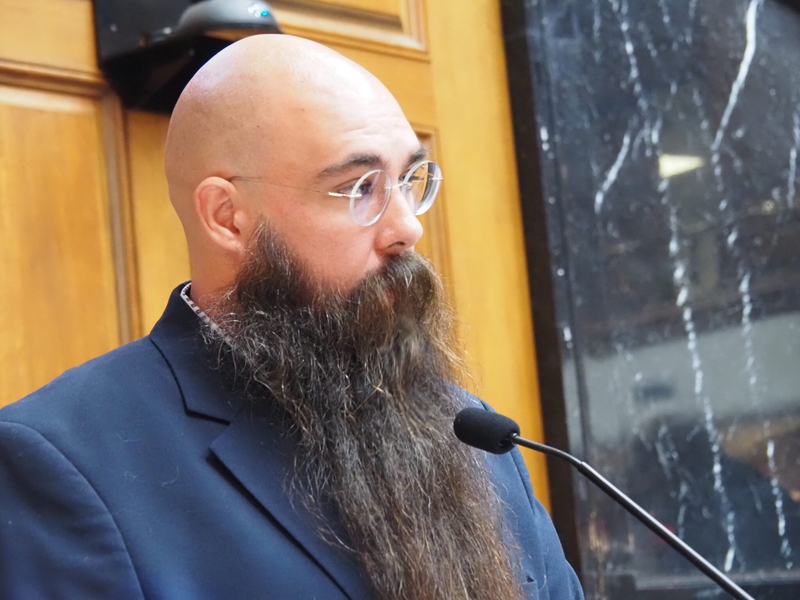
He suggested the Legislature ensure utilities have enough staff to meet baseline customer need and lower reliance on expensive out-of-state contract workers.
Others want NIPSCO to pay for lost food and medicine, skip charging customers for fixed costs over the time they had no service and improve its public communications. Several communities weren’t listed on storm restoration communications, which Parisi said was because NIPSCO didn’t have information.
“Even if the answer is, ‘We don’t know yet, we haven’t worked out a timeline for your city yet,’ some sort of communication has to be in place,” said Rep. Earl Harris, D-East Chicago. “This way, people at least have an idea.”
Indiana Utility Regulatory Commission Chair Anthony Swinger said the agency’s investigation into the storm response would include field hearings in northwest Indiana. He also encouraged customers to submit written comments, which become part of the case record.
Indianapolis, IN