Passing Medicaid ballot measure would reduce services and spike insurance costs, opponents say
Sep 29, 2026 | 5:13 pm ET
Description
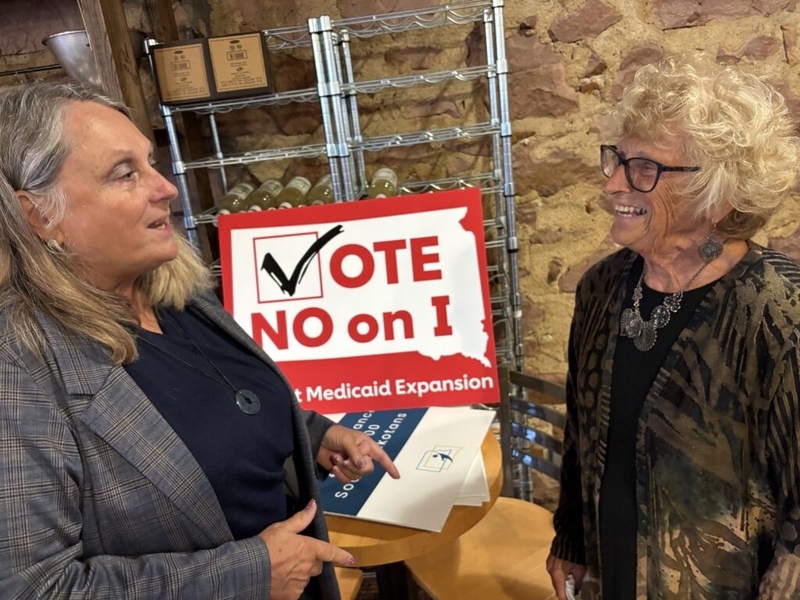
South Dakota Nurses Association President Deb Fischer-Clemens (left) and Republican Jean Hunhoff, a longtime nurse and former state lawmaker, chat after their coalition encouraging people to vote "No on I" host it's first press conference in Sioux Falls, South Dakota on Aug. 9, 2026. (Photo by Joshua Haiar/South Dakota Searchlight)
SIOUX FALLS — Opponents of a Nov. 3 ballot measure to end Medicaid expansion if federal funding is cut said Monday that the measure would reduce access to care and shift more health care costs onto people with private insurance.
South Dakota’s Republican attorney general and its opponents say Amendment I would automatically repeal Medicaid expansion if federal funding falls and no longer covers 90% of the program’s costs. Proponents say the measure allows lawmakers to consider repealing, altering or maintaining it if federal funding falls below that level.
The ‘No on I’ coalition is led in part by Republican Jean Hunhoff, a longtime nurse and former state lawmaker who served 24 years in Pierre, including as chair of the state’s budget committee.
Hospitals can’t turn people away because they are uninsured, she said. If people lose Medicaid and their ability to pay for care along with it, Hunhoff said, hospitals will need to charge other people more to make up their losses.
“They have to serve those patients, and they’re going to do it,” Hunhoff said. “But they are a business, too, and like any other business, they have to have the finances to be able to continue those services.”
Medicaid is a federal-state health insurance program for low income people. In 2022, South Dakota voters approved a citizen-initiated state constitutional amendment to extend Medicaid eligibility to adults with incomes up to 138% of the poverty level. The expansion capitalized on a federal law passed during the President Barack Obama administration that covers 90% of states’ expansion costs.
Because the expansion is part of the state constitution, only voters can alter it.
At a coalition press conference in Sioux Falls, Hunhoff and South Dakota Nurses Association President Deb Fischer-Clemens said Medicaid expansion provides health coverage to more than 31,000 South Dakotans and helps patients get preventive care and treatment before medical conditions become more costly emergencies.
“It is health insurance coverage for real people, real families and real communities across South Dakota,” Fischer-Clemens said.
Fischer-Clemens said the financial burden on hospitals would only grow as more preventive care and minor treatments become emergency room visits and surgeries.
Ballot measure could auto-repeal Medicaid expansion, attorney general says in contrast to lawmakers
Expanded Medicaid provides about $400 million annually to hospitals that would otherwise go unreimbursed, South Dakota Association of Healthcare Organizations President Tim Rave said. Without Medicaid reimbursement, more of that care would become charity or unreimbursed care, Fischer-Clemens and Hunhoff said, leaving hospitals to find other revenue sources or cut services.
“If you take that away, think about the future,” Hunhoff said.
The consequences of undoing Medicaid expansion would be particularly serious in rural communities, Hunhoff said, because those hospitals and clinics often operate on thin margins.
Those costs could ultimately be spread through higher private insurance premiums, too.
“The public will pay for these people’s health care, whether you cut Medicaid or not,” Fischer-Clemens told South Dakota Searchlight.
The federal government could warn states if it planned to cut the federal match rate, the measure’s opponents argued, giving lawmakers and voters time to address a hypothetical cut. But if they didn’t, Hunhoff said. programs would need to be cut or new taxes would be needed to pay for them.
Republican former Rep. Will Mortenson, of Fort Pierre, sponsored the bill to put Amendment I to a public vote. The issue is fundamentally about budget priorities, he said. If federal funding declines, lawmakers should have the flexibility to decide whether Medicaid expansion should continue, rather than protecting it ahead of other budget priorities, he said.
“This is about whether able-bodied people receiving welfare is a higher priority than, say, K-12 education,” Mortenson said.

Pierre, SD