State legislators make the case for a Nuclear Lifecycle Innovation Campus in Idaho
Sep 28, 2026 | 6:15 am ET
Description
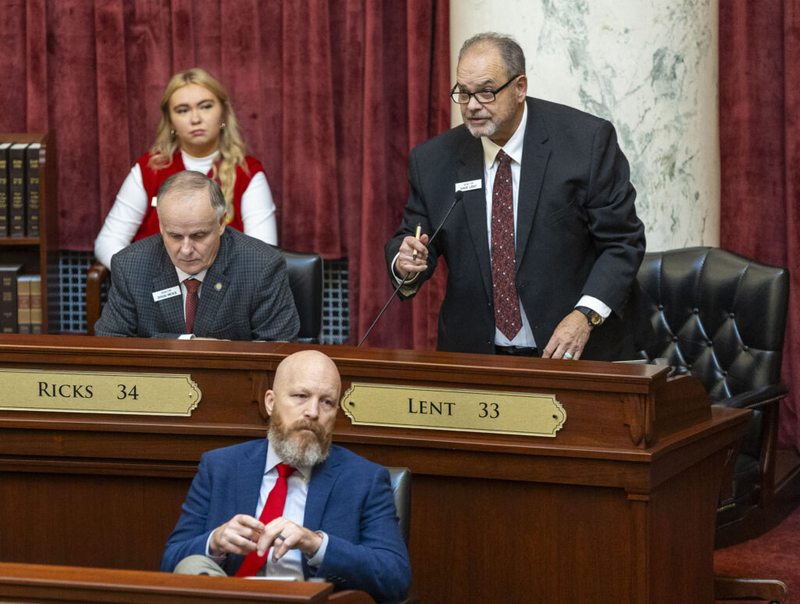
Idaho state Sen. Dave Lent, R-Idaho Falls, makes an announcement from the Senate floor on Jan. 7, 2025, at the State Capitol Building in Boise. (Phot by Pat Sutphin for the Idaho Capital Sun)
Editor’s Note: This is the second installment of a three-part Idaho Capital Sun series examining a proposal to bring a new Nuclear Lifecycle Innovation Campus to Idaho. Part one focused on Gov. Brad Little’s role in negotiations and his priorities for Idaho and is available online. The series concludes Tuesday with a closer look at the opponents who say they are against bringing the project to the state.
Idaho is in a uniquely strong position to host a Nuclear Lifecycle Innovation Campus because of the 75-year track record of research, safety and innovation at Idaho National Laboratory, says state Sen. Dave Lent.
Lent, R-Idaho Falls, is a retired nuclear facility training manager whose career was focused on protecting workers and the environment from radioactive materials at Idaho National Laboratory, or INL for short.
In nuclear campus talks, Idaho Gov. Brad Little says protecting Snake aquifer is ‘nonnegotiable’
But if Idaho is one of the handful of states selected for the federal U.S. Department of Energy project, it would require the state to accept and store spent nuclear fuel and radioactive waste. If three states are selected to host a campus, each state could be responsible for accepting approximately 33,000 tons of the country’s spent nuclear fuel and radioactive waste, said state Rep. Monica Church, D-Boise, who opposes the project.
But researchers and engineers at Idaho National Laboratory are already involved in much of the nuclear lifecycle work, such as taking spent nuclear fuel, reprocessing it and turning it into new fuel for a reactor, Lent said.
“If you look at all of the aspects, and that includes the workforce, the location, facilities and expertise, we are a standout (potential host site) there,” Lent said in an interview with the Idaho Capital Sun. “Our challenge is going to be helping our citizenry understand what high level waste is and how it can be handled safely.”
Officials at Idaho National Laboratory declined to be interviewed for this series of articles.
Lent isn’t the only legislator supporting bringing a Nuclear Lifecycle Innovation Campus to Idaho. Dozens of other lawmakers do, too.
More than 40 Idaho legislators voice support for nuclear campus
On Aug. 17, 46 of Idaho’s 105 state legislators wrote a letter in support of the innovation campus, telling Idaho Gov. Brad Little and Lt. Gov. Scott Bedke they would help the cause by pursuing bills, funding mechanisms and more.
“We will prioritize legislation needed to strengthen Idaho’s position, including funding mechanisms, permitting authority and workforce investments that keep pace with the timeline DOE has set,” the letter stated.
The two highest ranking legislators, Senate President Pro Tem Kelly Anthon, R-Rupert, and House Speaker Mike Moyle, R-Star, both signed the letter. Forty of the legislators who signed are Republicans. Two Democrats, Sens. Ali Rabe, D-Boise, and James Ruchti, D-Pocatello, also signed the letter to Little and Bedke.
“Idaho’s case for hosting this campus rests on decades of preparation,” the letter continued. “The Legislature is committed to matching that preparation with the policy support needed to see this through to a final decision, and to a successful campus if Idaho is selected.”
“We are probably the best equipped in the country because of our operating experience with spent fuel,” Lent added.
Some legislators say Nuclear Lifecycle Innovation Campus would be economic boon to the Gem State
“The benefit to Idaho is significant,” Lent said, calling the new campus the most secure new revenue source available to the state. “We’re talking about billions of dollars as revenue streaming into our state.”
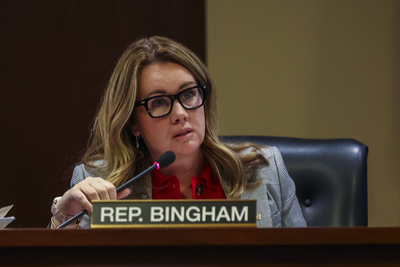
Rep. Erin Bingham, R-Idaho Falls, also believes the campus would support good-paying jobs for generations of Idahoans to come. In an op-ed, Bingham wrote that her children have grown up in a community positively shaped by the Idaho National Laboratory by having a “hometown identity built partly around being the place where nuclear energy was born.”
“Here’s what I actually want my kids to understand. Used nuclear fuel isn’t the same thing as high-level waste headed for permanent burial,” Bingham wrote. “It still holds most of its original energy value, and the entire point of the research NLIC would support is developing the technology to use that value again, shrinking both the volume of material that needs long-term management and how long it stays hazardous.
“That’s a research and manufacturing mission, not a dumping ground, and conflating the two doesn’t protect my kids. It just confuses them and their neighbors about what our hometown lab is actually being asked to do.”
While the Department of Energy, or DOE for short, says the new campuses would create thousands of jobs and attract financial investment, the states selected to host a campus will be required to accept shipments of radioactive waste and spent nuclear fuel for reprocessing from other states.
Church, a Boise Democrat, said the risk to the Eastern Snake Plain Aquifer and public health is too great to accept. She said Idaho should rely on and be guided by the 1995 Settlement Agreement between the state and the federal government that limits the amount of spent nuclear fuel and radioactive waste that can be brought into Idaho.
“The thing Idahoans need to understand most is that agreement is not only protecting Idaho writ large, it also is protecting our aquifer,” Church said. “It’s protecting our farmland, and it’s protecting our drinking water,”
Church called on state officials to continue to support Idaho National Laboratory’s overall research and mission while rejecting the DOE’s innovation campus proposal because of the shipments of radioactive waste.
Bingham wrote in her op-ed that residents and legislators should be asking hard questions about how the project would affect eastern Idaho, its environment and its people. But, she wrote, that doesn’t mean that those questions should prevent the state from exploring the benefits that the project could bring to the state.
“That doesn’t mean I think every question about this proposal is settled, and I wouldn’t tell my kids that either,” Bingham wrote. “Asking good questions is something I try to model for my children every day, and I expect our state to do the same here. But there’s a real difference between asking good questions and assuming the worst before the process has even played out, and I think a lot of the recent rhetoric has crossed that line.”
Lent said Idaho National Laboratory has proven it can do hard work safely.
“Idaho really has the expertise to do this, and we have the location and the facilities,” Lent said. “We would have to build larger facilities, but like I said, we are already doing this now and we really have the place to do it.”
Idaho legislator says risk is misunderstood, Idaho has track record of nuclear safety
During his career, Lent led training programs at Idaho National Laboratory and obtained national certifications. He said the risks associated with a Nuclear Lifecycle Innovation Campus and accepting spent fuel and radioactive waste are misunderstood and sometimes exaggerated by opponents of the proposal.
“We have an overamplification of the risk in our culture,” Lent said. “Most people don’t realize that every day they are exposed to radiation. There is radioactive material in the air we breathe; it comes from the earth and sky. The body has radioactivity in it naturally. We have an overamplification of risk, and I think it is up to us to help educate folks.”
Lent also said the understanding of nuclear materials and the approach to protecting the environment has evolved in the 30 years since Idaho reached the 1995 Settlement Agreement.
Lent said regulations are stronger, science has advanced and measurements are much more precise than they were decades ago.
That’s not to say public safety isn’t Lent’s priority.
This summer, Lent participated in meetings between Department of Energy and Idaho state officials discussing the Nuclear Lifecycle Innovation Campus. One meeting was in Chicago in August with the other states in the running to host an innovation campus and another was in Little’s office at the Idaho State Capitol in Boise, Lent said.
“We had a pretty frank discussion about nonnegotiables and what our expectations were as a state,” Lent said.
“I usually start every discussion with the fact (that) ‘we have two nonnegotiables when we talk about doing work in Idaho,” Lent said. “The first is absolutely protecting the people of Idaho and their health and the second is protecting the environment in Idaho and keeping it the way it is. Those are nonnegotiable, and where we start all our discussions with.”
On Wednesday, Little told the Idaho Capital Sun that protecting the Eastern Snake Plain Aquifer and the health of Idahoans are also nonnegotiable issues for him.
To legislators like Bingham, exploring the possibility of being a host site to a campus also protects the state’s economic possibilities that could come with more federal investments and funding into nuclear energy.
“My kids are growing up in a community that helped launch the nuclear age and could help lead its next chapter,” Bingham wrote. “I’d rather they grow up believing that’s something to be proud of, backed by real facts, than absorbing fear stirred up by people who don’t have to live with the consequences of getting this conversation wrong.”
Boise, ID