Foster care official says Kansas should be ‘laser focused’ on Wichita’s placement crisis
Sep 25, 2026 | 9:00 am ET
Description
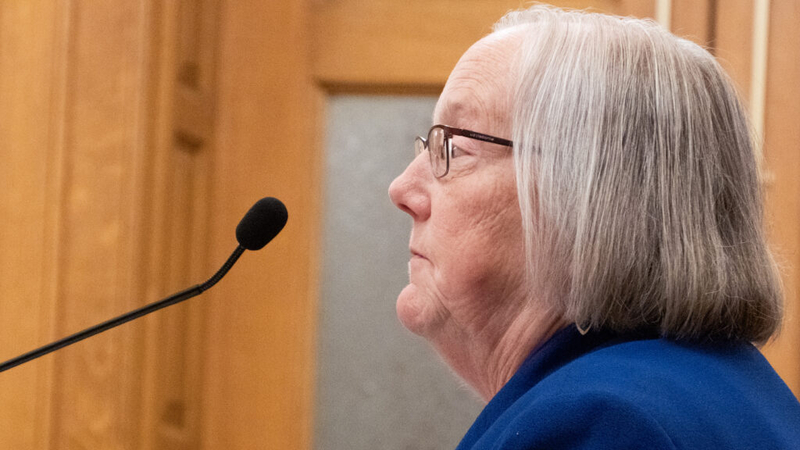
Laura Howard, secretary of the Kansas Department for Children and Families, speaks at a June 10, 2025 hearing before the Senate Committee on Government Efficiency. (Photo by Anna Kaminski/Kansas Reflector)
TOPEKA — Kansas’s top foster care official said the state should be “laser focused” on Wichita to improve a youth placement measure that has consistently fallen short of court-ordered standards.
Foster care contractors in Sedgwick County, where Wichita is located, have continuously struggled to place children in housing instead of offices or unlicensed beds. Since 2024, numbers have deteriorated.
Laura Howard, secretary of the Kansas Department for Children and Families, told a legislative committee that in 2025 the “failure to place” metric worsened for the second year in a row in Sedgwick County. It appears on track to do the same in 2026. Failure to place refers to how often foster care contractors let kids sleep in an unlicensed environment.
She reviewed for the committee a recently released independent report that analyzed the entire state foster care system’s performance based on measures set by a court-mandated settlement agreement, which requires the state to seek better outcomes for foster children in 10 categories.
According to the report released Wednesday that analyzed 2025 data, 136 children spent a cumulative 870 nights without a proper place to stay in Kansas, and 94% of those were in Sedgwick County. In 2024, 100 children spent 316 nights without a placement. Again, most of those kids were in Wichita. In 2023, 57 children spent a total of 83 nights without a placement.
EmberHope Connections, the faith-based agency that took over as the state-contracted foster care organization in Sedgwick County in 2024, has struggled to make improvements, and it recently brought on a new president, Dee Nighswonger.
Numbers for 2026 show a worsening problem. Publicly available data reveal that as of Aug. 31, there have already been 1,163 nights when DCF has failed to place children. An estimated 96% of those instances were in Sedgwick County.
Howard said the state needs to be “laser focused” on Sedgwick County to address the issue, which she acknowledged is one that the state has discussed in recent years.
“I think it’s a larger issue than the case management provider and DCF,” she said.
Erica Case, an attorney for EmberHope, said Thursday that Kansas can improve its foster care system by limiting entry to children experiencing abuse, neglect or immediate safety concerns; prioritizing workforce retention; creating specialized family treatment courts for people in the criminal justice system for drug use; and expanding options for young adults with complex needs from intellectual and developmental disabilities.
The organization appears to be looking upstream, attempting to focus on solutions that can prevent children from entering foster care in the first place.
The number of kids entering care has increased in Sedgwick County almost every quarter since EmberHope took over, Case said.
“I understand that Sedgwick County is risk averse, and I’m fine with that,” Case said, “but we have to reimagine those prevention pathways to make sure that we truly are reserving out-of-home care for those that have been abused, neglected or are in immediate danger.”
The annual, court-mandated report of the state of Kansas’ foster care system showed some improvements, allowing it to be released from court supervision in four areas, pending a judge’s approval.
But Leecia Welch, chief legal counsel at Children’s Rights, said “the picture remains grim for far too many children in Kansas.”
“Defendants are failing to provide some children with even a safe place to sleep for the night, much less the stable, supportive homes they deserve,” Welch said. “In their own words, children describe ‘being treated like cattle.’
Topeka, KS