Nebraska can cut property taxes. It can’t eliminate the bill.
Sep 23, 2026 | 11:06 am ET
Description
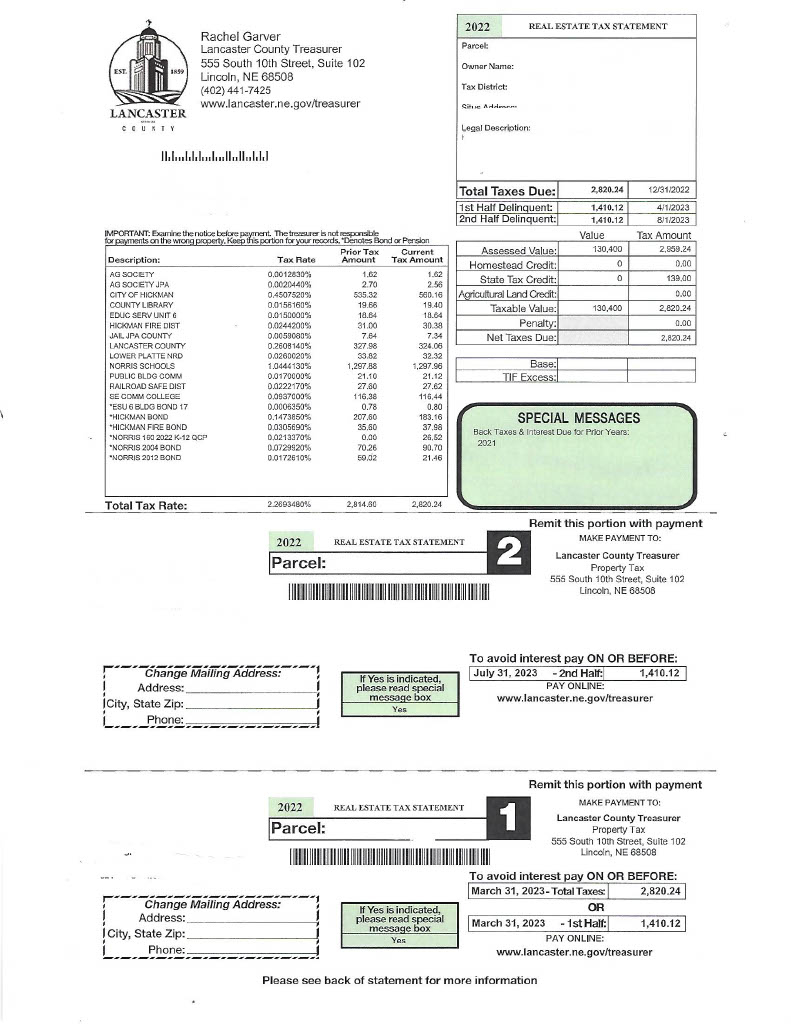
A tax statement with 'special messages' box regarding past due taxes. (Courtesy of Lancaster County Treasurer)
Affordability is on nearly everyone’s mind. With homeowners and prospective homeowners looking for every way they can to save on the necessities of life, it is only natural to consider that expense that is itself a perennial topic in Nebraska: how to reduce the property tax burden. But lowering property taxes is not easy, and the simplest-sounding solutions come with hard compromises for our communities. When property tax revenue declines, so does the funding available for the local services and investments that shape our daily lives.
In Nebraska last year, $5.6 billion of property taxes was levied in Nebraska:
- $3.3 billion was levied in support of local school districts, including bonded indebtedness.
- $975 million was levied for counties.
- $653 million was levied for cities.
- The remainder was levied by townships, fire districts, natural resource districts, educational service units, community colleges and miscellaneous districts like libraries and ag societies.
While the state of Nebraska partially offset those levies with over $1 billion of relief (through mechanisms like the property tax credits and the homestead exemption), that is still a lot of money for a state of just over 2 million people. Nearly every dollar raised through property taxes, however, stays in the local economy, funding the local workforce and purchasing local goods and services.
Strong schools. Safer neighborhoods. Reliable roads. Modern libraries. Parks and recreation. Emergency services. These are not abstract benefits. They are the foundations of thriving communities, and property taxes pay for them.
In Nebraska, the property tax debate affects more than homeowners. Farmers, ranchers and rural communities also feel the pressure of property taxes. Local property tax revenue helps support the critical infrastructure urban and rural Nebraska communities depend on. For homeowners, property taxes assess an illiquid household asset; for farmers and ranchers, they tax the productive land required to make a living. As Nebraskans consider additional property tax relief, the challenge is not simply how to lower the tax bill, but also how to ensure our communities can continue funding the services and infrastructure Nebraskans demand.
Eliminating or significantly reducing property taxes does not eliminate the cost of providing public services. It simply shifts that cost somewhere else and through a different revenue source. A common refrain is that local governments need to “tighten their belts,” as if local governments can simply disregard duties and services mandated by the state. Further, if things that impact our quality of life are reduced or eliminated in the name of property tax relief, we have seen those communities less and less likely to retain the next generation of citizens and property owners.
Alternatively, shifting funding to sales or income taxes introduces severe budget volatility, as these revenues generally fluctuate more with economic conditions, making long-term budgeting more difficult.
Property taxes offer something especially valuable: stable, locally controlled and locally invested funding. Residents elect the officials who set budgets and tax rates, giving taxpayers a far more direct role in how their community’s money is raised and spent, as opposed to asking the state legislature for money to fix a bridge or to hire a special education teacher. Locally elected officials want lower property taxes, too. They live in the communities they serve, own property and pay the exact same taxes they levy.
That local connection matters. It allows communities to set priorities based on their own needs rather than relying more heavily on decisions made at the state level. Replacing local tax authority with state funding or other revenue sources inevitably shifts decision-making to the state Capitol. As the old saying goes, “Whoever has the gold makes the rules.”
Property taxes are more than a line on a tax bill. They are one of the primary tools communities use to invest in the places people call home. As we consider property tax reform for Nebraska, the most important question is not “How much should we cut?” but more accurately, “What do we need to pay for, and who should pay for it?”
A sustainable path forward requires two things:
- Broadening our economic base: Growing local business, housing and agricultural development allows the cost of essential services to be shared across more people and more property, lowering the individual burden naturally.
- Aligning state and local responsibilities: If the state asks local property owners to carry duties that are statewide in scope, the state should assume and fund them. Conversely, if certain local programs are deemed too expensive for local taxpayers to sustain, communities should have the choice to scale them back locally.
At the end of the day, basic infrastructure and public safety are expensive needs. Meaningful property tax relief begins with growing our communities and conducting an honest assessment of local government’s responsibilities – not an uncalculated shift of the bill.
Lincoln, NE