‘Go and Do Likewise:’ Beshear’s book touts Christian values (except when it comes to Bevin)
Sep 23, 2026 | 11:38 am ET
Description
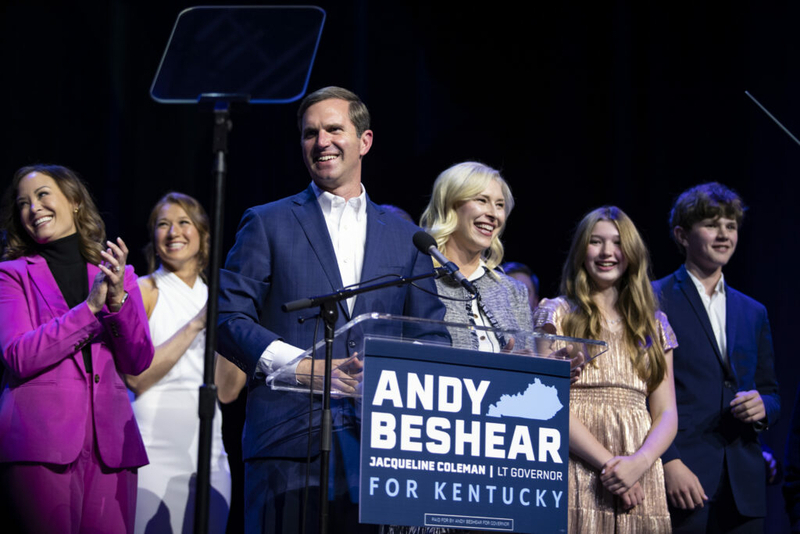
Democratic Gov. Andy Beshear, flanked by Lt. Gov. Jacqueline Coleman and his family, takes in the celebration at his reelection party on Nov. 7, 2023, in Louisville. (Austin Anthony/Kentucky Lantern)
If there are one or two of you out there who still have doubts that Gov. Andy Beshear will run for president in 2028, doubt no more. This week, he officially released “Go and Do Likewise: How We Heal a Broken Country,” joining the Presidential Hopeful section of your local bookstore already stocked with choices such as “Young Man in a Hurry: A Journey of Discovery” by Gavin Newsom, “Where We Keep the Light: Stories From a Life of Service” by Josh Shapiro, “Crisis of the Common Good: The Fight for Meaning and Connection in a Broken America,” by Chris Murphy. You get the idea – first you set up a PAC, then write a book with a colon in the title and you’re halfway to New Hampshire.

Luckily for these busy men, 1) Donald Trump has provided an excellent opening to talk about such hopeful, healing topics, and 2) there are many talented ghost writers out there. Mark Tabb, who is thanked by Beshear in the acknowledgements, keeps a light touch and a fast pace with the greatest hits of the Kentucky governor.
Luckily for Tabb, Beshear has a truly unusual number of high-drama moments from his years in office, which also provide him with excellent examples of his Biblical themes, the good Samaritan etc. From COVID to the West Kentucky tornadoes to the Eastern Kentucky floods, Kentuckians shine in crises – neighbors helping neighbors – in all the ways that are antithetical to the Trumpist individualism that has poisoned our public discourse.
Trump will not be on the ballot in 2028 (we hope) so it’s interesting the book is so focused on him, but it’s clear that Trumpism is what Democrats will have to continue to run against, and thus is how Beshear has structured the book. (He may not have imagined Trump’s polls being this low as he and Tabb wrote it.)
Luckily for us readers, Beshear is not so filled with the Holy Spirit that he leaves out any thoughts of payback. Kentucky’s favorite bad guy, former Gov. Matt Bevin, is referred to throughout as Trump Lite, and their political tussles are highlighted with more candor than previously encountered.
There is, for example, the time then-Attorney General Beshear was crossing the Capitol parking lot when he ran into then-Gov. Bevin, and chastised him for not doing his job after a Louisville child was hit by a stray bullet.
“Eyes wide, Bevin leaned toward me and snarled, ‘Spare me your talking points. If you want to get political, I’ll knock your f—— head off!’
I stared directly into his bugged-out eyes. ‘Are you threatening me, Governor?’ I said as calmly as I could but, raising my voice, added, ‘Cause I don’t take kindly to being threatened.’
He shot back, ‘I didn’t threaten you.’
‘You just said you’d knock my head off,’ I replied. I could see in his face Bevin knew he’d made a mistake, not that he’d admit it. Ever. Instead, he shook his head and scoffed, ‘Is this how you people act?’”
It turns out “you people” are Democrats, and Beshear uses the moment to further explore the ongoing political divide expertly manipulated by Trump and the ever charming Trump Lite.
But Bevin is not the only politician who doesn’t like to admit he made a mistake. In the book, Beshear mentions only a few of his own, such as Tupac Shakur’s unemployment application during COVID. He does not write about the entire debacle over unemployment benefits, or the many problems in his Department of Juvenile Justice so aptly documented by the Lexington Herald-Leader, or the various travesties around the Kentucky Wired program.
But generally speaking, people writing books before they run for president aren’t going to explore those themes.
The most affecting chapters are about abortion rights advocate Hadley Duvall, who almost certainly made the difference in his second gubernatorial election, the mass shooting at Louisville’s Old National Bank that killed one of his closest friends, and America’s civil rights history, and the removal of the Jefferson Davis statue from the Capitol.
I think it’s smart of Beshear to talk about his faith because so many people perceive the Democratic Party as one full of atheists; his willingness to talk about God is part of what has created a genuine rapport with Kentuckians. One of Beshear’s greatest strengths is his ability to do the right thing while seeing clearly how to reap political rewards from it. For example, his daily COVID briefings brought real comfort to thousands of people, and beamed his awkward dad jokes and Mr. Rogers persona into an indelible image that clearly helped him win a second term in a deep red state.
What’s still unclear is whether Beshear, despite the sharp political instincts and prodigious fundraising, has the charisma to appeal to people outside Kentucky, and whether this book will help him do so. He’ll sell plenty of copies; on Wednesday, Tom Loftus reported that in addition to the Kentucky Democratic Party spending $10,000 to buy books, Beshear’s PAC, In This Together, bought $9,000 worth of them. Will your average voter in Iowa or South Carolina join this group? In the runup to a presidential campaign, does it even matter?

Frankfort