RI judge reverses Trump administration’s cancellation of $7B solar grant program
Sep 21, 2026 | 12:21 pm ET
Description
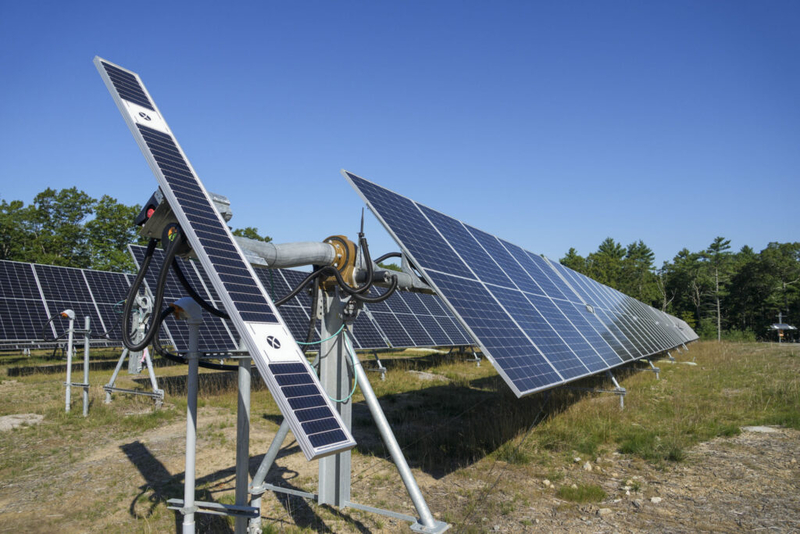
The 6.5 megawatt Exeter Mail solar farm, completed in September 2025, lets homeowners and renters access the benefits of renewable energy even if they can't put solar panels on their roofs. A $7 billion federal grant program seeks to further expand solar access for low-income property owners and renters. (Photo by Laura Paton/Rhode Island Current)
More than a year after federal regulators abruptly canceled a $7 billion solar energy grant program — with funds already distributed and even partially spent — a Rhode Island federal judge has ordered them to revive the program.
But it’s too early for the group of union laborers, solar panel installation companies, homeowners and nonprofit advocates who filed the complaint in October 2025 against the U.S. Environmental Protection Agency to declare victory
“The result is maddeningly difficult to talk about what happens next because we just don’t know what they’ll do,” said Kevin Hubbard, executive director of the Lawyers’ Committee for Rhode Island, one of the attorneys for the plaintiffs.
The 20-page order issued on Friday by U.S. Judge Mary S. McElroy of the U.S. District Court for Rhode Island determines that the federal agency overstepped its statutory authority when it ended the $7 billion Solar for All grant program in August 2025.
Originally included in the 2022 Inflation Reduction Act, the Biden-era incentive program sought to make solar panels more widely accessible by offsetting the installation costs for low-to-moderate-income homeowners and renters. Funding was distributed in 2024 to state and local governments, nonprofits, and tribal organizations, including a $49.3 million allocation to Rhode Island through the state’s Office of Energy Resources.
Many funding recipients, including Rhode Island, had already set up the framework to begin giving out the money to eligible applicants, with union laborers and solar development companies at the ready for an expected 200,000 jobs over the course of the five-year program. The grants were expected to help $900,000 households nationwide save $350 million annually on their energy bills, according to prior estimates from the Biden administration.
“This will be a really big deal for solar deployment in Rhode Island,” said Patrick Crowley, president of the Rhode Island AFL-CIO, which was one of the plaintiffs in the suit. “This program could really be a gamechanger for meeting our Act on Climate goals.”
The 2021 decarbonization law requires the state to reach net-zero emissions by 2050, with incremental benchmarks starting in 2030. Based on the 9.52 million metric tons of net greenhouse gas emissions measured in 2023, Rhode Island would need more than 25,000 megawatts of solar, wind and other renewable powered-electricity to reach net zero. Including the 400 megawatts from the nearly finished Revolution Wind project, the state has 1,418 megawatts of clean energy capacity. As of the second quarter of 2026, the 1,418 RHode Island’s renewable energy portfolio
The prospect of advancing Rhode Island’s renewable energy while boosting the local economy through the Solar for All program never materialized, almost immediately thrust into limbo when President Donald Trump took office in January 2025, and ended permanently by the EPA via a social media video published Aug. 7.
The AFL-CIO, accompanied by other nonprofit and business groups, sued in October 2025.
Federal environmental regulators pointed to the “One BIg Beautiful Bill Act,” signed into law on July 4, which rescinded the congressional authority for the program and clawed back any unspent funds, as justification for the termination.
McElroy rejected this interpretation.
“Defendants’ preferred approach runs contrary to Congress’s clear intent that already obligated Greenhouse Gas Reduction Fund monies, including SFA grants, not be disturbed by the repeal of Section 134,” she wrote. “They provide no legal authority for their proposition that the obligated SFA funds were somehow converted into lump-sum amounts untethered to the program for which they were originally appropriated.”
Although McElroy threw out the cancellation order, she didn’t specify how federal administrators should revive the solar grant program.
The “ideal” outcome, said Hubbard, would be that the federal agency allows the program to continue through the recipients already awarded grant funds. But, it could decide to start anew, forcing recipients to reapply for the competitive funding and delaying the entire process of putting more solar panels on rooftops.
Based on the Trump administration’s actions in almost every legal challenge it has encountered, Hubbard is expecting federal regulators will appeal McElroy’s order anyway.
An unidentified spokesperson for the EPA said the agency is “reviewing the decision and considering options for appeal.”
If and when the case is finalized and funds are released, Crowley said there are electricians, iron workers and laborers ready to jump in on the jobs.
“We already have trained tradespeople to start doing this work,” he said, noting that renewable energy sector jobs have dried up since the change in presidential administrations.
There were more than 15,000 clean energy jobs in Rhode Island as of January 2025, according to an August report by Rhode Island Office of Energy Resources. The job count, which does not reflect any changes to the state economy since Trump took office, marked the highest industry employment in five years, buoyed by large increases in heating and cooling jobs thanks to a state rebate program for residential heat pumps. Wind and solar employment stayed relatively flat year over year, the report showed.
But the state needs clarity on the outcome of the Solar for All complaint before it can proceed with Rhode Island’s $49 million grant, Robert Beadle, a spokesperson for the Office of Energy Resources, said in an email.
Other plaintiffs in the lawsuit include the Rhode Island Center for Justice, which had increased its staff of public interest attorneys in preparation for the grant rollout; a Georgia homeowner who applied for free solar installation; and businesses and nonprofits that work on solar panel installation, financing and education.
“Our low-income clients continue to face ever-escalating housing and utility costs, Jennifer L. Wood, executive director of the Rhode Island Center for Justice, said in a statement. “This is a major step toward restoring an important path to utility affordability for Rhode Islanders struggling to afford stable housing and access to utilities.”
The Southern Environmental Law Center, Lawyers for Good Government and the Conservation Law Foundation also represented the plaintiffs.
- 1:52 pmUpdated to include responses from the U.S. Environmental Protection Agency and the Rhode Island Office of Energy Resources.
Providence, RI