Can Oregon’s top federal prosecutor balance Trump’s priorities with the law? He says ‘yes.’
Sep 21, 2026 | 9:00 am ET
Description
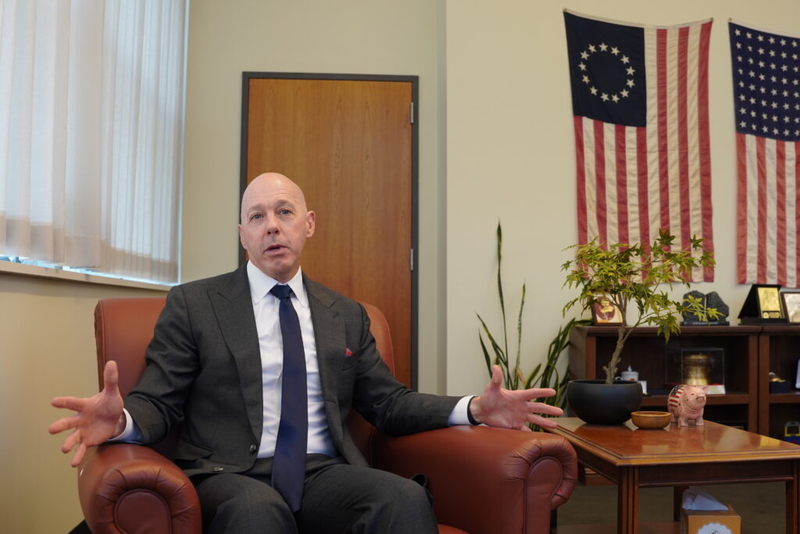
Scott Bradford, U.S. Attorney for the District of Oregon, sits in his office in downtown Portland. He recently sat down for an interview to discuss his record and cases taken by his office. (Photo by Shaanth Nanguneri/Oregon Capital Chronicle)
As the newest top federal prosecutor in Oregon under the Trump administration, Scott Bradford has forged alliances with some of Oregon’s top local prosecutors, Oregon Attorney General Dan Rayfield and Portland Police Chief Bob Day. He has also taken aim at one of the state’s signature first-in-the-nation policies which those law enforcement officials must uphold.
Former U.S. Attorney General Pam Bondi tapped Bradford last July to serve as Oregon’s U.S. attorney, following his 18-year career with the U.S Department of Justice tackling cases over issues such as white-collar and cyber crime. But under Bradford’s watch, the U.S. Attorney’s Office in the District of Oregon has changed how it publicizes cases involving immigrants without legal status.
“Illegal Alien from Mexico Sentenced for Immigration Violation,” reads one recent press release from his agency. Another? “Honduran National Unlawfully Residing in the United States Sentenced to 21 Years in Federal Prison for Distribution of Fentanyl Resulting in Death.” No national backgrounds are emphasized for convicted citizens, who instead are identified by their city of residence.
Bradford said he made that change to raise alarm over Oregon’s sanctuary policies, a unique target of the Trump administration for barring jails and prisons from holding people with violent criminal records for immigration authorities to come arrest them without a court order. Yet neither Bradford nor the White House has offered any evidence or statistical data showing that immigrants are more likely to re-offend or commit crimes, a step he described as unnecessary in a recent interview with the Capital Chronicle.
“I’m not trying to say a particular segment of society is more likely to commit a crime or is more likely to reoffend,” Bradford said from his Portland office. “What I’m saying is we have specific examples in Oregon where the person should have been deported, and they weren’t, and they victimized another Oregonian, a family, a woman with minor children.”
The fine line Bradford draws between evidence and rhetoric underscores the challenges facing a career law enforcement official who serves an administration that civil and immigrant rights groups have routinely criticized for using the courts as a tool of retribution.
More than 40 Oregon-based Justice Department staff have left the agency since 2025, according to federal data from the Office of Personnel Management, many of whom are career-prosecutors part of a nationwide exodus from the agency.
Bradford argues that his work has not always been well understood by the public.
“What the public never knows are the cases that we decline each and every day because there was a constitutional violation or some other related issue,” Bradford told the Capital Chronicle. “Maybe there were some equities in play, and that person shouldn’t be charged.”
Not all of Trump agenda is getting action
Bradford, a career attorney who has spent 13 years in the Portland-based U.S. Attorney’s Office, has cultivated partnerships with district attorneys statewide and local police in Portland. He is eager to speak about his office’s work on issues such as child protection, drug trafficking, fraud and national security.
But when asked about the Trump administration’s push last July to charge Portland-area protesters for doxing federal agents, he cast doubt on his ability to do so. While he said he has witnessed doxing affect his staff as well as federal agents, his office hasn’t charged anyone for stalking or the unlawful release of a federal official’s personal information.
“Because people can anonymize their identities on the internet, it can be difficult to prove,” he said. “A lot of them are right on the line of speech versus criminal conduct.”
The U.S. Attorney’s Office in Oregon has also charged more than three dozen of the thousands of protesters who have demonstrated outside Portland’s waterfront U.S. Immigration and Customs Enforcement facility. It is arguing one of three recorded cases involving felony assault against a federal officer nationwide that is going to trial, in comparison to dozens of cases nationwide where charges were either dismissed or lowered to a misdemeanor, according to a recent analysis by the Associated Press.
That phenomenon has also played out recently in Portland. Bradford’s office bumped down felony charges to a misdemeanor to secure a plea agreement this month of 39-year-old clarinet player Oriana Korol, who prosecutors said kicked and bit a federal officer in the arm during her October arrest outside the Portland ICE facility.
“I don’t think anyone could find fault with any of the cases or any of the positions that we’ve taken. They’re all righteous,” Bradford said. “If you look at the cases we’ve done since the election, they’re the cases we’ve traditionally done. Our priorities under this administration are the priorities that we’ve always had.”
State-federal relationships
At the main entrance of his office, traces of the federal administration are evident. Portraits of Vice President JD Vance and Trump hang behind the front glass, while another sign outside the entrance encourages people to read up on their rights as victims of crime. Bradford speaks positively of his relationships with local law enforcement as well as an “open line” of communication with Rayfield, whom he refers to by his first name.
“We work very well together on shared priorities,” he said, “and then there are just different areas where we’re gonna disagree.”
Perhaps no conflict between state and federal law enforcement highlighted those differing priorities than the January U.S. Border Patrol shooting in Portland, a day after an ICE agent fatally shot 37-year old Renee Nicole Good in Minnesota.
The incident raised questions about whether Oregon’s local and state prosecutors would be able to access evidence related to the shooting for potential criminal investigations into violations of state law by federal agents, given the challenges law enforcement in Minnesota faced accessing similar evidence. Federal defense attorneys for one of the individuals shot, 33-year-old Luis Niño-Moncada, have alleged that a Portland police officer stopped a federal agent from removing evidence from the scene of the shooting in a hospital parking lot.
Niño-Moncada, meanwhile, pleaded guilty and received time served last week for depredation of federal property, but federal attorneys dropped an original charge of aggravated assault against a federal officer. Bradford’s office also backed away in court from claims by the U.S. Department of Homeland Security alleging the Venezuelan nationals U.S. Border Patrol shot in Portland in January were tied to a transnational gang.
Bradford told the Capital Chronicle that he cooperated with Rayfield, Portland Police Chief Bob Day and Multnomah County District Attorney Nathan Vasquez after the shooting, which the Oregon Department of Justice is investigating on its own. He declined to speak about specific forms of evidence he shared with Oregon law enforcement.
“I was very transparent with Dan, Nathan, and Chief Day, and coordinating with them about our findings, the evidence, and where things stood, and what we found and believed happened, and what we were going to do, what action we were going to take,” Bradford said. “That’s a great example of ‘we took the lead.’ They had questions, but we coordinated.”
Salem, OR