Wisconsin Supreme Court hears challenges to congressional maps
Sep 16, 2026 | 5:34 pm ET
Description
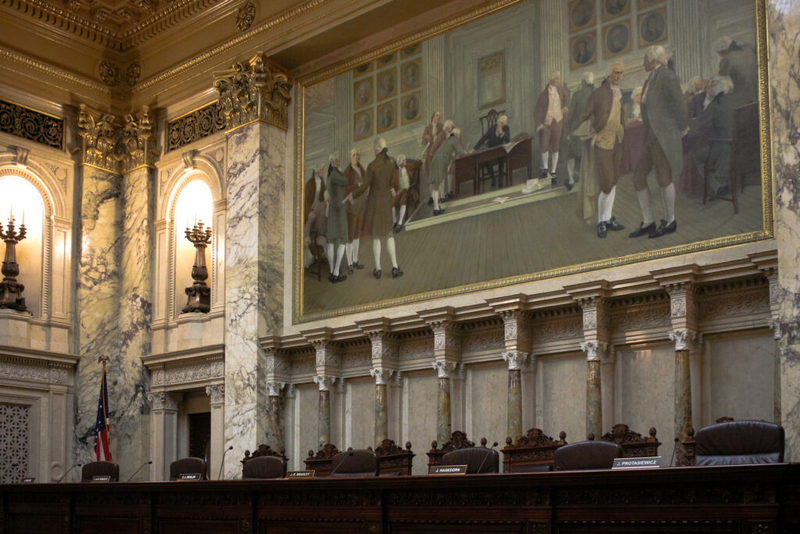
The Wisconsin Supreme Court chambers. (Photo by Henry Redman/Wisconsin Examiner)
The Wisconsin Supreme Court on Wednesday heard oral arguments in two cases challenging the constitutionality of the state’s congressional maps. One challenge is based on the claim that the maps unfairly benefit Republicans and the other is on the grounds that the maps are intentionally anti-competitive to protect incumbents.
Both cases were previously dismissed by panels of three circuit court judges. In both, the Court is not deciding the merits of the arguments but determining if the circuit panels were correct to dismiss the cases. If the Court determines that the dismissals were incorrect, the cases will be sent back to the circuit court level for discovery and trials on the merits of the argument.
Because of that process, neither case will change Wisconsin’s maps ahead of this year’s midterm elections, but could install new maps ahead of the 2028 elections.
Wisconsin’s congressional maps were instituted by the Court in 2022 after Gov. Tony Evers and the Republican-controlled Legislature were unable to reach a compromise on new maps. In that case, the Court installed a “least change” principle in which the newly proposed maps had to match as closely as possible to the maps instituted in 2011 — which were widely considered to be the most gerrymandered in the country.
The maps selected by the Court in 2022 were drawn by Evers, but followed the least change standard. Democrats and fair maps proponents have argued the least change standard poisoned the maps while Republicans have said the argument falls flat because a Democratic governor created them.
Wisconsin’s congressional maps have repeatedly been challenged since the initial 2011 gerrymander and since the 2022 update.
In the first part of the day, the Court heard the arguments of the partisan gerrymandering challenge, in which attorney Abha Khanna said that the Wisconsin Constitution’s equal protection clauses give voters in the state protection against maps designed to benefit one party.
“Was partisan vote dilution the predominant purpose? Was that in fact the effect of the map, and is there any legislative justification outside of sheer partisan dominance that would justify the configuration of these districts?” Khanna said.
A trio of attorneys argued in favor of the existing congressional maps, saying that the lawsuit was brought so late in the decade it can’t be litigated in the courts anymore, that if the Court wants to rule that partisan gerrymandering isn’t allowed then this case isn’t the right one and that the lawsuit doesn’t give a good enough standard for assessing what counts as an extreme partisan gerrymander.
During the first arguments, the two conservative justices on the panel expressed skepticism with the claim that the state Constitution protects against partisan gerrymandering.
“I actually don’t care what happens in other states. I don’t care at all. I care about our Constitution and our laws and what our law says,” Justice Brian Hagedorn said.
“I know that some states have explicit prohibitions against partisan gerrymandering, however that’s defined. I don’t know what that means,” he added. “But you’re asking for us to just invent a new right that has never been recognized, that even though our founders were well aware of it, as even your own brief recognizes, from the time of our founding, but have never addressed. And you’re appealing to just democratic self-governance, not our actual Constitution, your just sense of what democracy ought to protect.”
The Court’s liberal majority appeared to give some deference to the argument that the lawsuit didn’t properly set up how to assess the extent of a partisan gerrymandering claim, but often got into extended back and forths over the harm that partisan gerrymandering represents.
Luke Berg, one of the attorneys arguing to protect the existing maps, said in an exchange with Justice Chris Taylor that partisan gerrymandering “doesn’t implicate the right to vote.”
“How can you say that there is no remedy if it’s demonstrated that partisanship has led to the dilution of the disfavored group’s vote?” Taylor said. “It makes no sense to me, if our whole government is derived from the people, and the power that they give is through the vote, that’s how the people give the power to the government. And so if their right to vote is diluted because of partisanship, I just don’t understand why you’re saying we have no ability as a state court to remedy that.”
Khanna said Republicans, including some of the attorneys arguing the case in Madison on Wednesday, have made the exact opposite arguments in other states and that they’ve argued map opponents aren’t following the proper process no matter which process is followed.
“What we’ve seen from just the last couple of years, and frankly, from this argument, where intervenors have said, ‘Oh no, you can’t do this. Oh, you can’t reopen Johnson. Oh wait, you can’t hear this original action. Oh wait, you can’t appoint a three-judge panel. And now that you have appointed a three-judge panel, you can’t hear this appeal,’” she said. “These are just part and parcel of their strategy, which has been to draw this out, and now they say, ‘you know what? The decade’s almost over. There’s really nothing more that this court can do.’”
In the second part of the day, attorney Nicholas Stephanopoulos argued that the congressional maps are illegally anti-competitive.
“Our position here is a straightforward one,” he said. “Wisconsin’s Constitution does not tolerate officeholders entrenching themselves in power and cutting out the people by suppressing electoral competition.”
But liberal and conservative members of the Court appeared confused by the distinction between a map that is anti-competitive and a map that is gerrymandered to benefit one party.
“Because it seems to me that what’s underlying that is that the district lines are drawn in such a way to have it be a foregone conclusion that a particular party will win that district, and so I don’t see a whole lot of airspace between this claim and the partisan gerrymandering claim,” Justice Susan Crawford said.
Stephanopoulos said the difference is that a map drawn to be anti-competitive isn’t concerned with which party wins.
“It’s relevant what the odds of re-election would be for a candidate, but the anti-competitive theory is uninterested in which party actually,” he said.
But opponents argued that designing maps to be as competitive as possible comes with trade-offs that might not be ideal.
“There is a fundamental tension when you maximize for competitiveness or you increase for competitiveness, you are taking away other legitimate values such as representation, such as incumbency protection, such as bipartisan agreement,” Misha Tseytlin, an attorney for Wisconsin’s Republican members of Congress, said. “If you make a map more competitive, then you make it less likely that their incumbents will retain their seats. You also make it more likely that a larger number of the constituents of a particular district are going to be unhappy with the result. There is a legitimate policy dispute as to whether more competitiveness or more representation, incumbency protection is better. Nothing in the Constitution’s text, history, or discourse precedent settles that question as a matter of text.”
Madison, WI