Kansas Constitution Day program goes global with online mock trial for third graders
Sep 16, 2026 | 4:49 pm ET
Description
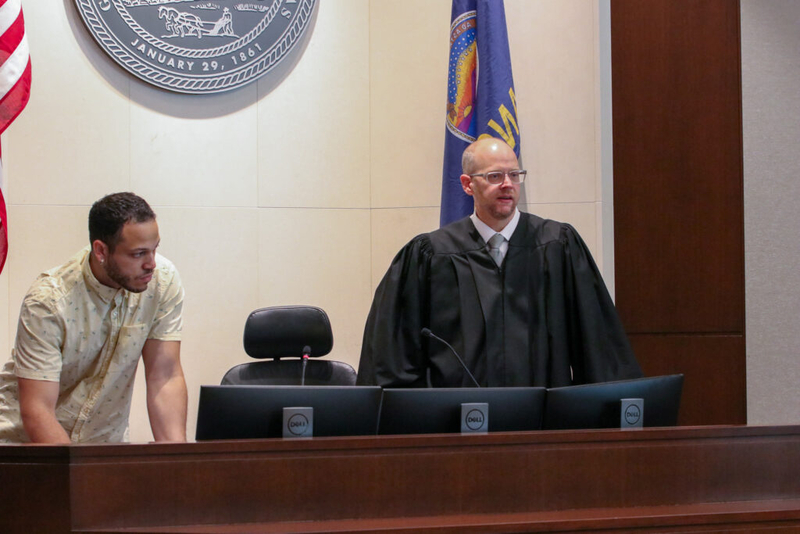
Judge Robert Wonnell presides over a 2025 mock trial held on Constitution Day to teach third graders across the country about the court system. (Photo by Kansas Courts)
TOPEKA — Twelve years ago, 90 third-grade students walked into District Judge Robert Wonnell’s courtroom on Constitution Day to watch a hearing about whether Goldilocks was guilty of trespassing.
Wonnell put the last-minute mock trial together to teach Olathe’s Forest View Elementary School students about how the court system works. Because he loves teaching, he researched how such an event could be conducted every year.
Wonnell’s research led him to an even stronger commitment when he found that it is written in U.S. law, specifically 36 US Code 106, that government officials should offer educational opportunities to the public on Constitution and Citizenship days. The country celebrates Constitution Day on Sept. 17, in honor of the day the Constitution was signed.
“I’m someone who very much enjoys following the law, and I thought, ‘Well OK, this is great,’” Wonnell said, laughing. “For the next four years, we had some individuals — court reporters, interpreters, attorneys — we would go to a couple of different elementary schools, and we would put on a little mock trial after we talked about the three branches of government for third graders, and each of the kids would play a role.”
Educators reached out to say how well received the program was and how engaged the kids were. Wonnell said he’s sure it’s because the students actually participate in the mock trial, which usually puts a fourth-grade student on trial for running in the school hall.
“We really think that we have created something and put something out there that they can come back to, that they can engage with,” he said. “When we announce the verdict, every single kid thinks ‘I was part of that.’”
Wonnell and others working on the event realized their ability to expand was limited because of physically going to the schools. Then the COVID pandemic hit and classes were conducted online, so the Constitution Day mock trial went online as well, he said.
Forest View Elementary staff were still involved and they helped put a remote program together in 2020, Wonnell said. It was a “little rough” that first year because everyone was still learning Zoom.
Online, the children in the classroom become the jury, Wonnell said.
“We thought the interaction would be entertaining, we thought people would like it, but we just wanted the kids to feel like they were involved,” he said. “We realized that if they’re the jury, they’re listening to the evidence, they’re deliberating, and they will vote and they will come to a verdict.”
The program expanded throughout the school district, and Julie Fishburn, K-12 social studies and science coordinator for Olathe schools, brought a team together to create curriculum teachers can use ahead of time, including presentations and games for students to play.
In 2024, Wonnell and other coordinators opened enrollment statewide, and about 10,000 students joined in. Gov. Laura Kelly spoke virtually about the executive branch, Kansas Chief Justice Marla Luckert about the judicial branch, and Sen. Jerry Moran about the legislative branch, Wonnell said.
The next natural step was to open it for national enrollment, he said.
The result was video presentations by Delaware Gov. Matt Meyer and Supreme Court Justice Neil Gorsuch. Fourteen states joined in and involved about 17,000 third-graders, Wonnell said.
They decided to go national a little late in the year, Wonnell said, so participation was lower. This year gave them more time to prepare. On Thursday, more than 45,000 third-graders from 47 states will participate, Wonnell said.
This year’s video presentations will be from Meyer and Supreme Court Justice Amy Coney Barrett, he said.
As word spread, Wonnell said the federal government reached out to ask if classes at military bases could be included, so more than 70 third-grade classes on military bases from four continents will participate.
Wonnell never thought his Goldilocks trial would evolve into the current version of a Constitution Day educational activity. But he has a passion for teaching and thinks it is important for youth to learn about their country.
“I think there’s a real value in learning how our system works, and in the promotion of civil discourse, and I talk about that briefly at a third-grade level,” he said. “When everyone got together to talk about this document, they did not all agree, and there was a lot of listening to someone else disagreeing. But ultimately, they came together and created one of the most important documents in the history of the world.”
While he doesn’t speak deeply about civil dialogue because of student’s ages, Wonnell said it is an important concept.
“This can lay a foundation for understanding the importance of civil discourse, and just realizing that there are some amazing people who have a different perspective than you do,” he said.
Topeka, KS