Benson, James pitch tariff remedies, business boosts & data center limits at Detroit Economic Club
Sep 16, 2026 | 5:29 pm ET
Description
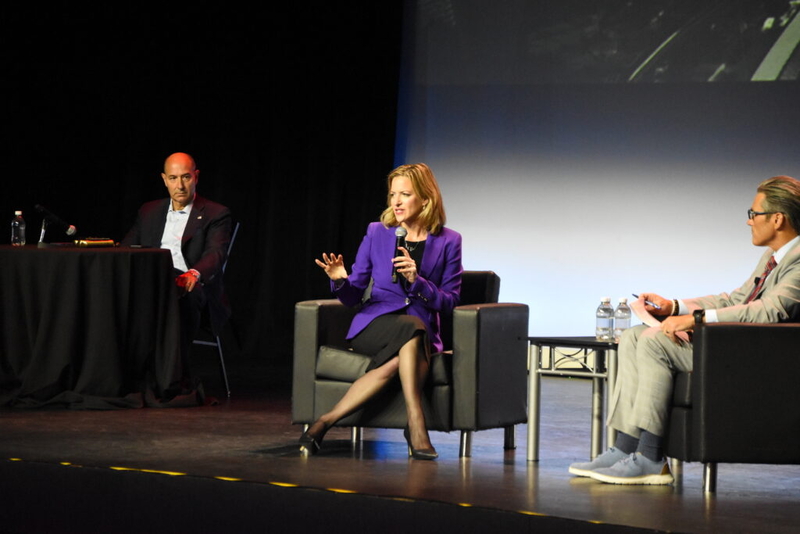
Democratic gubernatorial nominee Secretary of State Jocelyn Benson speaks to the Detroit Economic Club about her plans on taxes, economic development and affordability. Sept. 16, 2026. (Photo by Katherine Dailey/Michigan Advance.)
DETROIT — The respective Republican and Democratic nominees for Michigan governor on Wednesday each proposed new solutions to the economic tariffs levied by the administration of President Donald Trump, especially those being used against Canada.
Addressing the Detroit Economic Club on Wednesday afternoon in separate speaking events were Republican U.S. Rep. John James and Democrat Secretary of State Jocelyn Benson. Benson appeared in person while James appeared via video conferencing from Washington, D.C.
Benson said that she plans to negotiate subnational agreements with Canada directly to mitigate the impacts of federal policy — and said that if Trump tried to undercut those efforts, she feels strongly that the law would be on Michigan’s side.
“I’ll partner with other governors from neighboring states like Pennsylvania, Wisconsin, Minnesota, who perhaps have similar needs, but of course Michigan’s economic interests come first and are pivotal in this moment,” Benson said. “I’ve already begun having conversations with folks in Canada about how we can carve out a subnational agreement to protect our jobs, protect our costs, and if this escalates further, protect our electricity, which we also need to recognize as a unique partnership with Canada.”
James, meanwhile, told the crowd that he has a bill in the U.S. Congress that “will be dropping in the next few days” to use tariff revenue to reduce the costs that have come from Trump’s go-to economic tool.
“I have told the administration directly that in these negotiations, Michigan will not be a pawn. Michigan will not be collateral damage in these negotiations. But we also have to recognize the truth that you need two parties to negotiate,” he said. “I’m doing my part in Congress to make sure that we have a clear path so that we can insulate our workers and our businesses from any strains that may occur from attempting to bring our jobs back, and have a mutually beneficial and reciprocal trade relationship with our friend and partner in Canada.”
Beyond tariffs, Trump’s policies influenced the forum.
Benson, who said that “the decisions we will make in this election will define the future of our economy and our democracy,” repeatedly emphasized her ability and desire to stand up to the federal government.
“In contrast to my opponent, who has supported every failed economic policy that the current president has promoted and has denied election results, as I’ve defended them, we need a leader in this moment who will speak the truth, bring people together, and get stuff done,” she said. “I know everything we do in these next eight years will determine whether or not my son and our loved ones all across the state choose Michigan as their home for my kid and for all of our kids, for our future of this state. I want Michigan to be the best place to be a kid, to raise a kid, and call home.”
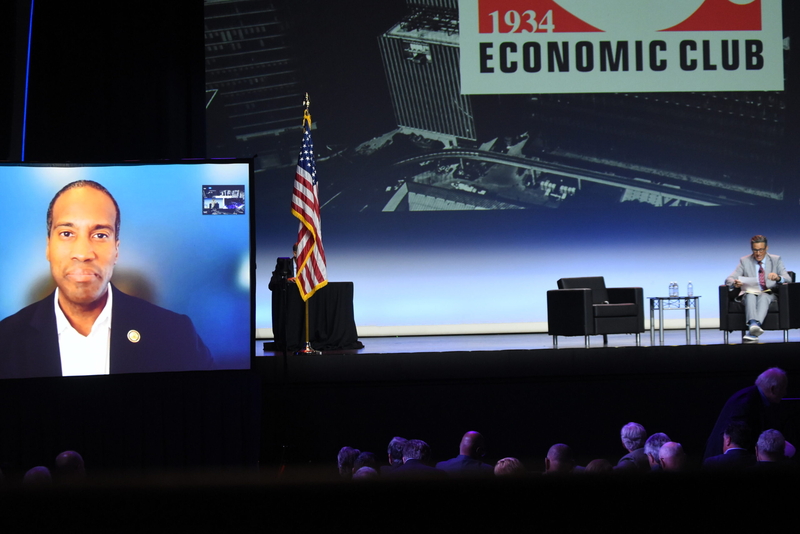
James, however, seemed skeptical of Benson tying problems in Michigan to Trump, saying, “I’ll point out to you that I’m the only one you talked to today that hasn’t blamed the other party, because I think that in leadership we need to use our thumbs more than we use our fingers.”
“There’s plenty of blame to go around, and I’m more focused on fixing a problem than fixing the blame. Michigan’s on fire. We are 42nd out of 50 in infrastructure. We’re 43rd out of 50 in the economy,” James said. “We’re 45th out of 50 in education. We’re 46th overall out of 50, and we all have the same president.”
While the visions on how to achieve economic improvement in Michigan — including lowering healthcare costs, improving educational outcomes and boosting the automotive industry — differed between Benson and James, their platforms on some issues seemed nearly identical.
On data centers, for example, both James and Benson emphasized the importance of local control, as well as establishing guardrails to address concerns about privacy and environmental harms of data centers and artificial intelligence.
Both candidates emphasized the need to support business growth in Michigan to match neighboring states like Ohio and Indiana, which Benson said “are eating our lunch here.” Benson said that the Michigan Economic Development Corporation is at the “top of my list” of agencies to overhaul at the state level.
James similarly remarked, “You talk about competing with Mexico and China. We can barely compete with the Southeast and with our neighboring states,” in regard to economic development and the MEDC’s role in the state.
As for how to achieve those goals, James leaned into slimming state government in order to free up money for his initiatives, like lowering income taxes.
“I talk a lot about cutting taxes, but we can’t just cut our way to success,” James said. “We need to make sure that we get our spending under control and that we grow, attracting talent, young talent here from all over the state and from all over the country to be able to grow and keep the talent that we have. We need a change in culture that’s customer service obsessed, more focused on support than enforcement, and actually treats business leaders like yourselves like revenue generators rather than a piggy bank for Lansing’s operations.”
James also emphasized his own past business experience as an important background to be the “CEO of a state” as governor.
Benson said that she wants to “do a wholesale review of how we’re bringing revenue into the state,” also relying on her own background as Secretary of State.
But she also proposed new spending, for example, on improving salaries for public educators and establishing tax credits for childcare and long-term familial care. Benson discussed both during her speech in Detroit and in a roundtable discussion at a Ferndale grocery store, focusing on the need to fix stagnated wages.

Asked how state policy can work to actually increase wages, Benson noted that “it’s about boosting our workforce so that we have a talented workforce, investing in apprenticeship programs and other skills training so that we have the talent here, recruiting more employers to come to Michigan so that we are with high-paying jobs.”
James did not speak at the event in-person as initially planned, citing a change in the U.S. House of Representatives voting schedule that required him to be in Washington.
“My father always taught us that in order to get the job you want, you have to do the job you have well,” James said via Zoom in his speech. “Right now, my job is in Congress, and also to answer your question, I’m not going to wait until I become governor to begin to represent, advocate, and putting my state first.”
Benson, however, criticized James’ absence at an event held later in the afternoon at a grocery store in Ferndale. Benson told reporters that“it’s not lost on me the day when I choose to be here in Michigan, talking not just to the Detroit Economic Club but to residents here, that my opponent chooses Trump, chooses to go to D.C. chooses to vote for a war that is driving up these costs, and that is the choice in this race.”
Lansing, MI