Arsenic testing kits available to Iowa private well owners in certain counties
Sep 16, 2026 | 9:00 am ET

Description
A research program at University of Iowa is seeking information on arsenic levels in Iowa private wells. (Photo by Cami Koons/Iowa Capital Dispatch)
A University of Iowa research project is attempting to develop a better understanding of arsenic in private drinking wells in Iowa and offering landowners, in certain counties, free testing for their wells.
Arsenic is a naturally occurring element found in soil and rock that has been linked to health risks, including cancer, from long-term exposure, even at small levels. Because private wells are not regulated, the chemical could be present in the well water at unsafe levels without property owners being aware of it.
According to information from the university’s Integrated Network for Science, Information, and Geospatial Health Tracking, or INSIGHT program, some Iowa counties have limited private well testing data for arsenic, even though those counties border other areas with documented, unsafe levels of the chemical element.
A news release about the new testing program said areas of north central Iowa have some of the highest rates of private wells with arsenic levels exceeding U.S. Environmental Protection Agency drinking water limits.
“Where you live has a big impact on your exposure to arsenic in drinking water,” said David Cwiertny, the lead of Iowa INSIGHT. “Expanding arsenic testing in at-risk counties can support prevention strategies to improve public health outcomes.”
Private well owners in Mitchell, Floyd, Cedar, Benton, Plymouth and Jones counties can request the free kits from the INSIGHT website.
According to data from Iowa INSIGHT, 0% or 1% of private wells in these counties have been tested for arsenic.
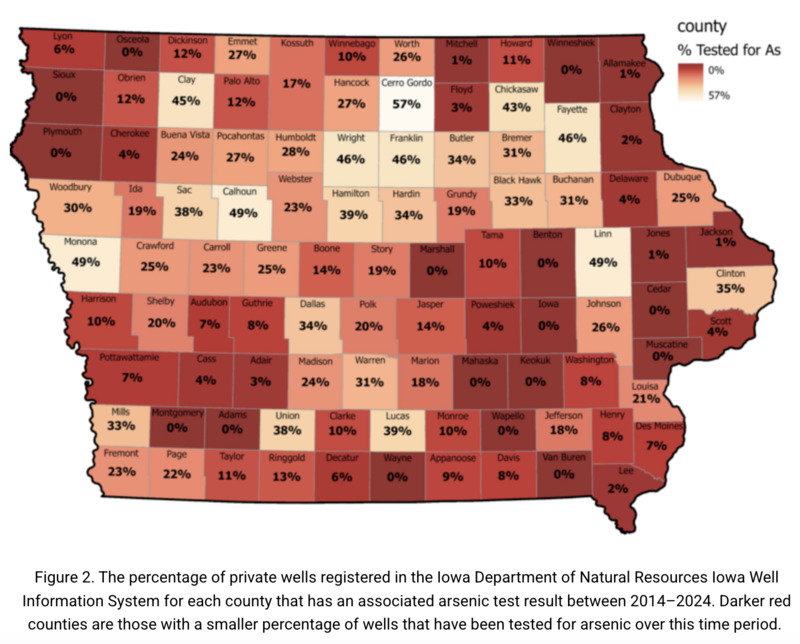
The research project website notes that the absence of testing should “not be interpreted as evidence of low risk.”
The EPA limit for arsenic is 10 micrograms per liter. The agency holds that exposure to arsenic can lead to skin damage, circulatory issues and potentially “increased risk of getting cancer.”
The Iowa Private Well Grants program enabled the testing of more than 22,000 wells in Iowa between 2014 and 2024 and found that 11% of tested wells exceeded EPA’s maximum contaminant level and an additional 8.4% of tested wells had levels between 5–10 µg/L.
The Iowa Department of Natural Resources estimates that 5.5% of the population relies on private wells for their drinking water. Private wells, unlike public drinking water systems, are not subject to regulations — meaning testing is up to the private well owners.
Reverse osmosis water filtration systems, but not common pitcher filtration or whole-house carbon filtration systems, are effective at removing arsenic from drinking water.
In addition to calling for private well owners to test their drinking water, Iowa INSIGHT recommends increased funding for the Private Well Grants program, which is run by DNR and offers free private well testing on a schedule.
Other policy solutions proposed by Iowa INSIGHT include financial incentives for in-home water filtration systems, and local educational initiatives to bring greater awareness of arsenic levels in private wells.
Des Moines, IA