State Land Office says New Mexico’s renewable energy brings in revenue, offsets environmental harm
Sep 15, 2026 | 12:00 pm ET
Description
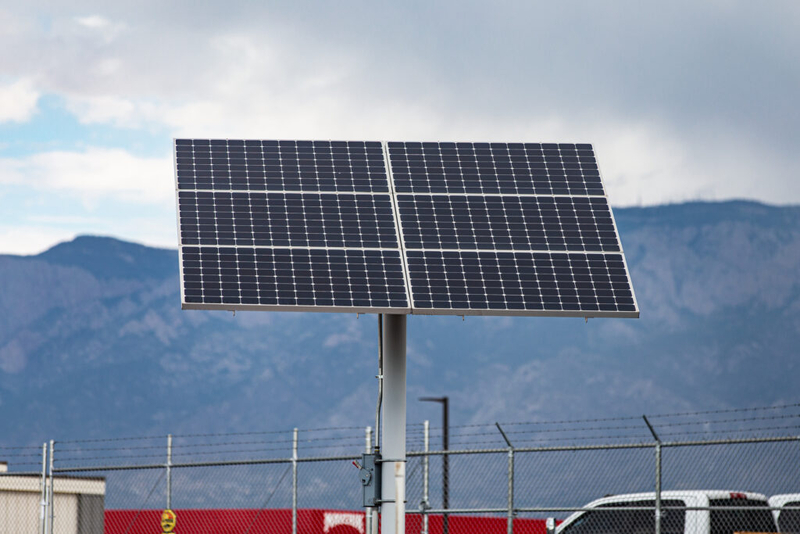
New Mexico State Land Office officials shared projected revenue from renewable energy sources such as solar with legislators during the Sept. 14, 2026, meeting of the interim Revenue Stabilization and Tax Policy committee meeting. (Photo by Anna Padilla for Source New Mexico)
Renewable energy projects leased on state land are expected to bring in billions of dollars for New Mexico in the years to come, State Land Office officials told legislators Monday.
The 55 active green energy projects, such as solar and wind farms, brought in $8 million in revenue this year, a 1,287% increase from 2019, they said.
Around 12% of all land in New Mexico is managed by the State Land Office, which offers bonds for leases of the land for various projects: energy, commercial development and agriculture. The office generated $16 billion in eight years.
Though the renewable energy revenue may seem small now compared to the $3.1 billion that went into the state permanent fund last year from oil and gas revenues, the projected revenue on just existing leased projects, not including pending or future leases, will bring in $2.5 billion by 2040, State Land Office Deputy Commissioner Sunalei Stewart told lawmakers on the interim Revenue Stabilization and Tax Policy Committee during their meeting at the state Capitol.
Moreover, Stewart said, those renewables will offset air pollution equivalent to the carbon emissions of 380 million barrels of oil.
Stewart said the long projection time stems from renewable energy projects having a different life span when compared to oil and gas projects. While oil and gas leases generate massive revenues in the short term and decline over a long period, renewable energy leases are “the inverse,” Stewart said, due to the “initial phase” of building renewable energy: securing the capital, acquiring the lease for the plant site and building the infrastructure.
The long-term nature of building renewable energy infrastructure left some lawmakers concerned about the possibility of energy developers failing during the long lifespan of solar and wind farms, which would leave the state with the decommission costs.
“I think you’re putting us at risk,” Sen. George Muñoz (R-Gallup) said.
Stewart noted that the State Land Office’s lease agreements include decommissioning costs.
The state is also planning to expand the geothermal energy sector. In May, the State Land Office published a new rule that would allow for larger projects to be developed on state lands. Last year, Gov. Michelle Lujan Grisham touted the state as a potential leader for geothermal energy, following a report about its potential here.
“New Mexico is primed to attract additional renewable energy business,” Stewart told state lawmakers. “We’re beginning to see the state investment council do more renewable energy investments because they’re seeing the value in it.”
Santa Fe, NM