Rhode Island archery hunters get earlier start under new deer rules
Sep 15, 2026 | 6:18 pm ET
Description
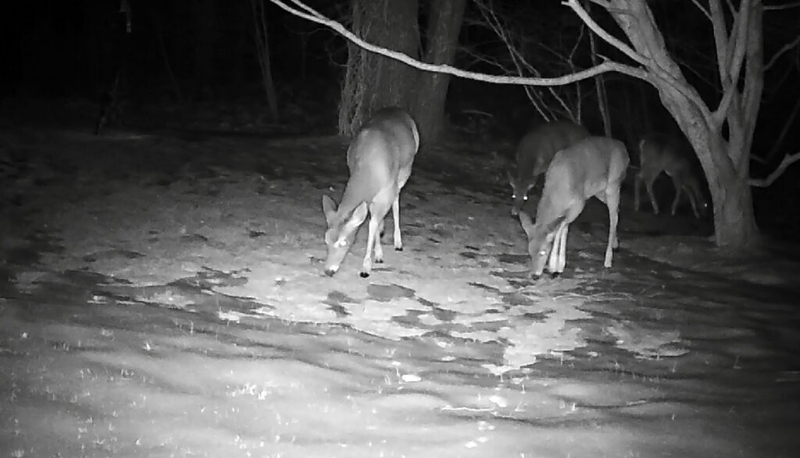
A backyard camera captures several deer deer at 12:51 a.m. on Jan. 2, 2025, in Beechwood Estates in the Yawgoo area of Exeter. The town is located in Zone 2 where archery season started two weeks earlier. (Photo by Laura Paton/Rhode Island Current)
Rhode Island archery deer hunters started the season two weeks earlier in a larger portion of the state on Tuesday, a change supported by new data on the size of the deer population.
The Rhode Island Department of Environmental Management (DEM) divides the Ocean State into four deer management zones for hunters. Archery season in Zones 1 and 2 opened Tuesday for adults and runs through Jan. 31, 2027. (An archery hunting weekend for youth started on Saturday, Sept. 12.)
This marks a change in Zone 2, where archery season previously began Oct. 1. The zone covers much of western and southern Rhode Island, as well as Tiverton and Little Compton.
Zone 1’s archery season also began Tuesday. Its territory includes the state’s more developed and more densely populated urban corridor, including Providence, Warwick, Cranston and communities extending north toward Woonsocket.
The additional time allowed hunters in Zone 2 this fall is part of a broader change to DEM’s regulations aligning archery, muzzleloader and shotgun hunting dates in Zones 1 and 2. The agency’s July deer program report noted that the respective start and end dates for these different modes of hunting are now the same across the two zones.
Muzzleloader season lasts Nov. 7 through Dec. 4. Shotgun season begins a day later and lasts through the end of the year.
Kim Keough, a DEM spokesperson, said the longer deer hunting season for archers in Zone 2 was requested in a survey of the state’s hunters.
New data on the state’s deer population also gave a reason for the change, Keough said. The agency granted the hunters’ wish after an aerial infrared survey conducted last winter estimated a statewide distribution of 16 deer per square mile, with the distribution of deer across Zones 1 and 2 likely comparable. Tiverton and Little Compton had 17 deer per square mile.
Only about 8% of the state’s land area was surveyed in February and March 2025, while Colt State Park, Dutch Island and Patience Island were surveyed in their entirety. Colt State Park had a concentration of 70 deer per square mile, Dutch Island had 94 and Patience Island had 56.
The survey results released in February 2026. A helicopter equipped with an infrared camera flew in planned routes about a mile apart. The goal, the report recaps, “was not to produce a perfect count of every deer in the state…[but] to better understand how deer are distributed across Rhode Island and to see if the current hunting season structure should be modified.”
The camera captured images about once every second along its routes. The resulting thousands of images were later reviewed by University of Rhode Island researchers who extrapolated estimates of the deer population from the visual data.
Warm-bodied deer sometimes appeared on the infrared images “as bright shapes against cooler ground,” the report reads, while noting that the conditions for photography were not always ideal.
“In many images, deer did not stand out clearly from the background,” the report said, adding that the camera could not see through pine trees like it could deciduous trees like oaks, which offer better visibility when stripped of leaves in the winter.
“Therefore, it is likely that some deer were not counted as they were not visible to the camera.”
The survey’s estimates were less than the range of roughly 18,000 to 21,000 deer in earlier population projections , Keough said.
DEM’s 2025-2026 deer report noted that the state’s hunters harvested 2,816 deer, which was only a 1% decline from 2,846 the previous year.
Overall, the state’s hunters have harvested more deer annually since the 1970s: While 145 deer were harvested in 1976, the state’s harvests increased considerably until peaking at 2,937 in 2008.
Much of the state’s hunting activity was concentrated in Zone 2, which comprised the largest share of the state’s deer harvest, with 1,601 deer successfully harvested in Zone 2 last season.
Zone 2’s popularity is largely due to its concentration of the state’s forested areas, much of which hosts the state’s public and cooperative hunting property.
Full hunting area maps for all four zones can be found on DEM’s website, as well as an interactive atlas.
Providence, RI