Profs and staff give UW a failing grade for budget and bureaucracy troubles
Sep 16, 2026 | 7:00 am ET
Description
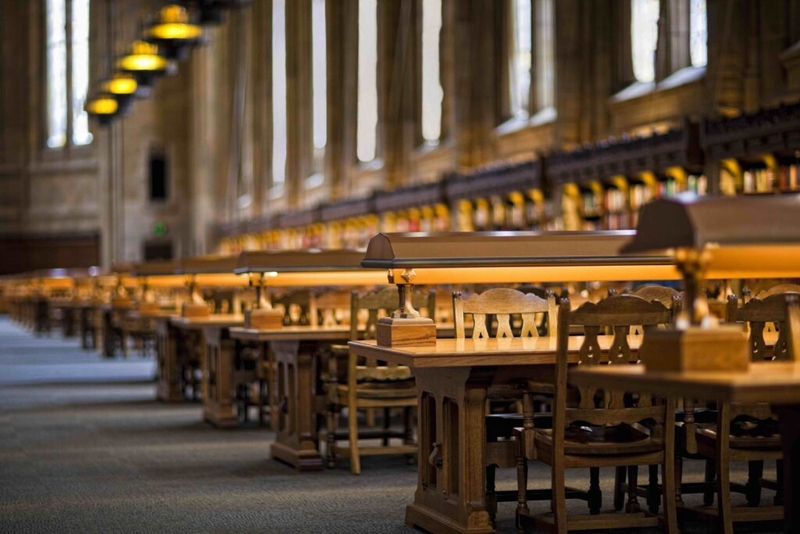
The Suzzallo Library at University of Washington. (Getty Images)
SEATTLE — Genome sciences professor Doug Fowler a few months back got word from the federal government that his $3 million per year grant would be renewed.
The grant pays for about a dozen researchers at the University of Washington. But because of a problem in the university’s finance platform, which launched a few years ago and cost $340 million, the school hasn’t been billing the feds, Fowler said.
This has Fowler fearing he could lose out on the grant, he said.
“All the people we’ve been working with have tried hard, but the system isn’t set up to succeed, and we may lose the money, which means that people would get let go immediately,” Fowler said on a recent panel voicing concerns over the direction of the university.
“It’s that kind of unforced error,” Fowler continued, “that we just can’t afford in this environment.”
Professors, staff and lawmakers on the panel shared a dire outlook on the state of the University of Washington, with ill effects for more than 63,000 undergraduate and graduate students across three campuses. They’re calling for more staff and faculty involvement in the types of decision-making that they believe could avoid the choices they’re crying foul about.
One issue: the new Workday finance system, which critics say has led to faculty losing benefits and staff getting incorrect pay. They also say recent layoffs have caused chaos for students and staff.
And a new system to centralize research support will take faculty time away from research and teaching while making it harder to get grants, they argue. Fowler said this could save millions of dollars in the short term, but cost more in the long run.
“Every minute that I spend doing administrative work is a minute I can’t spend writing a grant or doing research that lets me write a grant,” Fowler said. “So I think these policies are penny-wise, but will prove to be pound-foolish for the university.”
Sen. Javier Valdez, D-Seattle, said he doesn’t understand why the university isn’t more collaborative working with its employees.
Spokesperson Victor Balta said the university “values feedback and perspectives that come in a variety of forms.”
“We understand that there is anxiety related to changes aimed at making our unsustainable and highly decentralized processes more streamlined,” Balta added in an email. “Change can also come with challenges, and we are working quickly and transparently to address any issues as they arise.”
He noted the centralization process is still in its early stages, and so hasn’t been implemented yet.
Funding woes
The scope of the layoffs is unclear.
In June, the university laid off 13 employees in the Department of Health Systems and Population Health. Between July of last year and late October, it cut 16 workers in the College of Arts and Sciences, according to The Daily of the University of Washington.
And last year, amid uncertainty over federal funding from the Trump administration and the state’s budget woes, the university froze hiring of “non-essential” staff, limited faculty hiring and restricted staff travel.
Rep. Gerry Pollet, who represents northeast Seattle and is a clinical instructor in the UW’s School of Public Health, said he faced the decision of teaching more at the UW or at Western Washington University. He picked the Bellingham school because faculty there are unionized. He urged on UW faculty to unionize so that, for example, the school administration couldn’t cut back on teaching assistants without bargaining.
Pollet has been pushing legislation to end the state’s practice of funding collective bargaining agreements with higher education employees partially through tuition. At the University of Washington, for example, just 42% of this funding currently comes from state coffers, while the rest is paid for with student tuition dollars.
Ending this “fund split” could save the University of Washington tens of millions of dollars per two-year budget cycle, he said. That money should be “in the state budget, baked in like every other agency,” Pollet added.
Forcing the university to come up with this money “inevitably meant cutting staff,” Pollet said. “That’s the only thing left, or cutting some administrative salaries and maybe actually having something called the football program put money back into the main purpose of the university.”
Pollet also wants the higher education funding formula shifted to be more like K-12 public schools, which are funded on a per-pupil basis.
Cuts to Medicaid that Republicans in Congress passed last summer, meanwhile, will hurt the university’s hospital system, which includes the UW Medical Center and Harborview Medical Center. The university had been a leader in federally funded research, but that money has been slashed.
Universities avoided a major hit this year as the state Legislature and Gov. Bob Ferguson had to approve cuts to address a budget shortfall. Through a switcheroo, lawmakers shifted $240 million from Washington’s capital budget into the operating accounts of two-year and four-year institutions. Those construction dollars will then be backfilled using bonds.
In a survey last year, about half of responding employees reported they’d seriously considered leaving the UW in the year prior.
Public university budget crises are not uncommon. But the situation at the UW has turned “existential,” said Eva Cherniavsky, a professor of American literature and culture.
“At a certain point, after cuts, on top of reductions, on top of shortfalls, one reaches a tipping-point moment when it’s just not possible any longer to sustain the quality and the effectiveness of the work we do,” said Cherniavsky, president of the school’s chapter of the American Association of University Professors. “We are at the tipping point.”
Olympia, WA