Ohio GOP lawmaker says university centers are not right-wing indoctrination. Professor pushes back.
Sep 16, 2026 | 4:00 am ET
Description
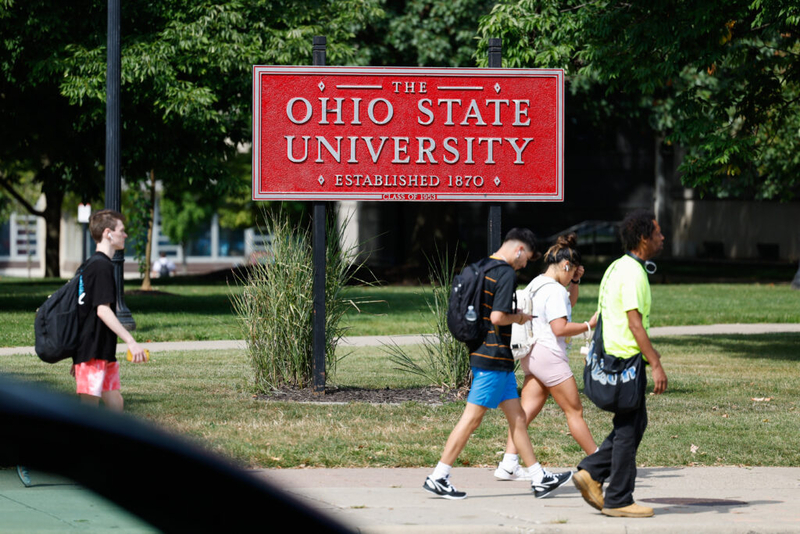
On the campus of The Ohio State University in Columbus, Ohio. (Photo by Graham Stokes for the Ohio Capital Journal. Republish photo only with original story.)
A Republican Ohio state senator says that Ohio’s five Republican lawmaker-mandated university civics centers are not “right-wing indoctrination,” as a George Washington University Law School professor questioned the need for the centers during a recent panel discussion.
Ohio state Sen. Jerry Cirino, R-Kirtland, spoke on a panel about civics centers last week at an Education Writers Association conference at Howard University in Washington, D.C.
Inside Higher Ed reporter Ryan Quinn moderated the discussion which also included George Washington University Law School Professor Mary Anne Franks and Arizona State University Professor Paul Carrese.
A dozen states have civics centers across 17 college campuses. Ohio’s five civics centers were created by supermajority Republican lawmakers through the state’s two-year budget in 2023 for $24 million.
“Ohio is not the first or the second to come up with these centers, but we took what some other states were doing very early, and we injected some steroids into it,” Cirino said.
Ohio’s five civics centers are at Ohio State University, the University of Toledo, Miami University, Wright State University, and Cleveland State University.
“The statute charges these centers with advancing teaching and research related to the historical ideas, traditions, and texts that have shaped the American constitutional order and society,” Cirino said.
“It’s not about forcing some belief down anybody’s throat, no indoctrination. It’s about having an open debate, open discussion about different sides of issues. … It’s to make sure that we are studying things in an objective fashion. Let’s let the students decide what they want to believe.”
Franks, who is on Uncivil Collective’s Advisory Board which has spoken out against university civics centers, questioned the need for civics centers.
“We’re talking about government mandated centers for education, we’re talking about millions of dollars of public funds. … I think it really is worth getting a very clear answer to what is the problem we’re trying to solve,” she said.
“The state is not the answer to whatever balance you want to have in higher education. The state should not be dictating their education.”
In 2023, only 13% of eighth graders were proficient in history and 22% were proficient in civics, according to the National Assessment of Educational Progress.
“Anywhere from 25-30% of students in most surveys that I read can’t answer basic questions about America’s founding and its history,” Cirino said.
“It’s just about knowing America’s civics history and the good, the bad, and the ugly. We have all three certainly in our history.”
College students lacking knowledge about civics education is nothing new, Franks said.
The New York Times reported in 1943 that college freshmen across the country showed an “ignorance of U.S. history” and only 6% of the 7,000 students surveyed could name the 13 original states.
Cirino argued there is a leftward tilt in higher education.
Ohio State University, three other Ohio universities receive an ‘F’ in latest free speech rankings
“We should be a little bit more neutral and make sure that the coursework in the syllabi are developed to present different alternative views of different things. … Let the student decide which one they are attracted to, which one they think works, which one historically has been more effective.”
Franks said professors are not indoctrinating students.
“Why do you think that the way that someone votes has anything to do with the way that someone teaches? … I can’t even get my students to read the syllabus. I am not shaping (their) beliefs.”
Arizona State University created the first state-funded university civics center in 2016 with the School of Civic and Economic Thought and Leadership opening in 2017.
ASU’s center developed a master’s degree, hosts public speakers, and engages with the state’s K-12 teachers through professional development workshops.
“Educators always believe that more education will help everything. So, if you have a restoration of focus on (civics education), it’s going to be good for our civic culture, especially now in America,” said Carrese, who served as the center’s founding director from 2016-2023.
Cirino introduced Ohio Senate Bill 461 over the summer which would give the centers’ directors the sole authority to hire faculty and staff, as well as determine their rank, salary, and tenure. It would also make it so the centers would receive all tuition and revenue from the courses it offers.
However, less than 1% of Ohio State students enrolled in the university’s Chase Center for Civics, Culture and Society in 2025, according to state data.
“We’re going to be looking at the number of students enrolled, but … new programs take some time to build up,” Cirino said.
He has proposed new legislation to mandate attendance for the centers.
Ohio GOP lawmakers’ university civics centers aren’t popular. They want to require attendance.
He hopes Ohio’s civics centers don’t become silos on campus.
“We wanted to have independence to a certain extent because otherwise, we would have faculty senates deciding who’s going to be teaching these courses and what the curricula are, and we had significant evidence to suggest to us that that would not be a wise thing to do,” Cirino said.
Cirino also authored S.B. 1 which bans diversity efforts, regulates classroom discussion, prohibits faculty strikes, creates post-tenure reviews, creates a retrenchment provision that blocks unions from negotiating on tenure, and requires students take an American civic literacy course as a graduation requirement.
Follow Ohio Capital Journal Reporter Megan Henry on X or on Bluesky.

Columbus, OH