SC Supreme Court to decide if governor overstepped sending National Guard to DC
Sep 15, 2026 | 6:11 pm ET
Description
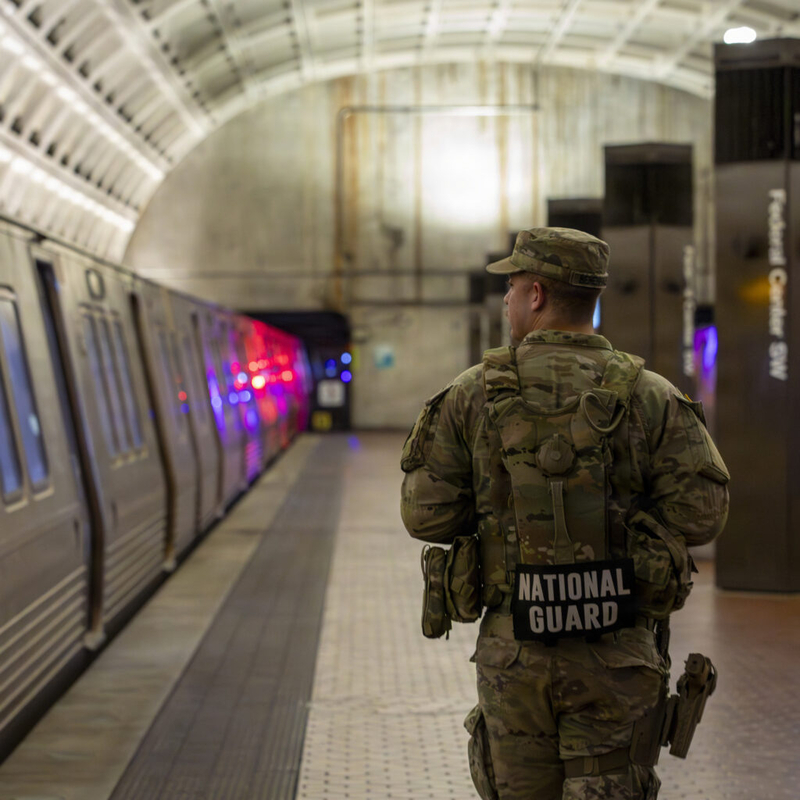
U.S. Army Spc. Zachary Benehaley, with the 4th Battalion, 118th Infantry Regiment, South Carolina National Guard, monitors a Metro platform at the Federal Center Metro Station in Washington, D.C., on Oct. 14, 2025. (Photo courtesy of U.S. Army National Guard/Sgt. Jalen Miller)
CLEMSON — A legal challenge over Gov. Henry McMaster’s decision to send National Guard troops to Washington, D.C., could test the bounds of the governor’s power as the state’s commander in chief, attorneys argued to the state Supreme Court on Tuesday.
Arguments in the case, which a government watchdog group filed in January, came as 30 troops from the state remain in the nation’s capital as part of President Donald Trump’s “Operation Make D.C. Safe and Beautiful.” McMaster first sent troops to D.C. in August 2025, and the most recent deployment returned in August after three months.
Lawsuit claims SC governor illegally sent National Guard troops to DC
The next rotation of 300 soldiers, which will last six months, is scheduled to leave the first week of December, according to the governor’s office.
The Public Interest Foundation and American Civil Liberties Union told the state’s highest court Tuesday that McMaster doesn’t have the legal authority to send them there. McMaster’s attorneys disagreed, saying he has sweeping powers as the state’s commander in chief.
A similar legal challenge in West Virginia was dismissed in November 2025, after a circuit court judge ruled Gov. Patrick Morrisey acted lawfully. D.C.’s attorney general is suing to remove National Guard troops from the city.
Questions of authority
The decision on the governor’s authority over the National Guard will likely come down to how the five justices interpret two longstanding state laws.
Under those laws, the governor can deploy or activate the National Guard to stop “war, insurrection, rebellion, invasion, tumult, riot or a mob,” or when a “public disaster,” such as a natural disaster, takes place. He can also activate the guard to execute laws, including as requested by the president.
Neither law says anything about sending troops to other states or jurisdictions, attorneys said.
SC governor deploys troops to Washington at Pentagon’s request
“I will grant, of course, there’s nothing explicit in those statutes that says you may send the guard out of state,” said Grayson Lambert, the governor’s chief legal counsel, after questions about the interpretation from justices. “But there is nothing explicit in those statutes that says you can’t.”
McMaster’s deployment of the troops didn’t meet the requirements established in the law, said Allen Chaney, attorney for the ACLU. The offices of the governor and adjutant general said the soldiers’ mission involved supporting local law enforcement and maintaining safety for residents and visitors, but their work didn’t reflect that, Chaney said.
“Hundreds of South Carolina guardsmen spent the better part of this year in Washington, D.C., not repelling an invasion, putting down a riot or quelling a tumult but picking up trash, spreading mulch and patrolling subway platforms,” Chaney said.
Typically, the governor deploys the National Guard at the request of another state’s governor, Chaney said.
An interstate mutual aid network gives states a standing agreement to deploy troops during emergencies, such as natural disasters. No similar agreement existed in this case, and McMaster’s only justification for deploying troops came from the news release he put out announcing the mission, Chaney said.
If justices side with the governor, nothing will stop McMaster or a future governor from sending troops to any other city, Chaney said. Though this deployment came at the president’s request, the ACLU contended it failed to meet legal benchmarks.
“Here, the governor is asserting pretty generalized, implicit authority to send the National Guard to D.C.,” Chaney said. “If he is given that power, there is no check of consent.”
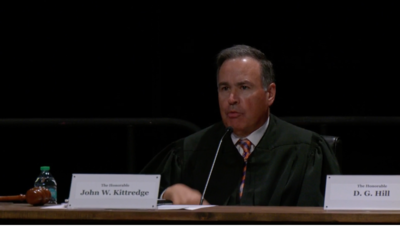
Chief Justice John Kittredge questioned where justices might draw the line on the governor’s authority. The state constitution puts the governor in charge of commanding the state’s militia, which suggests he has the authority to make decisions about how to use it, Kittredge said, adding that McMaster could have just as easily turned down Trump’s request.
“It’s a matter of discretion,” he said. “It’s that basic.”
That applies only after a situation meets the requirements set in state law, Chaney replied. Those laws are meant to create a check on the governor’s powers, keeping him from sending out soldiers whenever and wherever he wants, the attorney argued.
“We’re not asking the court, “Was this a good idea or a bad idea to deploy the National Guard to D.C.?’” Chaney said. “We’re asking, ‘Does the statute actually authorize the governor to deploy, under these conditions, the guard to D.C.?’”
The answer is yes, Lambert said.
“The governor is the commander in chief of the South Carolina militia, and he possesses broad constitutional and statutory authority to call out the militia,” Lambert said.
Legislators who passed that law clearly meant for the governor to have the authority to send troops to any other state, Lambert said.
He pointed to a separate law barring the State Guard, an all-volunteer force that assists the National Guard, from deploying across state lines. That specification would be pointless if legislators wrote their requirements for the state and national guards with the intention of working only within the state, he said.
Lambert pointed as far back as the Seminole, Mexican and Spanish-American wars of the 1800s as examples of governors using their authority to deploy the state militia, which eventually became the National Guard.
More recent deployments have used the same federal law used to send troops to D.C., Lambert said. Known as Title 32, the agreement requires the federal government to pay for the cost of deployment but allows the governor to keep control over the guardsmen.
Under those agreements, the state sent the National Guard to help with security missions in Atlanta during the 1996 Olympics and to provide security in D.C. during protests in 2020, Lambert said.
“There are 230-plus years of practice of the governor deploying the guard outside of South Carolina when the need arises and absolutely no pushback from another branch of government whose authority would theoretically be infringed by that,” Lambert said.
Because the state has done that before, though, doesn’t make it correct, said Justice George James.
“The fact that it hasn’t been challenged doesn’t make it legal,” he said.
That’s true, Lambert replied. But the multiple deployments without pushback from legislators suggest the governor could send troops to other states in similar instances under the boundaries legislators set, he said.
Justices gave no timeline on a decision Tuesday.
Broader legal questions
Much of Lambert’s argument centered around whether the watchdog groups had the right to sue.
South Carolina allows legal challenges under the “public importance exception,” which is meant to decide on matters that don’t actually harm anyone involved if they matter to the general public. The court can also take up cases for the sake of offering guidance for future laws and actions.
Justices shouldn’t take up those sorts of cases, including this one, and should instead hear only legal challenges from people directly affected, Lambert said.
If the Supreme Court were to agree, that could have major implications for how the court interprets the state’s laws, Kittredge and James said.
Cases where no one is directly hurt, such as violations of open meeting laws, would no longer come up, they said. Nor would environmental cases brought by nonprofits such as the Sierra Club, which isn’t involved with every piece of land it sues to protect, the justices said.
“Those would never have seen the light of day in a courtroom,” James said.
Just because no single person is harmed by a decision doesn’t mean it stops mattering to the people of the state, Chaney said.
“We are not suggesting that the abuse of the governor’s authority as commander in chief imposes no harm at all; merely that it’s a diffuse constitutional harm that’s borne by all citizens of the state,” Chaney said.

Columbia