Flathead County judges make their pitch for the Montana Supreme Court
Oct 09, 2026 | 3:05 pm ET
Description
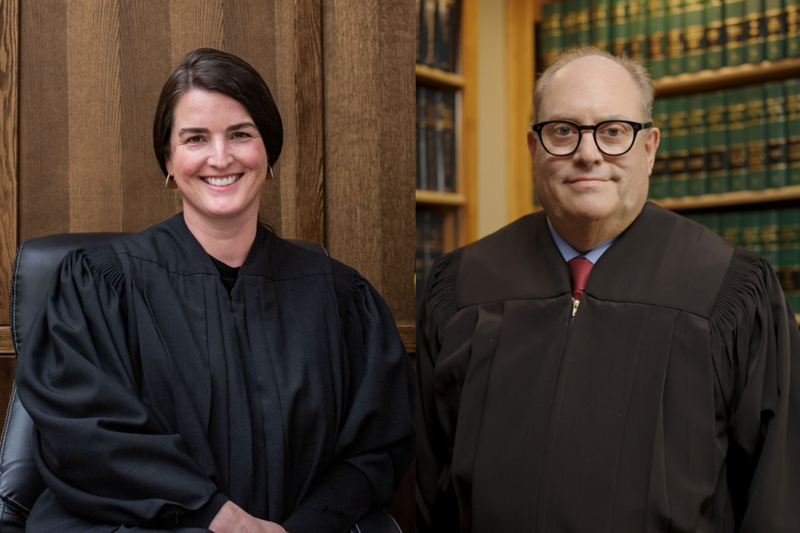
Flathead County District Court Judges Amy Eddy and Dan Wilson are facing off in the race for an open seat on the Montana Supreme Court. (contributed photos)
Two judges, both alike in current roles, are making the case for why they are best to ascend to the state’s highest bench.
At a series of forums around Montana in recent weeks, Flathead County District Court Judges Amy Eddy and Dan Wilson have sought to distinguish their legal bonafides, their campaign strategies and approach to impartiality as candidates for the Montana Supreme Court.
The most common thread was how to keep politics out of the courtroom, an issue Montana voters will also weigh in on with a ballot initiative, I-132, that could preserve the state’s nonpartisan judicial elections.
During a Bozeman event sponsored by the Gallatin County Bar Association, Eddy said that despite a new Montana law allowing political parties to donate to judicial campaigns, she is not accepting campaign donations from parties nor speaking at political gatherings.
“We do not want our judges swearing loyalty oaths to political party platforms before a judge makes a decision,” Eddy said. “We don’t want them considering whether that will jeopardize a political party endorsement or ongoing political party campaign contributions.”
Her decision to remain nonpartisan presents one of the clearest examples of where the two candidates differ, as Wilson has taken the opposite approach.
He has accepted campaign contributions from both the Montana Republican Party and county GOP committees, was the keynote at the state GOP winter campaign kickoff event this year, and the party has endorsed him as the “conservative candidate” in the race.
Wilson has said personal politics shouldn’t play a role in the courtroom, and in a Bozeman forum, he said the players making arguments before the bench certainly matter, and he has not sought out endorsements or donations from attorneys.
“As a judge, you know who those lawyers are who contributed funds to your campaign,” Wilson said, adding that it’s not hard to imagine they might expect a favorable ruling in return. “I made the decision early on that I wasn’t going to solicit money from attorneys.”
Both candidates have donations from lawyers listed on their campaign financial disclosures.
The jurists
Eddy grew up in Stanley, Idaho, which has a population generously reaching 100 during peak season. She skied to and from the bus stop to get to her K-8 school, early lessons in grit and perseverance she says have propelled her throughout her professional career.
She attended law school at the University of Montana and had a private practice before she was appointed to the district court bench in 2015 by Democratic Gov. Steve Bullock. She has twice been reelected to the position.
Eddy was also selected by the state Supreme Court to preside over the newly formed asbestos claims court in 2017 which dealt with hundreds of personal injury and wrongful death lawsuits stemming from vermiculite mining around Libby.
Wilson is a fourth-generation Montanan with family homesteading roots near Malta. His grandfather also wore judicial robes, serving as a Phillips County judge, which Wilson said gave him values of fairness and respect for the law.
Wilson also went to the University of Montana Law School and worked as a prosecutor in Great Falls, Chinook and Kalispell before moving into private practice. He was a Justice of the Peace in Flathead County before voters selected him for the district court bench in 2016.
Wilson has run for the supreme court before, losing by 14 points to current Justice Katherine Bidegaray. In the same election cycle, now-Chief Justice Cory Swanson, one of the court’s more conservative voices, won his own race by eight points.
This year, the two judges are competing to replace retiring Justice Beth Baker, who is sometimes seen as a swing vote on a bench that is characterized as having a moderate to leftward tilt which the state GOP has said Wilson will counteract if elected.
According to a 2026 Montana Law Review article, the Treasure State’s Supreme Court tends to be in agreement more often than not, even with two new justices joining the court last year.
Of 291 opinions authored by the court, only 30 dissents were written — led by Bidegaray, at nine — and 80% of opinions were unanimous.
That is in contrast to the federal Supreme Court, according to Constance Van Kley, a constitutional law professor at the Blewett School of Law at the University of Montana, which rarely approaches 50% unanimity.
During a forum hosted by the Yellowstone County Farm Bureau, Wilson said having a supreme court that is predictable benefits rural communities, by helping avoid hidden costs in “unnecessary complexities.”
“It’s vitally important that the Montana Supreme Court keep and maintain a rule of law in these cases that is predictable, that is common sense, and that people can rely on,” Wilson said. “The Montana Supreme Court is very predictable and very emphatic in its ruling. That, to me, is the ideal situation.”
He added part of a predictable supreme court comes from giving “weight and respect” to laws, with a presumption that they are constitutional, derived from the idea that power comes from the people.
“When the people elect their legislatures and send them to Helena to enact our laws, the outcome of their wrangling, arguing, voting … ultimately the laws they pass are entitled to tremendous respect,” Wilson said. “The law … is the product of thoughtful people who take time out of their lives to go to Helena for 90 days every two years and do the people’s business.”
Eddy emphasized the constitution maintains a clear separation between the three branches of government, which needs to be preserved. She said justices should respect the roles of the other branches of government, understand limits of judicial authority, but also prevent overreach by the legislative and executive branches.
“We are not elected to be the policymakers, and when we strike down a law, we are impacting policy sometimes in ways that we cannot even begin to anticipate,” Eddy said. “For that reason, we have a very high burden in establishing a law that is unconstitutional.”
Both Wilson and Eddy have broadly aligned on their views of the state judiciary.
Both judges advocate for more transparency at the state’s high court, with Eddy saying it will come as part of the new judicial performance and evaluation commission, which the 2025 Legislature formed to better show the public how judges operate.
Wilson has urged opening up more Supreme Court operations, such as holding more oral arguments in venues other than the Supreme Court chambers, as well as letting the public access normally closed-door conference discussions.
Voters have already had a chance to cast votes for Eddy and Wilson, during the state’s June Primary, though it was inconsequential as both were already set to advance to the general election regardless of the outcome. In the primary, Eddy earned more than 51% of the vote.
Helena, MT