George Ayoub: Getting petitions, elections just right
Sep 14, 2026 | 6:45 am ET
Description
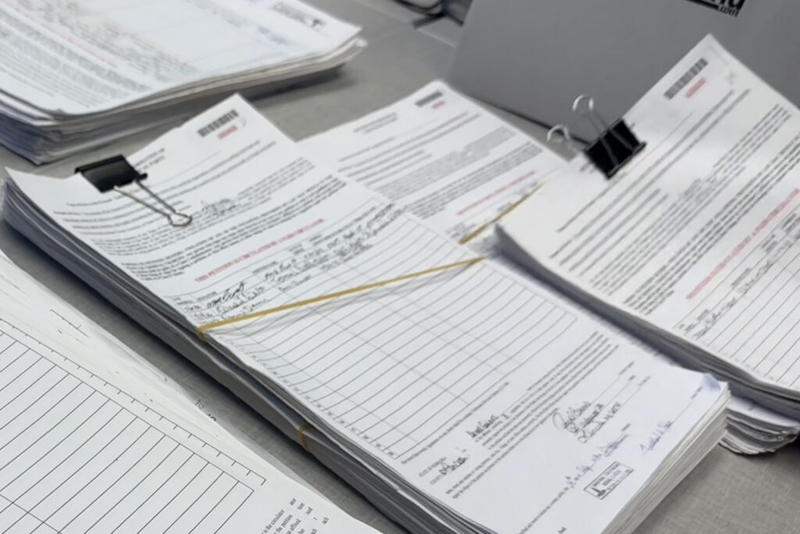
Petition pages reviewed by local county election officials and returned to the Nebraska Secretary of State's Office sit in the office for public inspection at the office's Elections Division in downtown Lincoln on Aug. 24, 2026. (Photo by Zach Wendling/Nebraska Examiner)
If you’re going to the polls — highly recommended in a democracy that prides itself on representative government — take note of a couple of recent developments. Not items on which to vote but rather on what you can cast your “yea” or “nay” and how safe it is after that. Who knew in the 250th year of this political and social journey that — without proof of any real problem with elections — we’d be choosing up sides about their processes?
To wit: Nebraska election officials and the governor said at a news conference a couple of weeks ago that we should put the kibosh on petition circulators getting paid by the signature, what the officials referred to as a “bounty.”
The argument goes that if we put a big enough dollar sign on the carrot, we tantalizingly shorten the stick. For further details, see Enron accounting techniques, Wells Fargo account openings and Apple backdating stock options.
The officials’ concern — rightly — was that among the 767,000 signatures across 17 petitions during Nebraska’s political campaign season, a rather shocking number of them turned out to be stinkers. The petitions covered a gamut of attempts at redress from the Lincoln city charter to state ballot measures to candidates from a variety of political corners, so the bogus entries stretched across a number of political ideas, office contenders and government administrivia.
Cue some serious handwringing?
Well, no. That’s because Nebraska’s election system works. Quite well, in fact. County election officials got it exactly right, going line by line to ferret out problem signatures. Things got a little felonious, too, as a half-dozen circulators have been arrested.
None of which means the Legislature might want to consider the efficacy of “bounty hunting” signatures for ballot initiatives or candidates. That is a conversation and debate worth having, given our wont to govern by referendum these days.
The more important takeaway is that Nebraskans can trust their elections despite an ongoing false narrative that something is amiss and we must “fix” it, also known as a solution looking for a problem.
Indeed, Omahan Scott Peterson, one of the quartet vying to replace Secretary of State Bob Evnen, said Nebraska’s elections are suspect, writing on X that they are “not fully verified, not fully inspected, and not held to modern standards.” Curiously unmodern is that he wants to return to hand counts and eliminate almost all mail-in voting. Running against Peterson are Democrat Sarah Slattery of Plattsmouth, Nebraska Working People Party candidate Paul Rumbaugh of Omaha, and America First Party candidate and former state senator Bob Krist of Omaha.
We should also be aware that when circulators, paid and otherwise, show up at the DMV, outside a coffee shop or even at a local pageant or parade, they are exercising a First Amendment right: petitioning the government for redress of grievances. That said, reasonable limitations — the number of signatures required to make the ballot, verification of signatures, that sort of thing — can be in place. Most states also keep budgetary, judicial or legal matters off petitions.
A less formal petitioning process comes in the form of lobbyists making their case in the halls of Congress, statehouses and city halls. Because so much money — there is that word again — is involved, scapegoating lobbyists for the nation’s ills has become a national sport. To further such a constitutionally protected practice as petitioning the government, citizens have also banded together in what we now call PACs and super PACs.
And so it goes … petitions, lobbyists, PACs. The First Amendment.
Let’s also not forget the recent rush to populate voting sites with poll watchers, especially among the election-denying crowd who shout “fraud!” unless their candidate wins. Go figure.
Poll watchers have been a part of our elections for years. What’s new seems to be that rather than observing the voting process at polling sites and reporting the rare irregularity should it occur, a new batch of beholders is coming to the task convinced (without evidence) that the fix is in. The contrast is remarkable … and potentially disruptive.
Poll-watching p’s and q’s must be minded, however. In Nebraska, you best follow the law or be tossed and charged with a Class V misdemeanor. Here’s the playbook: No interfering with, talking to or exit-polling voters unless you are 20 feet outside the polling site or, if in a large building, 100 feet from the voting booth. Stay 8 feet from the tables, booths and ballot boxes unless otherwise posted. It’s poll watching, not clandestine tradecraft.
Leave the poll workers alone, too. They’re busy. No pep rallies, political buttons, flash mobs or electioneering of any kind. I mean, duh!
All of which is … well … just right.
Lincoln, NE