Rhode Island congressional delegation presses FEMA on its denial for blizzard aid
Sep 14, 2026 | 5:15 am ET
Description
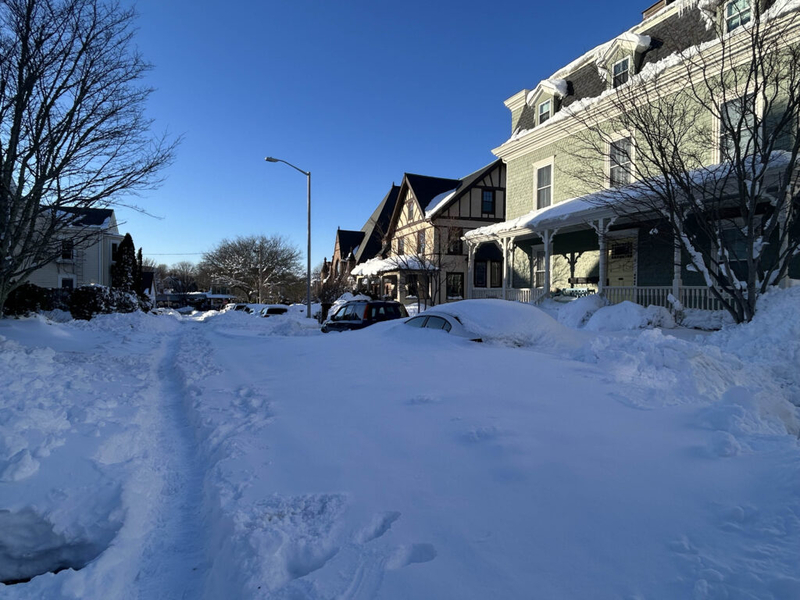
Cars parked on an unplowed street in Newport as 4:15 p.m. on Tuesday, Feb. 24, 2026. (Photo by Janine L. Weisman/Rhode Island Current)
Rhode Island’s congressional delegation is demanding answers from the Trump administration over why the Federal Emergency Management Agency (FEMA) repeatedly denied the state’s request for disaster aid following the historic February 2026 blizzard.
A Sept. 9 letter by U.S. Sens. Jack Reed and Sheldon Whitehouse along with U.S. Reps. Seth Magaziner and Gabe Amo asked the Department of Homeland Security and FEMA to preserve and provide all records related to the state’s request for a major disaster declaration in order to recover from the hurricane-strength blizzard that dumped more than 3 feet of snow.
FEMA is overseen by the Department of Homeland Security.
“To date, FEMA has not provided Rhode Island officials with a written, detailed explanation for why the state’s request was denied despite exceeding FEMA’s thresholds for assistance,” the delegation wrote.
Gov. Dan McKee submitted the state’s request for $19 million in aid on April 7 under the Stafford Disaster Relief and Emergency Assistance Act, which allows governors to either request support for disasters caused by severe weather or if “the situation is beyond the capability of the state.”
FEMA denied the state’s request on July 2. McKee appealed and the state was denied again on Sept. 2.
McKee calls FEMA’s denial of Rhode Island’s blizzard relief request ‘a new low’
On both occasions, FEMA’s leaders offered no specific reason for their decision, only stating in their denial letters that “based on our review of all of the information available, it has been determined that supplemental federal assistance under the Stafford Act is not warranted.”
FEMA Administrator Cameron Hamilton elaborated on the denial — which applied to similar requests from New York, New Jersey and Massachusetts — in an X post Sept. 3 stating neither state offered new information to consider and that “winter weather is not new to the Northeast.”
Rhode Island’s congressional delegates argue the storm “was not typical winter weather.”
Over 3 feet of snow fell across many parts of Rhode Island, with 37.9 inches of snow recorded at Rhode Island T.F. Green International Airport when the blizzard hit on Monday, Feb. 23. That surpassed the 28.6 inches that blanketed the state during the Blizzard of 1978.
The blizzard had the magnitude of a Category 2 hurricane with 74 mph wind gusts. The storm knocked out power to thousands of homes and caused $19 million in damage and cleanup costs across the state, including about $9 million in state costs and another $10 million incurred by Rhode Island’s cities and towns.
“The facts could not be clearer,” the delegation wrote. “Downplaying this devastating blizzard as just ‘winter weather’ is an insult to those whose lives and businesses were upended by the historic blizzard.”
The delegation wrote that a review of communications and records about the state’s request would illuminate how FEMA reached its decision and determine whether Hamilton’s explanation was supported by the agency’s records.
“If you fail to preserve and provide this information, it is only reasonable to assume that claim is entirely without merit,” the delegation wrote.
Asked for comment, spokespeople for FEMA and the Department of Homeland Security reiterated Hamilton’s stance that “no new information was provided” by the states who requested blizzard aid.
Providence, RI