In race to lead Texas agriculture department, Sheets and Tucker clash on data centers, credentials
Oct 15, 2026 | 12:54 pm ET
Description
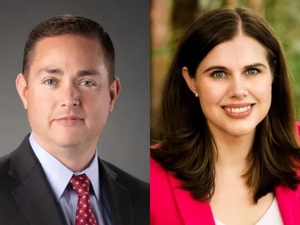
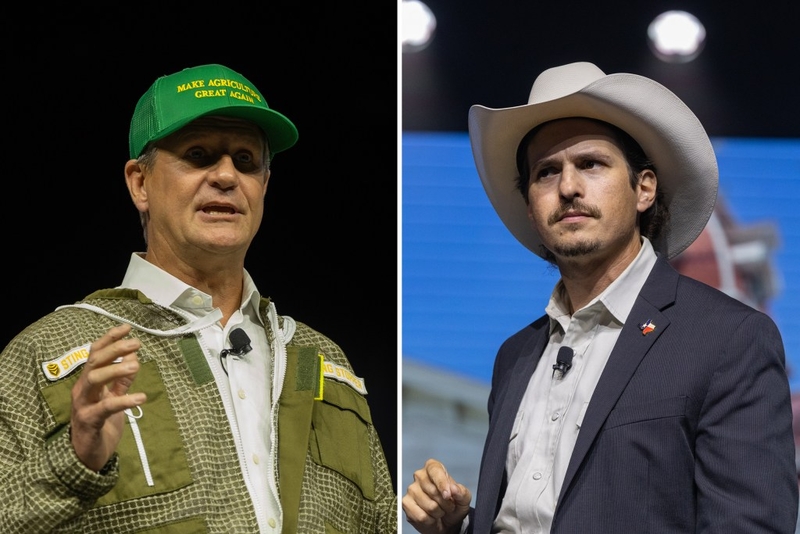
From left: Nate Sheets and Clayton Tucker, the Republican and Democratic nominees for Texas Agriculture Commissioner. (Eddie Gaspar/The Texas Tribune)
Subscribe to The Y’all — a weekly dispatch about the people, places and policies defining Texas, produced by Texas Tribune journalists living in communities across the state.
LUBBOCK — Nate Sheets and Clayton Tucker share little common ground beyond the Texas roads under the trucks they’ve driven crisscrossing the state, trawling for votes.
Both men are fifth-generation Texans who grew up in the Hill Country, and they want to be the state’s new agriculture commissioner. Yet at their cores, the two are diametrically opposed and have very different ideas for the job.
Sheets wants to make agriculture profitable for farmers and ranchers again and to see harsh chemicals taken out of food. Tucker wants to stop “irresponsible” data center companies from sucking up Texas’ resources, as well as busting corporate monopolies.
For the first time in more than a decade, Texas will have a new agriculture commissioner, and it’s a closer race than expected for the Republican-friendly state. Sheets, the Republican, has Gov. Greg Abbott’s powerful endorsement and a solid base among North Texas suburban voters. Tucker, the Democrat, built a strong backing of grassroots support as an ever-present figure at data center-related community events.
The agriculture commissioner leads one of the most complex state agencies, which has a $1.8 billion budget over two years. The department provides financial assistance to farmers and ranchers, provides infrastructure grants in rural communities for economic development, administers the National School Lunch Program to public schools and oversees SNAP and WIC benefits. It regulates scales at grocery stores and meat markets. And the state’s department of rural health is also under the agriculture department’s umbrella, as it helps rural hospitals with financial aid and technical assistance.
The winner of this election steps into a challenging time for farmers and ranchers who are looking at dried-up crops and rising inflation affecting their business. The agriculture industry has always faced hardships. The last few years have brought an onslaught of challenges that include drought, wildfires, the rising costs of business, tariffs, the loss of farm land to urban sprawl and development. Most recently, ranchers have contended with the New World screwworm while the entire industry waits for Congress to pass a long-delayed Farm Bill.
The next agriculture commissioner has another important role: He must restore the public’s trust in the department after exiting Commissioner Sid Miller fractured it. Miller faced a number of controversies in his 12-year tenure. The list includes spreading falsehoods on social media and sharing anti-Muslim rhetoric online. Miller also hired Todd Smith as his chief of staff three months after Smith pleaded guilty to commercial bribery for soliciting exorbitant fees from farmers in exchange for state hemp licenses.
“Texas farmers and ranchers are facing some of the toughest economic conditions we’ve seen in years,” said Charlie Leal, chair for the Texas Agriculture Council and state legislative director for Texas Farm Bureau. “We need a commissioner whose primary focus is the success of agriculture and the people who produce our food, fuel and fiber. Agriculture doesn’t need to be one item on a list of priorities for that ag commissioner. It needs to be the priority.”
Texas roots
Tucker, 35, grew up in Lampasas, on the edge of the Texas Hill Country. He’s worked on his family’s ranch, RX Ranch, since he was old enough to wear boots. He has also worked as a water researcher for the National Science Foundation and worked for an environmental compliance firm in Shanghai. He also taught kindergarten in Taipei.
Tucker moved back to Lampasas to help with the ranch in 2016. He began working on political campaigns and started leading a political organization founded by Jim Hightower, the last Democrat to serve as Texas agriculture commissioner. If Tucker wins, he would be the first Democrat agriculture commissioner since 1991.
After a failed Texas Senate campaign in 2020, Tucker turned his attention to other political efforts, including co-founding the Texas Grassroots Alliance and becoming secretary for the Texas Farmers Union. He also works for the Trade Justice Education Fund, a left-leaning nonprofit that advocates for better international trade policies.
Tucker’s platform includes a mandate that public school lunches be made and processed in Texas and busting monopolies that dominate the agriculture industry, such as Tyson Foods and John Deere. He wants to get harsh chemicals out of foods and make it easier for young farmers to stay in agriculture.
As the self-proclaimed “blueberry in the strawberry pie” that is his family, Tucker said he knows how to talk to Republicans and get them to focus on the issues.
“Thankfully, a lot of these issues are extremely bipartisan,” Tucker said. “Feeding kids? Extremely popular. Getting harmful chemicals out of our food? Extremely popular.”
Sheets, 56, grew up in Kyle and later served in the U.S. Navy. After his military service, Sheets bought a single beehive that eventually grew into his honey empire, Nature Nate’s. The company boasts about industry-leading testing practices for the honey industry, and Sheets added a label saying “100% Pure, Raw & Unfiltered” on each bottle, along with a bible verse. The bottles used to have Sheets’ cellphone number, and he says he talked to every customer who gave him a call.
In 2021, Sheets sold the business to Blue Road Capital. He served as CEO until 2024, before resigning to run for agriculture commissioner. Sheets now owns and operates Honey Rock Ranch, a sprawling 10,000 acres in West Texas that was once part of the historic 6666 Ranch. There, Sheets manages cow and calf operations and trains cutting horses, as well as experiments with regenerative ranching practices.
Most of Sheets’ campaign policies are rooted in his own experience — he wants trade policies that protect producers and boost their profits; cleaner food; and to grow rural economies through agricultural processing jobs. Sheets is also a self-declared member of the Make America Healthy Again movement, inspired by Health Secretary Robert F. Kennedy Jr.
Sheets has made food security a focus of his that ties into driving up profits for farmers and ranchers. The Go Texan program, an initiative by the agriculture department, connects Texas-based businesses with customers all over through branding and a directory listing. Sheets wants to expand it into an agriculture marketplace that connects consumers with local producers and ranchers, as well as manufacturers that use clean ingredients.
“Producers have lost the ability to stay in business and keep farming,” Sheets said. “As the ag commissioner, I would have the ability to try to change the economics and help farmers be more profitable.”
As far as their predecessor, Miller, and what they would do differently, Sheets and Tucker have different thoughts there as well. Tucker says his focus is on getting out the “thievin elite,” and avoiding the cultural fray.
Sheets’ answer was concise: “Well, I’m not going to hire criminals.”
Data center outrage
The data center boom is one of the most talked-about issues this election cycle. A recent poll found that 62% of people living in rural Texas oppose data center construction in their community. The industry has become so controversial that it’s fueling a wave of outrage and backlash that candidates have had to contend with. That includes the agriculture commissioner race.
Tucker has raised his profile thanks to his anti-data center stance, even though the agriculture commissioner would not have any say in data center operations. Tucker knows this, but still wants to use what political clout he would have to work with lawmakers on data centers. One of his campaign promises is to issue impact studies to force data centers to be transparent about the resources they consume.
“We’re already in a drought,” Tucker said. “The two top concerns about data centers I hear are water and power.”
Sheets, who was focused on the primary election against Miller for the first part of the year, stayed relatively quiet about data centers until the last few months. He is worried about the industry encroaching on agriculture and rural communities, he said. However, he does see it as an opportunity for the companies to pay into water and agriculture-related funds in Texas, and wants there to be some form of local control for county commissioners. He does not think there should be any tax abatements for the industry.
“They can negotiate for things like redoing all the kitchens in the schools, fixing water issues,” Sheets said. “They can go invest in the Texas Agriculture Finance Authority, which we can use to help producers because it throws off the value of the land when they come in.”
Just as the industry has woken a rage unseen in rural Texas, it animated the agriculture commissioner race. Tucker has nicknamed Sheets “Data Nate” in an effort to tie him to pro-data center policies. In turn, Sheets has called Tucker a hypocrite for making data centers a focus of his campaign while owning stock in Energy Transfer, which owns and operates natural gas transportation pipelines and storage facilities across the country.
Earlier this year, the company announced a long-term agreement with Cloudburst Data Centers to provide natural gas for an artificial intelligence-focused data center in Central Texas. Tucker told the Tribune he was unaware it had any ties to AI when he bought the stock, then said most people with a 401k have been involved in Big Tech, whether they know it or not.
“Do I plan to divest from Energy Transfer? Probably, yeah,” Tucker said. “Again, when I bought it two or three years ago, I was not aware it was related to AI. But to say you have to completely divest of stocks, I mean, you’re basically telling every American with a 401k to sell 40% of it right now.”
Tucker said his holdings are minuscule compared to Sheets’. Sheets owns stock in Riot Platforms, a large-scale data center developer.
A messy race
Sheets and Tucker have both taken to the road the last few weeks as early voting approaches. Tucker has driven more than 84,000 miles since the start of his campaign last year, he said. That’s the equivalent of driving from Amarillo to Brownsville about 100 times. Sheets is visiting three counties a day as part of his rural road tour.
The campaign has been contentious — and personal.
It started when Sheets faced Miller in the primary election. Abbott delivered a major blow to Miller’s reelection campaign when he endorsed Sheets.
Despite his loss, Miller has been a looming presence in the agriculture commissioner race. Miller has popped up at data center meetings Tucker is also attending. Miller has been on a warpath against Abbott this year, and said Republicans will lose the agriculture office, as well as other statewide offices, this election cycle.
The mudslinging took a turn late last month when attorneys for Tucker accused Sheets of being ineligible to serve in the role.
There are four ways to qualify to serve as agriculture commissioner: the person must have been engaged in agricultural business for at least five of the 10 years before the year they plan to be elected; worked for five years in a state or federal agency in a role directly related to agriculture; have owned or operated a farm, ranch, or timber land that qualifies for agricultural use for at least five of the 10 years before an election; or have worked for at least five years for the Texas Agricultural Council, a member organization, or another agricultural producer association.
In a letter to D’rinda Randall, chair of the Republican Party of Texas, Tucker’s attorneys cite several records that they say prove Sheets has not owned his ranch long enough — he is one year shy of the five-year criteria — and his honey company is not considered an agricultural business. They asked the GOP to review and potentially declare Sheets ineligible. Representatives for the party did not respond to requests from The Tribune.
Tucker said the qualifications do not include apiaries, a business containing bees. The rules aren’t perfect, he said, but right now, “the law is the law.”
“For right or for wrong, bees do not count,” Tucker said. “Would I recommend the ag code be adjusted to include that? Yeah, I probably would because I do believe in fairness. But I also believe in following the law.”
Sheets believes Miller is behind the accusation, as the outgoing agriculture commissioner made the same accusation before he lost the primary to Sheets earlier this year. Sheets said Miller tried to have him disqualified for the same reason. Sheets disputes the accusations, saying he has owned Nature Nate’s Farm since 2012 and has worked in agriculture production for 30 years.
Sheets has also accused Tucker of being ineligible, citing a personal financial statement where Tucker lists his occupation as a community organizer for a political group in Washington, D.C. He also says the ranch Tucker claims is not under his name, which Tucker does not dispute.
“He likes to say he’s a rancher because his grandma owns a goat farm, and she owns the land,” Sheets said. “He has no land. He’s a rancher because he has a cowboy hat his mom bought him. His ranch assets are $11,000 to $22,000, the mower shredder that goes on the back of my tractor costs twice that amount.”
Sheets added, “So if we apply the standard he’s trying to apply to me, then he should be ripped off the ballot so quick it makes his head spin.”
The Tribune reviewed documents and photos sent by Tucker to prove he has worked on the ranch for several years. The documents include a valid state timber registration, along with dozens of photos and videos dating back to 2018 showing Tucker working on the ranch.
It is a close race. A poll by Texas Southern University, conducted last month, found Sheets leads Tucker by 6% points. However, the same poll found that an overwhelming majority of likely voters do not know enough about either candidate to have an opinion about them.
“That’s usually good news for a Republican,” said Mark Jones, a political science professor at Rice University. “When that occurs, people tend to vote based on partisanship, and that’s a winning outcome for Republicans generally in statewide races.”
Disclosure: Texas Farm Bureau has been a major financial supporter of The Texas Tribune. Energy Transfer, Rice University and Texas Agriculture Council have been financial supporters within the past five years. The Texas Tribune is a nonprofit, nonpartisan news organization that is funded in part by donations from members, foundations and corporate sponsors. Financial supporters play no role in our journalism. Find a complete list of them and more information about our financial and disclosure policies here.
Austin, TX