Suit challenges Trump administration move to allow some ICE presence at polling places
Description
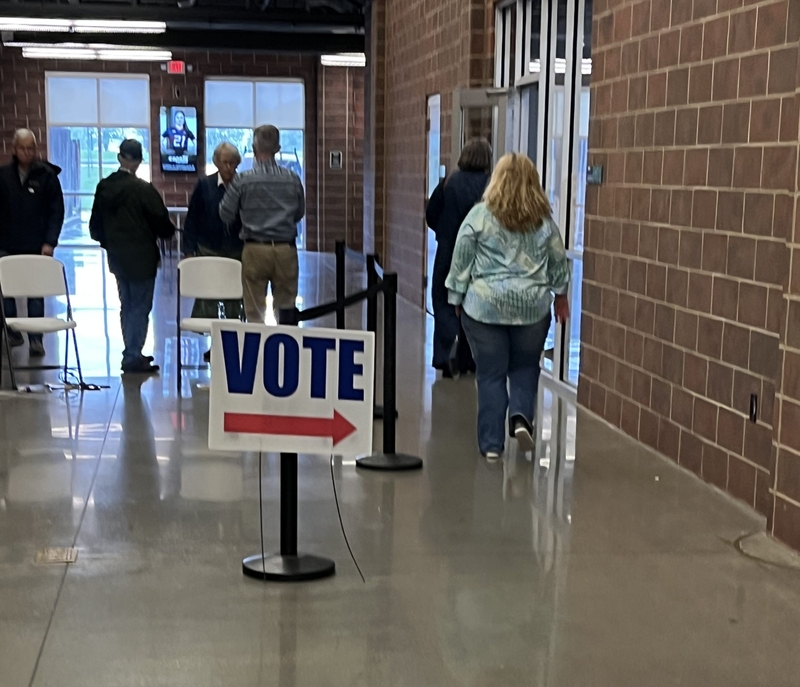
Voters head into a polling site at Grand Park in Westfield, Indiana, on May 5, 2026. (Photo by Tom Davies/Indiana Capital Chronicle)
WASHINGTON — Latino advocacy groups and voting rights organizations Thursday filed a suit in federal court challenging the Trump administration's policy of allowing U.S. Immigration and Customs Enforcement officers to enter polling locations in certain circumstances to conduct immigration enforcement during the 2026 midterm elections.
The suit in the District Court for the District of Columbia argues that Homeland Security Secretary Markwayne Mullin’s recent comments that ICE agents would be at polling locations for the purpose of immigration enforcement violates federal law that prohibits federal “armed men” at election sites.
The statute allows for “troops” or “armed men” at polling locations only if “such force be necessary to repel armed enemies of the United States.”
“The specter of armed officers at polling places threatens the freedom of this upcoming election,” according to the lawsuit. “It places voters in fear that they will be confronted by armed federal immigration enforcement officers if they choose to cast a ballot.”
In a statement to States Newsroom, a DHS spokesperson said that “ICE is not planning operations targeting polling locations.”
“ICE conducts intelligence-driven targeted enforcement, and if an active public safety threat endangered a polling location, they may be arrested as a result of that targeted enforcement action,” the spokesperson said.
Earlier this month, Mullin said that ICE officers at polling locations would be there “to enforce specific threats.”
“The only reason why we would be at polling places, if there is a threat to that polling place or we’re serving a warrant on someone that we have been actively tracking down,” he said. “ICE’s job is immigration (and) custom enforcement. That’s their job and so if we’re doing something, we’re doing that specifically.”
The suit asks the federal court to prevent the Trump administration from following that polling place policy and declaring it unlawful, as well as barring “officers from operating or carrying weapons in the vicinity of open polling places, including dropboxes, curbside voting locations, and similar places where votes are taken, collected, received, counted, or certified during early voting periods and on Election Day itself, for any reason other than repelling armed enemies of the United States.”
The civil rights groups that joined the suit said the tactic would lead to voter suppression.
“Sending armed ICE officers to polling places is not immigration enforcement — it is voter suppression, plain and simple,” UnidosUS President Janet Murguía said in a statement. “All Americans — including Latino voters — have a constitutional right to cast their ballot without fear of interrogation, detention, or family separation.”
The suit was filed by the oldest U.S. Latino civil rights organization, League of United Latin American Citizens, or LULAC; the largest Hispanic civil rights organization, UnidosUS; the voter mobilization group Common Cause; and the city and county of Denver, Colorado, which has a large immigrant population and has been targeted by ICE multiple times for immigration enforcement.
“The right to vote, and to do so without fear of intimidation, is fundamental to our democracy and to being an American,” Denver Mayor Mike Johnston said in a statement. “Stationing ICE agents near polling places is only meant to scare people and suppress votes. We’ll fight tooth and nail to prevent it.”
All States Newsroom content is free to republish. Read our republishing policy for more information.