State Supreme Court to consider lawsuit that challenges Act 10
Nov 11, 2026 | 4:35 pm ET
Description
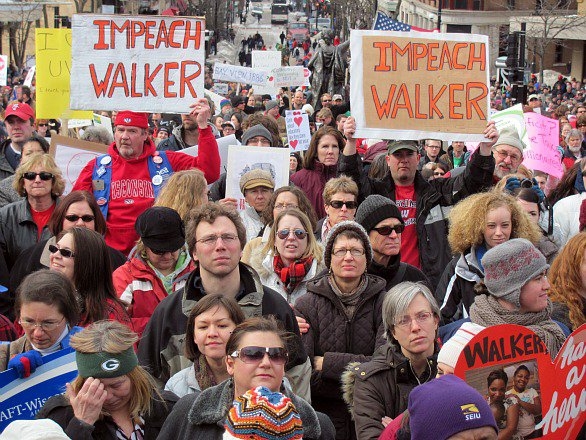
Act 10 protesters at the Wisconsin State Capitol in 2011. (Photo by Bill Lueders/Isthmus. Used with permission)
Under an order issued Wednesday, the Wisconsin Supreme Court will take up a challenge to Act 10, the 2011 state law stripping collective bargaining rights from most public employees.
The order was issued as Wisconsin’s governor-elect and leaders of the Legislature’s incoming Democratic majority prepare to take office, with many of them on record in support of repealing the law.
A Dane County circuit judge found Act 10 unconstitutional in December 2024 on the grounds that it treated two groups of public safety employees differently “with no rational basis for that difference.”
The Wisconsin 2nd District Court of Appeals overturned the lower court in July.
Former Republican Gov. Scott Walker introduced the law early in his first term when there was a Republican majority in both houses of the Legislature. It passed after weeks of protests and despite an effort by state Senate Democrats to thwart the legislation by leaving the state and huddling in northern Illinois.
Justice Annette Ziegler dissented from the Court’s order to take the case Wednesday. Supreme Court Justice Brian Hagedorn, who was Walker’s chief legal counsel, helped write the law and later defended it in a federal court case, didn’t participate in the justices’ discussion over taking the case. Hagedorn had already signaled he would recuse himself from the Act 10 lawsuit in an earlier procedural ruling.
Act 10 blocked public employee unions from collective bargaining on any topics other than wages and restricted wage negotiations to increases that were up to the inflation rate. The law made police officers and firefighters exempt from the law’s restrictions.
The lawsuit against Act 10 was filed by a coalition of unions, led by the Abbotsford Education Association in November 2023. Just over a year later, Dane County Circuit Court Judge Jacob Frost found the law unconstitutional because its exemptions for police and firefighters excluded other state law enforcement and public safety employees, such as state Capitol Police, University of Wisconsin Police, and state conservation wardens.
“Act 10 as written by the Legislature specifically and narrowly defines ‘public safety employee,’” Frost wrote in the December 2, 2024 decision. “It is that definition which is unconstitutional.”
On the appeals court, Judge Mark Gundrum, one of the court’s two conservative judges who supported the ruling, wrote that it wasn’t the courts’ role to pass judgement on the Legislature’s reasoning for making that distinction — only to determine “any reasonably conceivable state of facts that could provide a rational basis for the classification.” Judge Shelley Grogan joined Gundrum in the ruling.
Judge Lisa Neubauer dissented, arguing that the state’s equal protections clause requires “rational” reasoning from the Legislature, that financial savings weren’t enough and that the Legislature’s reasoning doesn’t make sense because of similarities among public safety employees whether or not they were exempt from the law.
Madison, WI