Citizens-only voting petition sponsors look to 2028 after initiative fails before state canvassers
Sep 10, 2026 | 8:35 am ET
Description
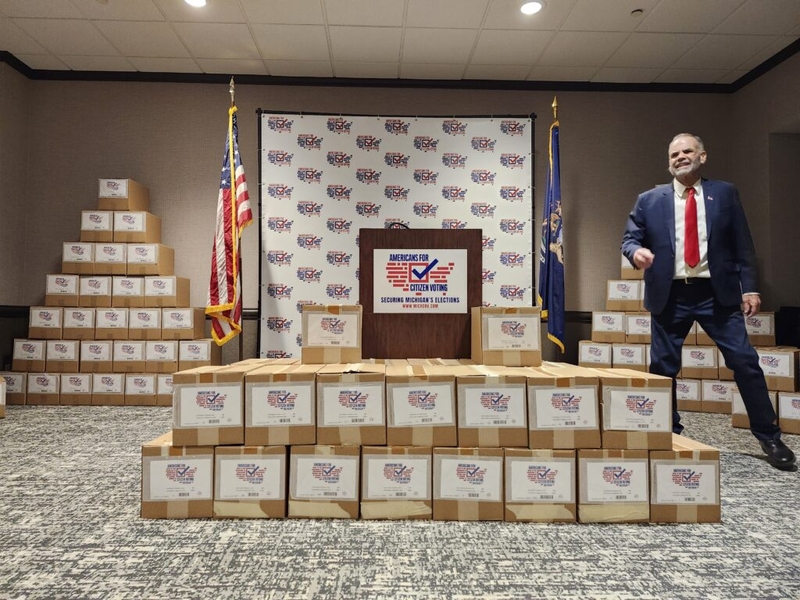
Kurt O'Keefe, one of the organizers behind Americans for Citizen Voting Michigan, a ballot committee dedicated to enacting voter ID and citizen-only voting in Michigan, lords over several boxes of petition signature sheets as the group prepares to deliver them to the Michigan Department of State. The group said it collected more than 750,000 signatures, which still need to be reviewed for validity by the state's Bureau of Elections. March 4, 2026 | Photo by Ben Solis/Michigan Advance
In the wake of decisions from both the Supreme Court of the United States and the Michigan Supreme Court not to hear appeals from sponsors of a citizens-only voting ballot petition, the leaders behind the initiative are promising to come back stronger in 2028.
The effort before the court sought to overturn a decision from the Board of State Canvassers and put the measure on the November general election ballot. That effort ultimately failed both at the federal and state level.
Paul Jacob, the chair of Americans for Citizen Voting-Michigan, told the Michigan Advance that for conservative ballot initiatives, “you cannot go in with simply enough signatures according to the law.”
“We have to get way more than that many signatures,” Jacob said. “We have to be cheat-proof and rig-proof, and that is what we’re going to be looking to do in 2028, is to come back with enough signatures that they can’t effectively cheat us.”
Meanwhile, the initiative’s opponents have emphasized that proper procedure was followed by state election officials in denying the measure a spot in 2026.
Chris Thomas was Michigan’s Director of Elections from 1981 to 2017, across leadership of both parties. In an interview, Thomas said the assertion that the measure was somehow cheated by the Michigan Bureau of Elections, or the state’s canvassers, was pure “nonsense.”
“That’s not anybody treating them adversely. That’s their own problem. It’s their own quality control, and I think that’s the case here,” Thomas said. “What appears to me is that they had this overwhelming number, and they thought they could push it through, and they almost did. They were only a couple signatures short at the end of the day, but had there been some better screening of the petition as it was being delivered to them, and better education of the circulators, a lot of these categories could have been improved.”
Thomas added that the group only needs “to improve them marginally in order to get over the top.”
“So I don’t think this is anybody going out to get them,” Thomas said. “I think that’s a ridiculous claim.”
Mark Brewer, an election lawyer who worked with Promote MI Vote, a group in opposition to the proposal, also rejected allegations of partisanship from the Board. Brewer also told the Advance that the procedure followed by the Board of State Canvassers and eventually the courts was “routine,” and that Americans for Citizen Voting-Michigan “was not treated worse than anybody else.”
Sponsors of the petition filed appeals with both the state and federal high courts, seeking to overturn the deadlocked decision by the Michigan Board of State Canvassers, which left the proposal off the ballot due to a lack of valid petition signatures, by a margin of just a few signatures in a sampling process.
Thomas said that the sampling process showed that the system works.
“That random sampling process has served Michigan well over the decades, and there’s always disappointment,” Thomas added. “They only had to get 62.9% of their signatures to be valid. That’s a pretty low bar that they failed to reach.”
Neither Jacob nor Thomas seemed surprised that the U.S. Supreme Court chose not to take up the case — though for different reasons.
The Michigan Supreme Court obviously had some discomfort, but looked at the facts and the law, and decided that there really wasn’t anything for them to do.
Jacob emphasized the last-minute nature of the appeal, given that the Michigan Department of State must have November ballots finalized by Friday, Sept. 3. The case with the Michigan Supreme Court was filed Aug. 27, and the application to the U.S. Supreme Court was filed Aug. 31.
Thomas, however, said that he believes it was appropriate for the U.S. Supreme Court not to be involved in the decision.
The decision from the U.S. Supreme Court came from Justice Brett Kavanaugh, who serves as the circuit justice for the Sixth Circuit Court, which includes Michigan. He did not publish an opinion alongside the decision, the court’s docket shows.
Brewer took Kavanaugh’s decision not to publish an opinion as a “signal about how weak he thought those claims were.”
“What Americans for Citizen Voting-Michigan was asking for was extraordinary, unprecedented,” he continued. “The United States Supreme Court has never done what they asked for. Not only was it premature, but the court has never ordered a ballot proposal on the ballot, basically overriding what the state authorities have done, overriding the state courts.”
But while Jacob expressed disappointment in Kavanaugh’s decision, he was far more unhappy with the Michigan Supreme Court, which did not issue its own ruling until after the federal court had made its decision.
“The Michigan Supreme Court refuses to do anything. Crickets. They didn’t make any announcement. Didn’t ask the other side to brief the issue, and so we had no choice but to go to the U.S. Supreme Court, and again, we appreciate Justice Kavanaugh taking it up and at least asking for briefs to be filed,” he said. “But this, it’s not fair. It’s not fair to us. It’s not fair to the people who signed this petition.”
The Michigan Supreme Court did publish an opinion on its decision not to grant relief in the complaint for mandamus and declaratory judgment.
“The Michigan Supreme Court obviously had some discomfort, but looked at the facts and the law, and decided that there really wasn’t anything for them to do,” Thomas said. “Mandamus did not stand because these were discretionary acts, and that’s what you need in Mandamus, is to have non-discretionary acts.”
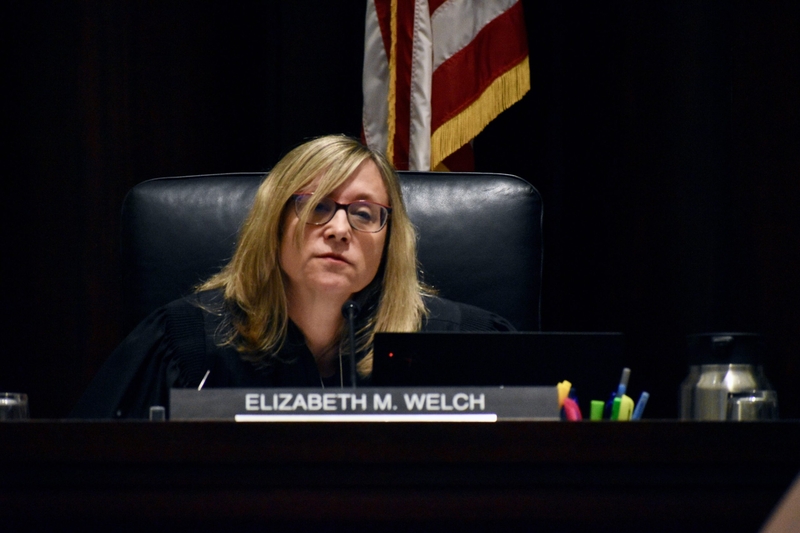
As for that discomfort, Thomas explained, judges pointed out potential changes to election law that might need to be changed or reconsidered by the Legislature — for example, Justice Elizabeth Welch noted that she had raised concerns about the Legislature’s policies regarding the signature verification process.
Welch also said that Justice Brian Zahra, as the court discussed the matter, raised important policy concerns about the manner in which signatures are canvassed, “but again, only the Legislature can fix that process.”
Thomas said he would expect changes to election law to be on the Legislature’s agenda next year.
The Michigan Supreme Court’s decision was nearly unanimous, with a partial concurrence and partial dissent from Zahra, the sole Republican on the court.
“With regard to the five affidavits rejected as untimely, I concur in the denial of the writ of mandamus,” Zahra wrote. “Enforcement of deadlines is a discretionary function not subject to a writ of mandamus. I dissent, however, from the court’s refusal to vacate the order rejecting four affidavits because the affiant’s signature allegedly did not match the digital signature for the voter in the Qualified Voter File.”
Zahra continued on to say that he believed that due process was violated in those four cases, and that he would have remanded the decision to the Board of State Canvassers to consider those four affidavits.
As for what happens through November, the attempts to put the initiative on the ballot were officially dead in the water once both courts made their rulings.
But Jacob says that his group intends to use the decision from the Board of State Canvassers in messaging through the general election.
Brewer in turn said that the decision “was very much in line with decades of Michigan precedents by conservative courts, by liberal courts, that this is the way mandamus operates, and Americans for Citizen Voting-Michgian simply failed to meet the standard.”
Lansing, MI