US Supreme Court again blocks use of Missouri’s gerrymandered congressional map
Sep 10, 2026 | 10:41 am ET
Description
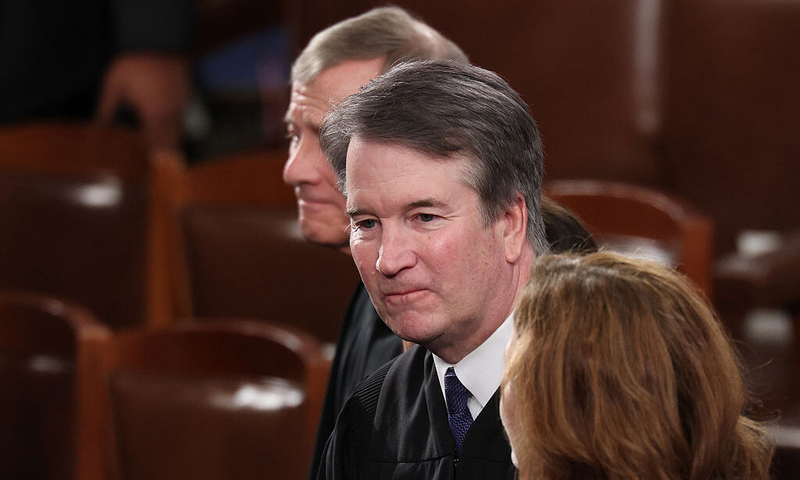
Supreme Court Associate Justice Brett Kavanaugh attends the State of the Union address during a Joint Session of Congress at the U.S. Capitol on Feb. 24 in Washington, DC. (Win McNamee/Getty Images).
The U.S. Supreme Court on Thursday blocked a federal judge’s order requiring Missouri to use a gerrymandered congressional map in November, putting the state back on course to conduct the election using districts drawn in 2022.
In a one-page order, the court granted an emergency request from a political action committee called People Not Politicians and its executive director, Richard von Glahn, to stay a temporary restraining order issued Tuesday by Chief U.S. District Judge Stephen Clark in St. Louis.
Justice Brett Kavanaugh, who handles emergency matters from Missouri, referred the request to the full court. The unsigned order did not disclose the vote or explain the court’s reasoning, and no justice publicly dissented.
In a hearing before the state Supreme Court Thursday morning, an attorney representing Secretary of State Denny Hoskins said unless some other federal court says otherwise, the intent is to is to conduct the November election using the 2022 map.
Thursday’s ruling is the latest turn in a legal fight that has bounced between the Missouri Supreme Court, a federal district judge, the 8th U.S. Circuit Court of Appeals and the U.S. Supreme Court in the span of a week.
Its immediate effect is to revive a unanimous Missouri Supreme Court ruling from Sept. 3 that found the gerrymandered 2025 congressional map never took effect because it was suspended by a valid referendum petition.
The state court ordered Secretary of State Denny Hoskins to place the referendum on the Nov. 3 ballot as Proposition A and conduct this year’s congressional election using the map adopted in 2022.
“The law is the law, the Missouri Constitution is clear as was the Missouri Supreme Court,” von Glahn said in an emailed statement, later adding: “The courts have settled this, now it’s up to Missouri voters to finish the job and vote NO on Proposition A.”
Republican lawmakers approved the new map during a 2025 special session called by Gov. Mike Kehoe. The plan was designed to make the Kansas City-based 5th Congressional District, represented by Democratic U.S. Rep. Emanuel Cleaver, more favorable to Republicans.
People Not Politicians gathered more than 300,000 signatures seeking a statewide vote on the plan.
Hoskins rejected the referendum petition on Aug. 4, the day of Missouri’s primary, citing constitutional objections raised by Attorney General Catherine Hanaway. The Missouri Supreme Court concluded last week that the petition was legal, sufficient and timely and that the 2022 map remained the only congressional map in effect.
Hoskins and Hanaway immediately sought emergency relief from the U.S. Supreme Court. Kavanaugh rejected that request Tuesday without referring it to the full court.
Missouri Supreme Court blocks gerrymandered congressional map, orders referendum vote
Minutes later, however, Clark issued a 14-day temporary restraining order in a separate federal lawsuit filed by Republican candidates and voters. Clark ordered Missouri to use the 2025 map in November, concluding that changing district lines after candidates had been nominated in the August primary could violate voters’ federal constitutional rights.
Clark wrote that voters moved into different districts would be forced to choose among candidates they had no opportunity to help nominate and that switching maps could disrupt the election.
People Not Politicians appealed. The 8th Circuit declined Wednesday to stay Clark’s order, sending the group back to Kavanaugh with an emergency application.
The group argued that Clark lacked authority to issue the order without convening a three-judge court, as federal law generally requires for constitutional challenges involving congressional apportionment. It also argued that the federal court had improperly interfered with a state court’s interpretation of Missouri law just weeks before an election.
Missouri and Hoskins opposed the stay, joined by the U.S. solicitor general. They argued that People Not Politicians lacked standing to pursue the appeal and that forcing the state to change maps again would cause severe election-administration problems.
Hoskins told the court that election authorities were already preparing ballots using the 2025 map and warned that switching back to the 2022 districts could jeopardize the Sept. 19 deadline for sending ballots to military and overseas voters.
The U.S. Supreme Court granted the stay anyway.
Thursday’s order does not resolve the underlying federal lawsuit or explain whether the justices agreed with People Not Politicians on standing, the three-judge court requirement or the merits of Clark’s constitutional analysis.
Instead, the court ordered Clark’s ruling stayed while the appeal proceeds in the 8th Circuit and, if necessary, through a petition asking the U.S. Supreme Court to hear the case. If the justices ultimately refuse to hear the case, the stay ends automatically.
For now, however, the order removes the federal ruling that had directly conflicted with the Missouri Supreme Court. That means election officials are once again under an order to use the 2022 congressional districts in November.
“Missouri Republicans have played their last card, and they lost,” said Abha Khanna, attorney for People Not Politicians.
The ruling came the same morning Hoskins was scheduled to appear before the Missouri Supreme Court to answer allegations that he violated its Sept. 3 order by directing election officials to implement the 2025 map.
The dispute has left local election authorities racing against the calendar. Some counties paused work on congressional ballots while others prepared the portions of ballots unaffected by the map fight, waiting for courts to settle which districts should be used.
Under the Missouri Supreme Court ruling now back in effect, voters will decide Proposition A in November. If voters reject the 2025 map, the 2022 districts remain in place. If they approve it, the new map can take effect after the election.
For this election, at least for now, Missouri is back to the old lines.
This story will be updated.
Jefferson City, MO