Rick Jackson pledges ‘intelligent’ Medicaid expansion, but offers few specifics
Sep 09, 2026 | 5:00 am ET
Description
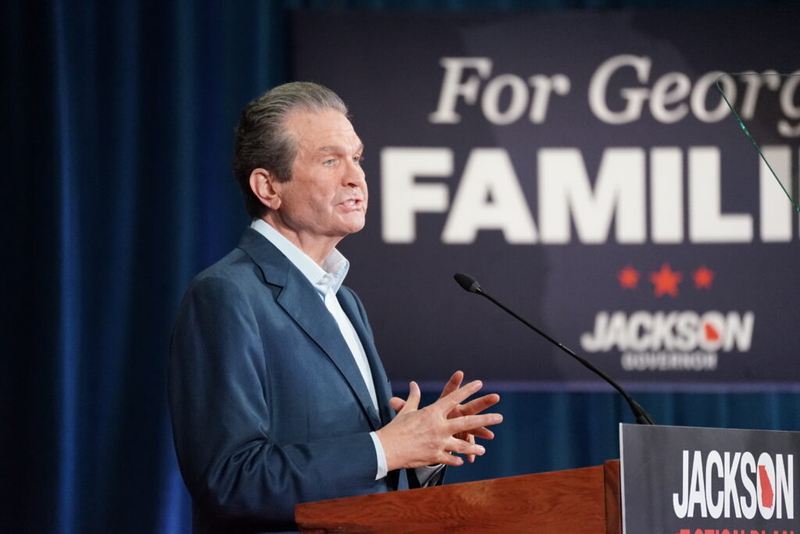
Wealthy businessman Rick Jackson, the Republican nominee for governor, unveiled his plan for covering more people with health insurance and reducing costs in north Atlanta on Sept. 8, 2026. Alander Rocha/Georgia Recorder
Republican candidate for governor Rick Jackson unveiled a health insurance plan he said will cover more Georgians and reduce healthcare costs, but how he would achieve that remains unclear.
“On day one, I will close the coverage gap with intelligent Medicaid expansion,” said Jackson, a wealthy businessman who made his fortune in healthcare, Tuesday at an event in north Atlanta.
His plan would rely in part on getting enhanced Medicaid funding from the federal government, which is available to states that have fully expanded Medicaid, something Georgia has not done. His proposal wasn’t clear how he would get that funding without providing coverage for those with income levels up to 138% of the federal poverty line – or about $22,025 for a single adult – a requirement for the enhanced federal funding.
Under Republican Gov. Brian Kemp’s “Pathways” partial expansion of Medicaid, only those earning up to 100% of the federal poverty level are included. Those making above 100%, or around $16,000 for a single adult, don’t get Medicaid, but instead get subsidized plans on the Affordable Care Act Marketplace. Jackson said he likes that those people get those private plans, which may have more robust coverage.
But under federal law, states must provide health insurance to the full Medicaid expansion population to receive 90% of Medicaid funding, and because Georgia only partially expanded Medicaid, it still only receives about 66% of its Medicaid funding from the federal government.
Kemp requested the same enhanced funding included in Jackson’s plan during the first Trump administration, but was denied by the Centers for Medicare and Medicaid Services. The governor recently asked the second Trump administration to reconsider in lieu of federal changes that require states to provide exemptions to work requirements that Georgia did not previously have.
Jackson’s plan would not shift “people who have subsidized private plans onto a government plan,” he said.
Jackson spokesperson Garrison Douglas said after the event that the campaign plans to pursue a new waiver that would replace the current Pathways program while keeping its work requirement to secure the enhanced funding, but he did not say what Jackson would do differently that would incentivize the Trump administration to approve the enhanced federal funding that has never been granted. Douglas added that getting that special approval will “require [Georgia] to be working with the federal government through the waiver process.”
“Rick Jackson’s focus is going to be making sure we’re going to be continuing to make sure we have a strong relationship with the federal government and being able to make that happen,” Douglas said.
Jackson’s proposal for a new Medicaid waiver caps a broader health care platform that includes building 500 new inpatient psychiatric beds across the state and putting more resources into prenatal and postpartum care, as well as cracking down on insurance practices that deny or delay care.
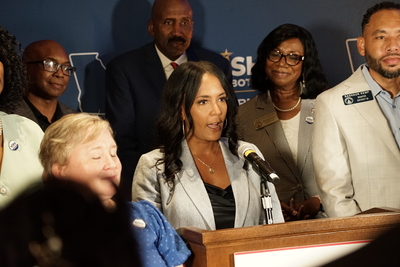
Full Medicaid expansion has been the cornerstone of Jackson’s Democratic opponent, former Mayor of Atlanta Keisha Lance Bottoms, who at a recent event defended her position to expand Medicaid despite federal changes that make the program more restrictive, saying that the state cannot bypass the enhanced federal funding that comes with full expansion and Georgians would have access to the “federal dollars that we’ve left on the table.”
“We’ve left over $700 million on the table because we’ve not expanded,” she said. “We may not be able to access all of that money, but we are paying for health care across this country. We just don’t have it in this state. So whatever steps we can take, whatever money is there, I don’t care if it’s $10 that we left on the table. We’re going to get that $10.”
“Is it ideal? It may not be ideal at this point, but we need to take whatever steps are available to us to get us closer to having a healthy and whole state,” she added.
Atlanta, GA