The Rev. Martin Luther King Jr.’s address to the AFL-CIO fourth constitutional convention
Sep 07, 2026 | 6:59 am ET
Description
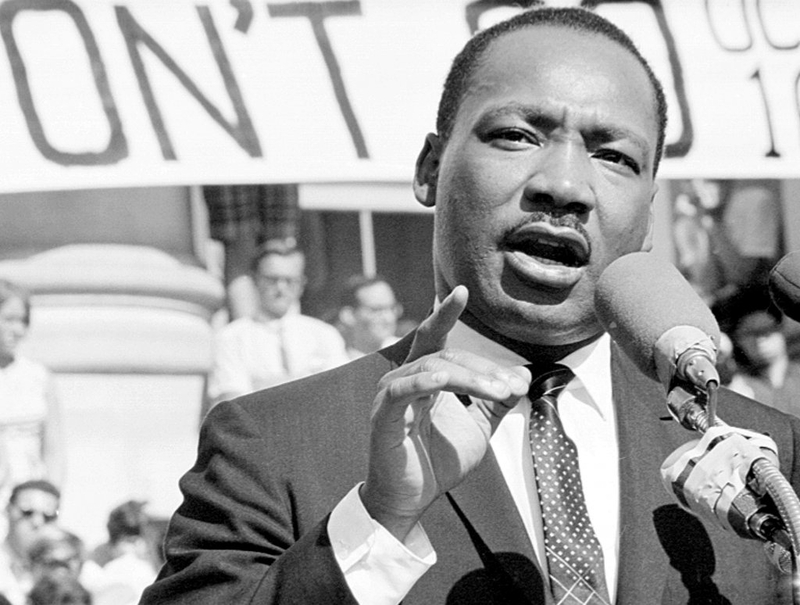
King fought for economic justice, too. (Photo by Getty Images)
Edtior’s note: The following are excerpts of King’s speech in Dec. 1961, when he sought to explain the shared interests of the Civil Right Movement and organized labor. Courtesy of the Stanford University Martin Luther King, Jr. Research and Education Institute.
Less than a century ago, the laborer had no rights, little or no respect, and led a life which was socially submerged and barren. He was hired and fired by economic despots whose power over him decreed his life or death. The children of workers had no childhood and no future; they too worked for pennies an hour, and by the time they reached their teens, they were worn-out old men, devoid of spirit, devoid of hope, and devoid of self-respect. Jack London described the child worker in these words: “He did not walk like a man. He did not look like a man. He was a travesty of the human. It was a twisted and stunted and nameless piece of life that shambled like a sickly ape, arms loose-hanging, stoop-shouldered, narrow-chested, grotesque and terrible.” American industry organized misery into sweatshops and proclaimed the right of capital to act without restraints and without conscience. Victor Hugo, literary genius of that day, commented bitterly that there was always more misery in the lower classes than there was humanity in the upper classes.
The inspiring answer to this intolerable and dehumanizing existence was economic organization through trade unions. The worker became determined not to wait for charitable impulses to grow in his employer. He constructed the means by which a fairer sharing of the fruits of his toil had to be given to him, or the wheels of industry, which he alone turned, would halt and wealth for no one would be available. This revolution within industry was fought bitterly by those who blindly believed their right to uncontrolled profits was a law of the universe, and that without the maintenance of the old order, catastrophe faced the nation. But history is a great teacher. Now everyone knows that the labor movement did not diminish the strength of the nation but enlarged it by raising the living standards of millions. Labor miraculously created a market for industry and lifted the whole nation to undreamed-of levels of production. Those who today attack labor forget these simple truths, but history remembers them.
Labor’s next monumental struggle emerged in the thirties, when it wrote into federal law the right freely to organize and bargain collectively. It was now apparently emancipated. The days when workers were jailed for organizing and when in the English parliament, Lord Macaulay had to debate against a bill decreeing the death penalty for anyone engaging in a strike were grim but almost-forgotten memories. Yet the Wagner Act, like any other legislation, tended merely to declare rights but did not deliver them. Labor had to bring the law to life, by exercising in practice its rights over stubborn, tenacious opposition. It was warned to go slow, to be moderate, not to stir up trouble. But labor knew it was always the right time to do right, and it spread its organization over the nation and achieved equality, organizationally, with capital, and the day of economic democracy was born.
Negroes in the United States read this history of labor and find that it mirrors their own experience. We are confronted by powerful forces, telling us to rely on the goodwill and understanding of those who profit by exploiting us. They deplore our discontent, they resent our will to organize so that we may guarantee that humanity will prevail and equality will be exacted. They are shocked that action organizations, sit-ins, civil disobedience and protests are becoming our everyday tools, just as strikes, demonstrations and union organization became yours to ensure that bargaining power genuinely existed on both sides of the table. We want to rely upon the goodwill of those who would oppose us. Indeed, we have brought forward the method of nonviolence to give an example of unilateral goodwill in an effort to evoke it in those who have not yet felt it in their hearts. But we know that if we are not simultaneously organizing our strength, we will have no means to move forward. If we do not advance, and the crushing burden of centuries of neglect and economic deprivation will destroy our will, our spirits and our hopes. In this way, labor’s historic tradition of moving forward to create vital people as consumers and citizens has become our own tradition and for the same reasons.
This unity of purpose is not an historical coincident. Negroes are almost entirely a working people. There are pitifully few Negro millionaires and few Negro employers. Our needs are identical with labor’s needs: decent wages, fair working conditions, livable housing, old-age security, health and welfare measures, conditions in which families can grow, have education for their children, and respect in the community. That is why Negroes support labor’s demands and fight laws which curb labor. That is why the labor-hater and labor-baiter is virtually always a twin-headed creature, spewing anti-Negro epithets from one mouth and anti-labor propaganda from the other mouth.
The duality of interests of labor and Negroes makes any crisis which lacerates you a crisis from which we bleed. And as we stand on the threshold of the second half of the 20th century, a crisis confronts us both. Those who in the second half of the 19th century could not tolerate organized labor have had a rebirth of power and seek to regain the despotism of that era, while retaining the wealth and privileges of the 20th century. Whether it be the ultra-white right wing in the form of Birch Societies the alliance which former President Dwight Eisenhower denounced, the alliance between big military and big business, or the coalition of southern Dixiecrats and northern reactionaries — whatever the form, these menaces now threaten everything decent and fair in American life. Their target is labor, liberals and Negro people, not scattered reds or even Justice (Earl) Warren, former Presidents Eisenhower and Harry Truman, and President John F. Kennedy, who are in truth beyond the reach of their crude and vicious falsehoods.
Labor today faces a grave crisis, perhaps the most calamitous since it began its march from the shadows of want and insecurity. In the next 10 to 20 years, automation will grind jobs into dust as it grinds out unbelievable volumes of production. This period is made to order for those who would seek to drive labor into impotency by viciously attacking it at every point of weakness. Hard-core unemployment is now an ugly and unavoidable fact of life, and like malignant cancer, it has grown year by year and continues its spread. But automation can be used to generate an abundance of wealth for a people or an abundance of poverty for millions as its human-like machines turn out human scrap, along with machine scrap, as a by-product of production. And I am convinced that our society, with its ability to perform miracles with machinery, has the capacity to make some miracles for men, if it values men as highly as it values machines.
To find a great design to solve a great problem, labor will have to intervene in the political life of the nation, to chart a course which distributes the abundance to all instead of concentrating it among a few. The strength to carry through such a program requires that labor know its friends and collaborate as a friend. If all that I have said is sound, labor has no firmer friend than the 20 million Negroes whose lives will be deeply affected by the new patterns of production.
Now to say that we are friends would be an empty platitude if we fail to behave as friends and honestly look to weaknesses in our relationship. And unfortunately, there are weaknesses. Labor has not adequately used its great power, its vision and resources to advance Negro rights. Undeniably, it has done more than other forces in American society to this end. Aid from real friends in labor has often come when the flames of struggle heighten, but Negroes are a solid component within the labor movement and a reliable bulwark for labor’s whole program and should expect more from it, exactly as a member of a family expects more from his relatives than he expects from his neighbors. Labor, which made impatience for long-delayed justice for itself a vital motive force, cannot lack understanding of the Negro’s impatience. It cannot speak with the reactionary’s calm indifference of progress around some obscure corner, yet not yet possible even to see. That is a maximum in the law: justice too long delayed is justice denied.
How can labor rise to the heights of its potential statesmanship and cement its bonds with Negroes to their mutual advantage? First, labor should accept the logic of its special position with respect to Negroes and the struggle for equality. Although organized labor has taken actions to eliminate discrimination in its ranks, the standard expected of you is higher than the standard for the general community. Your conduct should and can set an example for others, as you have done in other crusades for social justice. You should root out vigorously every manifestation of discrimination so that some internationals, central labor bodies, or locals may not besmirch the positive accomplishments of labor. I am aware that this is not easy, nor popular, but the eight-hour day was not popular, nor easy to achieve, nor was a closed shop, nor was the right to strike, nor was outlawing anti-labor injunctions. But you accomplished all of these with a massive will and determination. And out of such struggle for democratic rights you won both economic gains and the respect of the country, and you will win both again if you will make Negro rights a great crusade.
Second, the political strength you are going to need to prevent automation from becoming a Moloch, consuming jobs and contract gains, can be multiplied if you tap the vast reservoir of Negro political power. Negroes, given the vote, will vote liberal and labor, because they need the same liberal legislation labor needs. To give just an example of the importance of the Negro vote to labor, I might cite the arresting fact that the only state in the South which repealed the right-to-work law is Louisiana. And this was achieved because the Negro vote in that state grew large enough to become a balance of power, and it went along with labor to wipe out anti-labor legislation.
The two most dynamic and cohesive liberal forces in the country are the labor movement and the Negro freedom movement. Together we can be architects of democracy. In a South now rapidly industrializing, together we can retool the political structure of the South, sending to Congress steadfast liberals who, joining with those from Northern industrial states, will extend the frontiers of democracy for the whole nation. Together, we can bring about the day when there will be no separate identification of Negroes and labor. There is no intrinsic difference, as I have tried to demonstrate. Differences have been contrived by outsiders who seek to impose disunity by dividing brothers because the color of their skin has a different shade.
I look forward confidently to the day when all who work for a living will be one, with no thought of their separateness as Negroes, Jews, Italians or any other distinctions. This will be the day when we shall bring into full realization the dream of American democracy, a dream yet unfulfilled. A dream of equality of opportunity, a privilege and property widely distributed. A dream of a land where men will not take necessities from the many to give luxuries to the few. A dream of a land where men will not argue that the color of a man’s skin determines the content of his character. A dream of a nation where all our gifts and resources are held not for ourselves alone, but as instruments of service, for the rest of humanity. The dream of a country where every man will respect the dignity and worth of human personality — that is the dream. And as we struggle to make racial and economic justice a reality, let us maintain faith in the future. At times we confront difficult and frustrating moments in the struggle to make justice a reality, but we must believe somehow that these problems can be solved.
There is a little song that we sing in the movement taking place in the South; it goes something like this: “We shall overcome / We shall overcome / Deep in my heart / I do believe / We shall overcome.” And somehow all over America, we must believe that we shall overcome and that these problems can be solved and they will be solved.
Before the victory’s won, some of us will have to get scarred up, but we shall overcome. Before the victory of justice is a reality, some may even face physical death, but if physical death is the price that some must pay to free their children and their brothers from a permanent life of psychological death, then nothing could be more moral. Before the victory’s won, some more will have to go to jail. We must be willing to go to jail and transform the jails from dungeons of shame to havens of freedom and human dignity. Yes before the victory’s won, before the victory’s won, some will be misunderstood; some will be dismissed as dangerous rabble rousers and agitators; some will be called reds and communists merely because they believe in economic justice and the brotherhood of man.
But we shall overcome, and I am convinced that we shall overcome because the arc of the moral universe is long but it bends toward justice. We shall overcome because Carlyle is right: “No lie can live forever.” We shall overcome because William Cullen Bryant is right: “Truth crushed to earth, will rise again.” We shall overcome because James Russell Lowell is right: “Truth forever on the scaffold / Wrong forever on the throne / Yet that scaffold sways the future.…”
And so if we will go out with this faith, and with this determination to solve these problems, we will bring into being that new day, and that new America. When that day comes, the fears of insecurity and the doubts clouding our future will be transformed into radiant confidence, into glowing excitement to reach creative goals, and into an abiding moral balance where the brotherhood of man will be undergirded by a secure, and expanded prosperity for all. Yes, this will be the day when all of God’s children — Black men and white men, Jews and Gentiles, Protestants and Catholics — will be able to join hands all over this nation and sing in the words of the old Negro spiritual, “Free at last, free at last / Thank God almighty, we are free at last.”

Saint Paul, MN