How does the Oklahoma House decide who’s in trouble? Your guess is as good as any.
Sep 08, 2026 | 6:29 am ET
Description
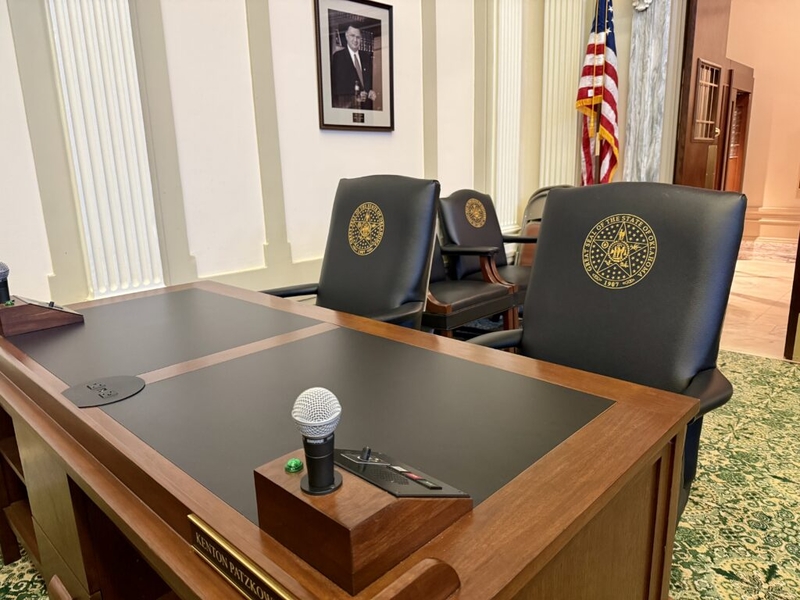
Lawmakers' desks on the Oklahoma House floor are pictured June 1, 2026 at the state Capitol in Oklahoma City. (Photo by Emma Murphy/Oklahoma Voice)
It sure feels like Oklahoma leaders are in the business of cherrypicking which officials they want to make an example of these days.
Because I don’t know how else to explain why House Republicans are suddenly so hellbent on citing a mysteriously elusive “precedent” as a reason to call an investigatory committee to hold state Rep. Danny Williams accountable.
They certainly didn’t exercise this precedent on at least two other occasions in the past year or so.
To be clear, we don’t know what the Seminole Republican is accused of having done beyond what Speaker Kyle Hilbert wrote in a very vague letter to his colleagues. Hilbert’s letter indicated that Williams is under investigation for “improper behavior” toward House chamber staff and “potential misuse of state resources.”
Hilbert, R-Bristow, wrote that his decision to refer the issue to the House Rules Committee follows chamber precedent set in 2017, a year that featured several, separate investigations into lawmakers.
But the so-called investigatory “precedent” seems a little subjective because it appears that Republicans pick and choose when to wield it. They didn’t call for anything similar when two other House colleagues were accused of behaving badly and didn’t immediately resign either.
Take state Rep. John Waldron, D-Tulsa, who was publicly accused in April of sexually harassing a subordinate by sending an inappropriate AI-generated image to her. In fact, rather than face legislative inquiry that could lead to an expulsion, he’s been allowed to continue to collect his paycheck until his resignation becomes effective Oct. 1.
In January, state Rep. Ajay Pittman, D-Oklahoma City, resigned after pleading guilty to forgery-related charges and receiving a seven year deferred sentence. There was no House investigation into her.
And don’t forget, state Rep. Ty Burns, R-Pawnee, pleaded guilty to three domestic-violence related crimes last August. When Burns finally felt it necessary to resign a day or so after entering his pleas, House leaders let him continue to serve for about a month longer without any investigation or calls for expulsion. His resignation was allowed to be effective Oct. 1, 2025.
And then, we’ve got Republican Secretary of State Benjamin Lepak, who was recently arrested on suspicion of public intoxication outside an Edmond McDonald’s. While he denies that allegation, the police body cam footage of Lepak’s arrest went national and is frankly an embarrassment to our state. His bizarre behavior tied up vital police resources in an Oklahoma municipality. Yet House leaders haven’t called on Gov. Kevin Stitt to fire Lepak, who is, coincidentally, the son of another Republican House lawmaker.
And why on earth are Democrats suddenly acting all high and mighty by demanding that Williams remove his name from the fall ballot where he’ll face an opponent in November?
Democrats seem to have conveniently forgotten that they didn’t demand Waldron do any such thing when he put his name on the party primary ballot in June. In fact, Democrats circled the wagons and kept silent for months about Waldron’s alleged misconduct until a media outlet got wind of it.
In the past year, the public has unfortunately faced its share of legislators behaving badly. Yet after sitting idly on the sidelines for all of these, House Republicans are going after Williams with a vengeance?
Hilbert has OK’d spending a yet unknown amount of taxpayer dollars to hire an external law firm to conduct an investigation into Williams. We’ll use still more taxpayer resources to hold at least a daylong public hearing at the Capitol beginning Sept. 8. The committee has no real teeth, but could recommend Williams face sanctions or expulsion. The full chamber would need to OK booting Williams.
Even Williams said in an interview with Oklahoma television station KFOR that he’s not sure of what he supposedly did. He says the accusations aren’t sexual in nature and denied any wrongdoing.
That leaves one wondering what precedent exactly prompted this public committee hearing, because even allegations of sexual harassment or domestic violence in the past year haven’t prompted this level of scrutiny.
I would never wish ill on anyone, but in order to have this hearing, one would hope that allegations are very, very serious. Otherwise it’s going to look like House Republicans are persecuting each other based on who the cool kids are or which way the wind is blowing.
Cases considered by the House committee in 2017 involved accusations of several harassment by a male legislator to his female legislative assistant and an accusation of a grown man making an inappropriate comment to a high school page. That same year, a state senator resigned after being charged in a child prostitution case. Another senator was accused of embezzling campaign funds. And yet another was accused of sexual battery for inappropriate conduct with an Uber driver.
If House leaders want to resurrect investigative inquiries, that’s great, but they need to be applied equally and to anyone who behaves badly while elected, even if it’s outside the Capitol.
And that’s not what’s been happening, which sends a confusing and unfortunate message. Lawmakers have seemingly been allowed to police themselves, particularly when it comes to inappropriate behavior outside the confines of the Capitol.
And because of that, now it feels like lawmakers are picking and choosing winners and losers or burying their heads in the sand when certain accusations are uncomfortable, or once someone has resigned.
Because what happens outside the Capitol stays outside the Capitol, right?
Wrong. What our elected and appointed officials do affects us all regardless of whether it’s late at night outside a McDonald’s or in broad daylight in a Capitol office.
Our state has enough challenges to overcome already. We don’t need bad apples being allowed to continue serving, too.
Oklahoma City, OK