Another broke back-to-school season begins with anxiety, hope for change
Sep 04, 2026 | 4:00 am ET
Description
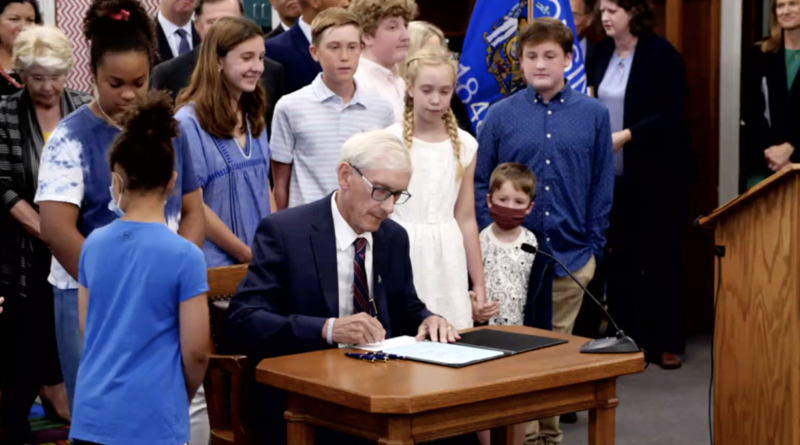
Gov. Tony Evers signs the 2021-23 biennial budget at Cumberland Elementary School in Whitefish Bay, after making 50 partial vetoes (screenshot | Gov. Evers Facebook video)
Gov. Tony Evers is taking his final back-to-school tour of the state, visiting K-12 classrooms across Wisconsin to meet students, families and staff and tout his record as the “Education Governor.”
If you don’t happen to live in one of the 72 Wisconsin school districts that went to referendum last spring, begging local property taxpayers to cover basic costs the state is not meeting, you might get the impression from Evers’ valedictory tour that he is leaving office having solved the urgent problem of chronic underfunding of Wisconsin schools.
“After a decade of disinvestment, Gov. Evers has spent the last almost eight years working to invest in public education at every level,” a statement released this week by the governor’s office declares. “During his time in office, Gov. Evers has enacted budgets to restore two-thirds funding for public schools for the first time in over two decades, provide the largest special education aid increase in state history, and bring per pupil aid to its highest level ever.”
Sounds like a strong record of accomplishment!
But wait, why does a lawsuit filed this year by the Wisconsin PTA, students, parents, teachers and communities across the state charge that Wisconsin “has seemingly abandoned its commitment to the education of Wisconsin’s public school children” and is violating its own constitution by failing to adequately fund public schools?
The short answer is that Evers, along with the Republican legislative leaders who are the targets of the lawsuit, are using misleading language to pass off austerity for schools as generosity.
Take Evers’ claim about restoring the state’s long-abandoned commitment to two-thirds funding for schools. That two-thirds number is based on counting money in the state budget that schools are not allowed to spend. While the money is technically allocated for education, the state did not lift school revenue caps, so it can only be spent for property-tax relief.
“Meeting the state’s two-thirds funding commitment doesn’t put a single new pencil in a classroom when you provide zero dollars in new spending,” explains Heather DuBois Bourenane of the Wisconsin Public Education Network, “and the current budget provided zero dollars in new spendable aid for both years of this biennium.”
Far from reaping a historic investment, students and teachers are starting the year in Wisconsin with no new money for schools.
The state’s share of special education funding, which fell from a high of 70% in the 1970s to hover around 30% in recent years, did get a bump in the last budget, reversing a dire drop-off. But the “largest special education increase in state history” only amounted to a jump from 30 to 35% last year — considerably less than the 42% reimbursement rate state officials originally projected.
Finally, in a sense, Evers did bring per-pupil aid to its highest level ever, but like his other claims, this is more a rhetorical victory than a concrete benefit to schools. Using his line-item veto, Evers extended school districts’ ability to raise $325 in revenue per pupil from local taxpayers for the next 400 years. This move infuriated Republicans, and they used it as a reason for not giving schools any new money in the current budget. But the $325 per pupil increase is not hard cash, it’s just revenue-raising authority granted to districts, which are allowed to raise property taxes by that amount if they choose to. Some, having exhausted the good will of local taxpayers with repeated referendum asks, have not done so.
All in all, schools in Wisconsin are in bad financial shape, and property taxpayers are weary of filling the gap left by the state abandoning its obligation to kids.
“The Legislature is selling kids short,” says Jeff Mandell of Law Forward, which is representing the plaintiffs in the school funding lawsuit. The Wisconsin Constitution guarantees every child an equal opportunity for a sound, basic education. But for years, the plaintiffs argue, the state has been breaking that promise.
Adams-Friendship school district, one of the parties in the lawsuit, used to have five elementary schools within its 500 square miles. Now, because of school closures due to low enrollment and shrinking budgets, it has only one K-12 school. Kids spend hours riding the bus to a single school building with aging infrastructure where many classrooms are unusable on hot days.
Huge challenges are also facing urban districts. In Beloit last year one in eight students was homeless.
“There is this fictitious idea that everyone has budgets, the schools just have to tighten their belts,” says Mandell. The reality is, even as the challenges schools face pile up, the state has steadily decreased funding, to the point where many now face an existential crisis.
The current lawsuit is not the first challenge to Wisconsin’s school funding formula based on the idea that the state is not meeting its constitutional obligation to provide a basic, free education to all children.
Back in 2000, a divided Wisconsin Supreme Court rejected a similar argument in the Vincent v. Voight case.
In that case, “the Court said the system is not bad enough right now to violate the constitution,” Mandell says. But since then, two full generations of kids have completed kindergarten through 12th grade, and conditions have deteriorated dramatically.
When Vincent v. Voight was decided, school revenue limits were still automatically pegged to inflation. A state law, abolished in 2003, still held that two-thirds of school funding should come from the state. A popular program, abolished in 2018, still kept class sizes small and offered extra supports to children living in poverty to help them succeed academically. Overall, according to the Wisconsin Policy Forum, school funding has not kept pace with inflation in Wisconsin since 2009, a major reversal from the early 2000s, when Wisconsin schools were among the best funded in the nation.
“The situation keeps getting worse and worse and worse, and we’re saying the court needs to give this another look,” says Mandell.
This is where the hopeful part comes in. Like the gerrymandering lawsuit that prompted the Legislature and the governor to pass fair voting maps in Wisconsin, Mandell believes the school funding lawsuit could trigger major legislative reform. As in the gerrymandering case, “the court’s job is to tell the Legislature, ‘What you have here is not good enough,’ and then give them a short window to fix it,” Mandell says.
It’s not the court’s job to come up with a new funding formula, but if the governor and the Legislature can’t agree, it could impose its own solution.
As the November elections approach, ushering in a new Legislature and a new governor, there’s a real opportunity for change.
“There is growing momentum and understanding of what the problem is, and what the issue is, on both sides of the aisle,” says DuBois Bourenane.
She and the other public school advocates in her organization are deeply disappointed that the governor and the Legislature failed to hammer out a deal to give more money to schools, after dangling the idea at the end of the last session. “It’s just criminal that they’re even willing to entertain the idea of sending these kids back to school with nothing again,” she says. “We’ve got 70-plus districts going to referendum again this fall … over a third of our districts went to referendum this calendar year.”
DuBois Bourenane agrees with Mandell that the lawsuit could spur a breakthrough.
“I’m just glad that everybody’s talking about it,” she says, “and I hope that they’re paying very close attention to what’s actually possible if we elect people who all agree that we have to fix this broken problem.”
Madison, WI