NTSB releases initial report in State Police helicopter collision with private plane
Sep 03, 2026 | 12:47 pm ET
Description
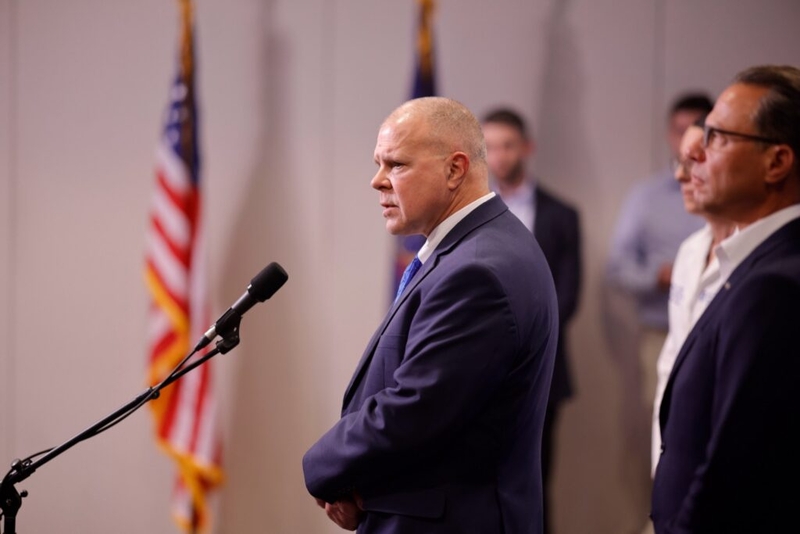
Lt. Col. George Bivens, acting Pennsylvania State Police commissioner, speaks about the crash of a state police helicopter involving another aircraft at an Aug. 19, 2026, news conference with Gov. Josh Shapiro. (Photo by Commonwealth Media Services)
Federal investigators released preliminary findings in the mid-air collision between a Pennsylvania State Police helicopter and a private propeller plane about two weeks after the fatal crash near Carlisle.
The report shows the crew of the helicopter was in radio contact with the pilot of the Cessna 150 airplane before it struck the Bell 407 helicopter while both were landing at Carlisle Regional Airport in Cumberland County.
The Cessna pilot, Paul Sokoloski, 57, of Hershey, who was a doctor at Penn State Health, died in the crash. The state troopers aboard the helicopter, Cpl. Bryce Corman and Trooper Jason Mills, suffered serious injuries.
The National Transportation Safety Board released the preliminary report, which does not list a cause, on Wednesday as part of its investigative process. A final report may take one to two years to complete, the agency says.
The NTSB said the helicopter crew took off from Capital City Airport in Fairview Township near Harrisburg and flew 15 miles to Carlisle Airport to do flight instruction exercises. The helicopter made a normal approach to the west-facing runway, descended and transitioned into a hover before flying over the grass to the right of the runway.
Flight tracking data showed that as the helicopter was landing, the Cessna flew over the airport and turned left to enter the landing pattern. A witness stated that he heard radio communications in which the helicopter crew was talking to the Cessna pilot, who acknowledged their message, the report says.
The state police flight instructor told investigators in an interview that he and the student pilot were first alerted about the Cessna by the helicopter’s traffic and collision warning system, which provides information about other aircraft in the area. The instructor said he made a radio call announcing the helicopter’s position on final approach.
The Cessna pilot asked whether they wanted him to extend his landing approach, which would have delayed his arrival at the airport while the helicopter was landing. The helicopter crew responded “yes.” The Cessna pilot acknowledged and said he was No. 2 for landing.
Three security cameras at the airport captured the final moments of the aircraft’s flights, the NTSB report says.
They document the helicopter crossing the beginning of the runway while the Cessna was flying perpendicular to the runway on the “base leg” of its approach. About 30 seconds later, the Cessna crossed the threshold of the runway while the helicopter was still hovering over the runway.
Video shows the Cessna’s wings rocking to the left and right as it flew low over the runway without touching down. The plane then made several side-to-side and vertical movements as it approached the helicopter.
The helicopter hovered from the runway to the grass area to the right, still facing in the direction of its landing. The helicopter crew told investigators they could not see the Cessna approaching.
The airplane continued flying along the runway with its wings rocking before it pitched up and started climbing briefly, abruptly turned right and struck the main rotor blades and tail rotor of the helicopter. The main rotor and the tail boom separated from the helicopter fuselage, which came to rest on its left side.
The Cessna broke into four pieces scattered over a 250 foot path. Damage to both aircraft was consistent with a collision. A post-accident inspection of the aircraft revealed no evidence of mechanical problems before the crash that would have prevented normal operations, the NTSB report says.
Harrisburg, PA