Without posing a single question, Stadium Authority approves another $75 million in public funding
Sep 03, 2026 | 8:00 am ET
Description
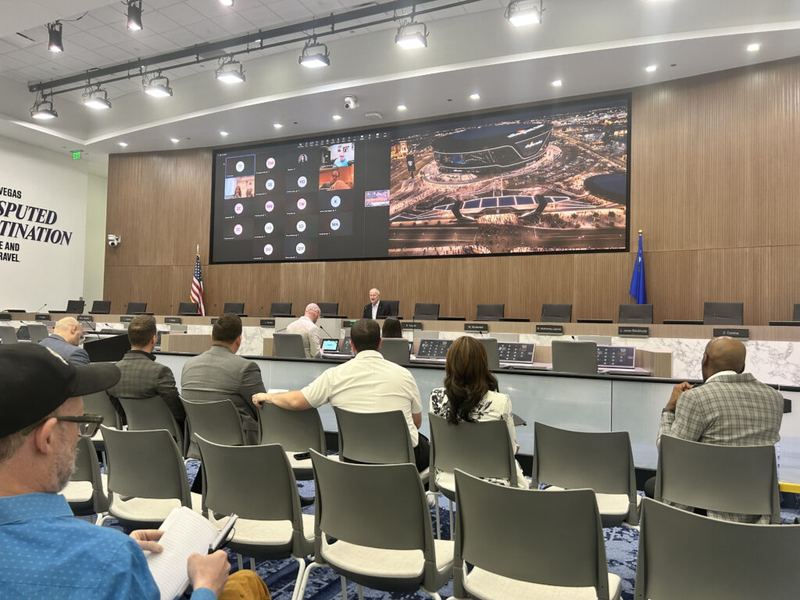
Las Vegas Stadium Authority Chair Steve Hill, who is also president of the Las Vegas Convention and Visitors Authority, sits alone at the dais at the Stadium Authority meeting Sept. 2, 2026, while other authority members joined the meeting via Zoom. (Photo: Dana Gentry/Nevada Current)
Allegiant Stadium, Southern Nevada’s $2 billion partially taxpayer-funded football arena, opened just six years ago but is already poised for a facelift, courtesy of taxpayers.
The Las Vegas Stadium Authority Board, without a comment or question from a single member, except Chairman Steve Hill who presented the item, voted unanimously Wednesday to allocate up to $75 million to fund about half of a $158 million expansion of Allegiant Stadium. The Las Vegas Raiders are paying for the balance.
“We need to keep driving all those great results that Jeremy (Aguero) presented,” Hill said in reference to a report from the Authority’s economic analyst in May that the stadium generated an estimated $2.6 billion in economic impact in 2025 from 30 events and 1.5 million visitors – exceeding the original projection of $890 million, adjusted for inflation.
“It was a great investment in Allegiant Stadium to invest seven-eighths of a percent of room tax to build that stadium” and generate twice the projected revenue, Hill, who is also president of the Las Vegas Convention and Visitors Authority, said of the increase in the room tax approved in 2016 to fund the $750 million public payout.
“We also think this is an appropriate level of cost-sharing with the Raiders,” Hill said of the plan to pay for half of the expansion.
The Raiders and the Stadium Authority are not reading the room, say critics who contend that with Nevadans struggling to pay their bills, now is no time to sink more public money into what some contend is a vanity project.
Richard Krebs, a retired Las Vegan, asked during public comment why the “billionaire owners” of the Raiders are seeking public money rather than self-funding the stadium expansion.
“They came to the desert, a land of milk and money, a land of milk and government subsidizing,” Krebs said, adding the franchise was worth about $3 billion at the time and “has increased in value to about $10 billion.”
Asked by the Current after the meeting why the Raiders aren’t footing the bill for the entire expansion, Raiders’ President Sandra Douglass Morgan said the 2016 legislation approving the stadium funding was “actually created to have continued investment in the stadium.”
Forbes valued the team at $7.7 billion in August 2025
Dayvid Figler, a Las Vegas attorney and former podcast host, says he blames state lawmakers who approved the public financing of the stadium for failing to put parameters on the public funds and for “almost creating a rubber stamp.”
He says he doesn’t “begrudge the Raiders for asking for the money, but I do begrudge the stewards of public funds for not asking one simple question: Is this the best use?”
Hill, Figler noted, said the project is a “good use” but noted he didn’t assert it was the best use for the money.
Douglass Morgan says it’s been “well documented” that Allegiant Stadium increases sports tourism “and actually bringing people there, so that we can continue to have people be employed at the stadium, and those tax dollars then go back into the community.”
Aguero reported to the board in May that the Stadium generated $10.6 billion in economic impact from its opening in 2020 through the present and $487.3 million in tax revenue. It supported 62,215 person-years of employment in that time, which is in line with Aguero’s 2016 projection of 6,000 permanent jobs a year,
Aguero, however, grossly overstated the number of construction jobs projected for building the stadium at 11,000. In May, he acknowledged Allegiant’s construction generated 7 million work hours, the full-time equivalent of 3,365 jobs.
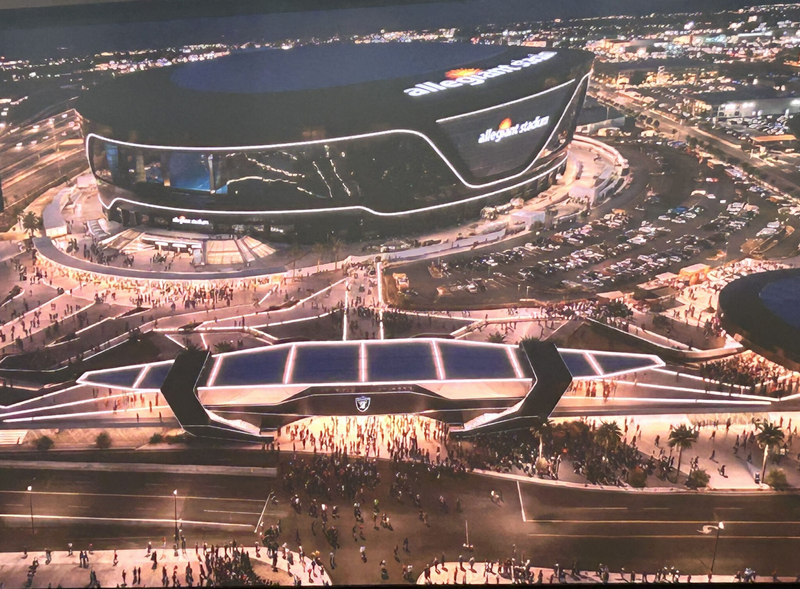
The expansion approved Wednesday creates a new second story entrance and outdoor event space on the north side of the building. It also includes a covered area to house ride sharing services, and likely down the road, a station to accommodate Elon Musk’s Vegas Loop.
Hill said reducing the increase in the room tax would not be meaningful for tourists, and he noted the bonds can’t be refinanced until 2028 — ten years after they are issued.
The “waterfall” of payment obligations in the 2016 legislation applies room tax revenue first to bond payments, Stadium Authority administrative costs, and a debt reserve that has been fully funded and no longer requires annual contributions.
Remaining funds are used to pay the University of Nevada Las Vegas up to $3.5 million to offset revenue lost to the closing of Sam Boyd Stadium and for statutory contributions to the Stadium Authority Capital Funds.
That leaves about $13 million a year for the waterfall residual fund, which is estimated to reach $80 million by the end of fiscal year 2027, and would be used to fund the expansion.
Figler acknowledges that Hill made a cogent argument, accompanied by reports from economists, that the expansion “is a good investment. But none of that’s definitive,” he said, adding a “more creative, thoughtful, and intelligent,” approach would “employ economists and analysts who aren’t on the payroll of the applicants.”
Figler, during public comment, suggested the Stadium Authority consider improving transit or housing for Southern Nevadans. Or invest in equipment for a live stream of their public meetings.
“They’re the only public entity that spends as much money as they do without a live stream,” Figler observed after the meeting. “They’re hiding from the public by not doing what every other public agency does.”
Las Vegas, NV