A new report on primary care Medicaid reimbursement rates, a new promise from McKee
Sep 02, 2026 | 5:52 pm ET

Description
Health Insurance Commissioner Cory King, right, speaks alongside Gov. Dan McKee during a press conference at the Rhode Island State House on Wednesday, Sept. 2, 2026. (Photo by Alexander Castro/Rhode Island Current)
Rhode Island’s primary care providers could see a big boost to their Medicaid reimbursements under a $16 million proposal Gov. Dan McKee pledged on Wednesday to include in his next state budget if reelected.
McKee’s promise accompanied the release of a yearlong review by the Rhode Island Office of the Health Insurance Commissioner, which looked into reimbursements across Rhode Island’s primary care providers.
“Being ahead of our neighbors is not the same as paying what it actually costs to provide care,” McKee said at a State House press event. “That was step one. This is step two.”
The 26-page report from the office led by Health Insurance Commissioner Cory King concluded that even after primary care reimbursement rates for Medicaid patients bumped higher in 2025, the cost of providing care has continued to outpace reimbursement. Reimbursements for common primary care services like office visits would need to rise by between 48% and 66% to adequately cover the expenses they incur, the review found.
Last year Rhode Island moved to match federally set Medicare rates to its Medicaid rates, which the federal government largely leaves up to states to determine.
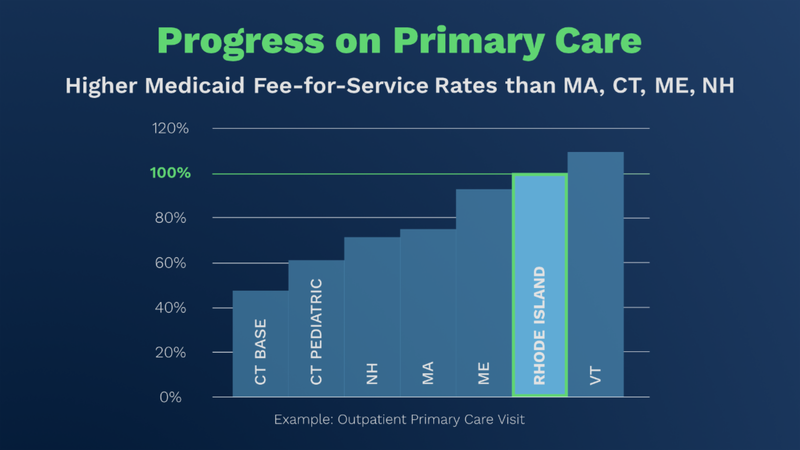
Making Rhode Island’s Medicaid rates equivalent to Medicare rates did give Rhode Island an advantage over neighboring states, King said. The report shows Rhode Island’s fee-for-service rates for Medicaid are now higher than those in Massachusetts, Connecticut, Maine and New Hampshire.
But King noted that rate competition with other New England states can only go so far.
“Benchmarking has limitations,” King said with McKee by his side. “It doesn’t actually tell us whether rates that are paid are sufficient for the cost of the services being delivered.”
For its new report, King’s office worked with actuarial consulting firm Milliman to craft a rate model that would be more inclusive of the actual costs of providing primary care, including staff salaries and benefits, administrative expenses and overhead.
Reimbursement for established patient visits led by physicians should rise by about 48% on average, the report recommends, while rates for new patient visits should see an increase of about 66%. Rates for similar services led by advanced practice providers — such as nurse practitioners and physician assistants — would rise between 10% and 23%.
The recommended rates are equivalent to roughly 150% of current Medicare reimbursement rates, albeit with some caveats, compared to 100% now. King said in a follow-up interview after Wednesday afternoon that the 150% is something of a moving target rather than a hard benchmark.
“The 150 [%] is really just, you know, it’s our best way of explaining the relativity to today’s Medicare rates,” he said.
The Office of the Health Insurance Commissioner used 2026 Medicare rates to calculate the 150% comparison, but the report’s projections stretch beyond that period and all the way into April 2028. King said that’s because the new rates, if approved by lawmakers and federal regulators, would not take effect until late next year. The report itself notes that future Medicare rates could change the calculus as well.
“Frankly, Medicare rates could go down,” King said, but he said his office’s analysis tried its best to accommodate these concerns by making sure “the rates were kind of up to par with the economic environment for the future.”
To get to the recommended rates, King’s report recommends around $22 million annually in combined state and federal money. McKee’s $16 million promise is lower than that full amount because it would take effect partway through a fiscal year, King said.
The recommendations still require approval from the General Assembly and the federal Centers for Medicare and Medicaid Services. The health insurance commissioner’s report also notes that a proposed federal rule could restrain states’ abilities to increase certain Medicaid reimbursements beyond Medicare levels.
Better reimbursements, better care?
So, how do the increased reimbursements lead to better access or more quality care for patients?
King said his office has an assortment of metrics at its disposal, both quantitative and qualitative, to assess the impact of higher rates, should they be approved. King’s office can track physician recruitment and turnover through surveys as well as monitoring of workforce and licensing data.
The agency can also watch whether Rhode Islanders are visiting their primary care doctor by measuring the services used, also known as utilization. King pointed to a June report from his office which noted utilization plateauing in the primary care space.
“Primary care utilization has really flattened out a bit,” King said over the phone. “It’s stagnated, whereas that wasn’t the case before the pandemic. So as we track utilization over time, we could see more office visits.”
More preventive or wellness visits, which King said the report showed “clear opportunities to improve the utilization” of, could also reflect more patients going to their doctor for primary care services.
An additional, more ambitious and more preliminary proposal in the report would pay practices to build expanded primary care teams incorporating nurses, social workers, behavioral health services and clinical pharmacists. These practices could then benefit from enhanced per-month payments tied to the practice as a whole, rather than individual office visits.
A very rough estimate of around $20 million annually is what such a system could cost, according to the report, although the final valuation would depend heavily on the final model and the number of practices participating. Still, King thought there were benefits worth pursuing with this “advanced primary care delivery system.”
“I strongly believe, and I think the evidence also supports this, that when you can attach an interdisciplinary team to a primary care practice, then you can improve patient outcomes, you can improve access,” King told reporters Wednesday. “You can help manage downstream healthcare costs.”
The report’s findings also exert some pressure on commercial insurers, which last year were required by the state to increase primary care spending through higher reimbursement and other investments. Blue Cross Blue Shield of Rhode Island, for instance, raised fee schedules for its fully insured plans by 15% in July 2025, followed by another 18% in January 2026. Another increase is on the way for 2027.
The commissioner’s latest report does not quite reflect that data in its analysis of commercial rate benchmarks, King acknowledged Wednesday. He said he expects the reimbursement gaps “between Massachusetts and the rest of New England” to narrow a bit with the 2025 and 2026 data. But, he added, “There’s still more work to do.”
“The work we did I think supports further increases in commercial health insurance reimbursement for primary care because we’re measuring the cost of primary care and assessing the reimbursement rate you get to fund that cost,” King said. “That’s not just specific to Medicaid.”
The underlying cost analysis, he said, nevertheless supports further increases from commercial insurers because the cost of providing primary care does not change depending on who pays the bill.
Still, a huge portion of Rhode Island’s health insurance plans remain outside the direct regulatory reach of King’s office: the roughly 65% of Rhode Islanders with employer-sponsored coverage who are enrolled in self-funded health plans, rather than the fully-insured plans which King’s office can regulate.
Self-insured plans involve the planholder taking on the financial risks associated with medical claims, with insurers acting as plan administrators, essentially. In fully-insured plans, however, insurers take on all the financial risk themselves.
“I think ultimately the right thing for the insurers to do is to increase their primary care reimbursements and their investments uniformly and equitably,” King said at the press conference. “But that’s an area that I think future policy development could be directed to to create a minimum fee schedule for commercial insurance that would govern all primary care payments, regardless of whether they’re fully insured, self-insured.”

Providence, RI