Alaska schools set to receive $115M in war-driven oil revenue bonus, state announces
Sep 02, 2026 | 5:34 pm ET
Description
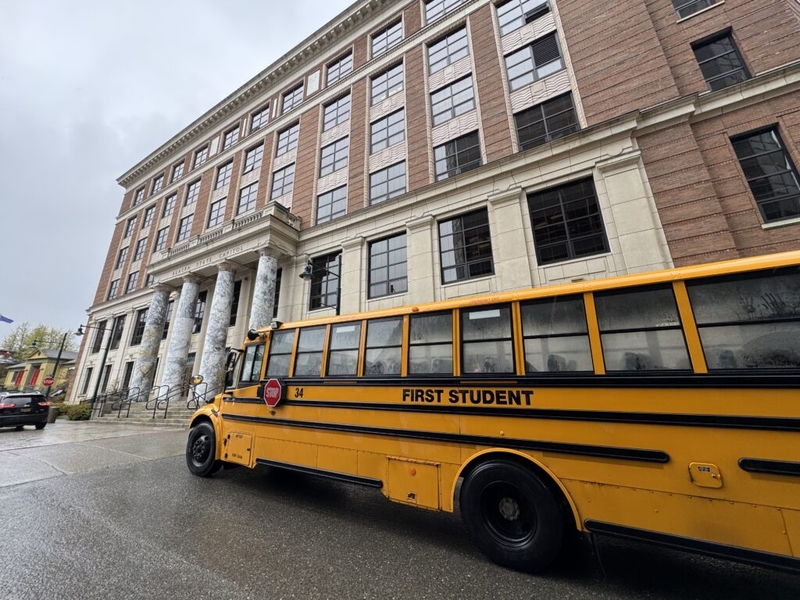
A school bus passes in front of the Alaska State Capitol on Wednesday, May 20, 2026. (James Brooks photo/Alaska Beacon)
The Alaska Department of Revenue announced on Monday that Alaska’s K-12 public schools will receive an additional $115 million in state funding this year, prompted by a boost in oil revenues driven by the U.S. war on Iran.
Legislators earmarked the additional oil revenue for schools as part of the state budget approved by Gov. Mike Dunleavy in June.
The additional funding is a relief to school districts statewide. Many districts have faced severe budget shortfalls in recent years due to funding not keeping pace with rising costs. This year, a record 12 elementary and middle schools closed across the state.
Following the announcement, Luke Meinert, superintendent of the Fairbanks North Star Borough School District — the state’s third-largest district by student count — welcomed the news, and said the district is appreciative of the Legislature for making it a priority.
“(We’re) very excited that the projected numbers came through and that we will see a sizable increase in funding for our school district through the one-time funds that are being allocated,” he said in an interview Tuesday.
Officials with the Department of Revenue announced the state had collected sufficient revenue funds to meet the special appropriation of nearly $600 million.
Lawmakers designated funding for four priorities areas, in sequential order: nearly $128 million to the Permanent Fund to allocate one-time energy relief payments of $200 per eligible Alaskan along with dividend checks; $115 million to K-12 schools through the Alaska Department of Education and Early Development; $15 million to the bulk fuel loan program; and $341 million to the state’s budget reserve account.
According to the announcement, the Monday revenue estimates are expected to be revised and finalized this fall. The revenue amounts are expected to “change slightly,” impacting the exact amount that will land in the budget reserve fund, the state’s savings account, officials said.
The $115 million will be distributed to school districts according to the state’s education funding formula, which is based on student enrollment counts in October.
For Fairbanks, that’s estimated to be roughly $10.2 million this year. Meinert said the district designed its budget this year anticipating about half of that amount, and the additional funding will go toward teachers and staff, as the district is currently in union contract negotiations that are ongoing, and other areas. “So that will help us in our negotiation discussions for this school year,” he said.
“Student activities have been an area that’s been cut pretty hard over the past several years,” he continued. “So potentially adding some funding there to ensure that families aren’t having to pick up a bigger burden of paying for student activities. And then, additionally, I think there may be some smaller investments for teacher mentoring, teacher coaching, and possibly some funding in our nutrition services department.”
School board members with Fairbanks and Anchorage called on the state in June to release estimates earlier, ahead of the school year — “the earliest practical information available,” they wrote in an op-ed for the Anchorage Daily News. They asked the state to announce whether “funding is likely, unlikely or still uncertain,” to help districts plan, particularly for hiring teachers.
But the Department of Revenue did not change its scheduled announcement.
Lisa Parady, executive director of the Alaska Council of School Administrators, said they were “elated” and “grateful” at the announcement. But she said it underscores Alaska schools’ needs for prior notice and consistent state funding.
“We do have to get to the place where we have predictable, reliable funds in advance of needing to extend contracts. That’s the biggest issue,” she said Tuesday.
“Because we’re in the greatest education shortage in the history of Alaska and in the nation, it allows for the recruitment and retention of quality educators and that ability to lock in those contracts sooner,” she said.
Among the state’s largest districts, the Anchorage School District is expected to get $32 million. The Matanuska-Susitna Borough School District is expecting $16.1 million, the Kenai Peninsula School District is expecting $7.6 million. Both districts closed schools this year.
Parady said it’s difficult to say if the additional funding earlier in the year would have prevented school closures.
Districts cited surging costs of operations, as well as declining enrollment as more families opting for homeschool programs or leaving the state.
“Each school district is in their own unique place in terms of overall education funding in their budgets,” Parady said. “Having a long term fiscal plan that allows for timely, reliable, and predictable revenue for schools … is the only way that school boards and our school district leaders can have the tools they need to make the best decisions as they’re managing their budgets. And school closures are obviously a piece of that, and so I can’t say for sure that it could have changed an outcome, but it’s certainly possible.”
Anchorage Democrat Sen. Löki Tobin, who chairs the Senate Education Committee expressed her reaction Tuesday as “mixed.” “We know that our schools are in desperate need of resources,” she said.
“We have nonpartisan financial memos from our Division of Legislative Finance that says to adequately address the years that inflation has eroded the purchasing power of our base in funding, we need to appropriate significant financial resources per student to our schools, and while $115 million is a significant amount of dollars, it’s clearly not enough. And one-time funds do not create stability nor predictability.”
Tobin also acknowledged the moral dilemma of the upswing of Alaska oil revenues and state funding driven by the U.S. war on Iran.
“It is gut-wrenching to know the reason that Alaska has been able to receive these resources,” Tobin said. “It is not without contemplation or thought that I have been thinking about the children that were bombed in these recent years in a place that is very far away from us, but is no less important and no less critical for the health and well-being of all of our kids, and how those choices are driving the record increases in the price of a per barrel of oil.”
With the boost in state revenues, Tobin also credited the efforts of lawmakers across political divides in designating funding for schools. “Folks who work to get this funding into our budget not only crossed the aisle but also were bicameral in nature, and that is absolutely critical,” she said.
Lawmakers allocated roughly $144 million in one-time additional funding for K-12 schools, plus $148 million for school repairs and construction this year to address an extensive maintenance backlog. They approved $29 million to offset districts’ rising energy costs beginning in 2028 and subject to future lawmakers approving the funding.
Juneau